Relationship anxiety is a persistent state of worry, doubt, or hypervigilance within romantic relationships—distinct from the normal nervousness of getting to know someone new. A YouGov (2023) survey found that 40 percent of anxiously attached adults report frequent loneliness, compared to just 12 percent of securely attached adults. This is not a phase that resolves on a fixed schedule.
If you are searching for how long this lasts, you are likely exhausted by the constant scanning—checking your partner's tone, rereading texts, bracing for the other shoe to drop. Wanting a timeline is completely natural. The answer depends on what is driving the anxiety: new relationship jitters, attachment patterns, or ROCD. This article breaks down timelines by cause, attachment style, and intervention type so you can locate yourself on the map.
Key takeaway: There is no single timeline for relationship anxiety. New relationship anxiety typically peaks at three to six months and subsides as trust builds. Attachment-driven anxiety follows a wave pattern tied to your nervous system and attachment style. With active work such as therapy, somatic practices, and security priming, most people see measurable shifts within eight to sixteen weeks. Healing means expanding your calm baseline, not eliminating all spikes.
Is It Normal to Feel Anxious in a New Relationship?
Yes—new relationship anxiety is one of the most common emotional experiences in early dating, and it typically resolves on its own as trust develops. Anxiety tends to peak around weeks 3–4 when the honeymoon glow fades and real vulnerability begins, and again around weeks 8–10 as emotional intimacy deepens (Feelset, 2025). For most people, this settles within 3–6 months as emotional safety builds through consistent, positive experiences with your partner (Melina Alden MFT).
That stomach-flip when your partner takes an hour to text back, the urge to analyze every conversation for hidden meaning—these responses make sense when your nervous system hasn't yet learned that this new person is safe. Your brain is doing exactly what it was designed to do: scanning for threat in unfamiliar territory.
The distinction that matters is trajectory. New relationship anxiety follows a downward slope. Each week, the spikes get a little shorter, a little less intense. You recover faster. If instead the anxiety is escalating—growing louder, more consuming, more constant after three to six months—that pattern usually points to something deeper than new-relationship jitters, such as attachment-driven anxiety or unresolved relational patterns.
The "What's New vs. What's Old" Journal (for anxious attachment)
- When anxiety spikes, write down the specific trigger (a delayed text, a canceled plan, a shift in tone)
- Ask yourself: "Is this about something my partner actually did, or does this feeling predate this relationship?"
- Track your entries over two weeks and look for patterns
Hyperactivation blurs present-moment signals with historical abandonment fear. Separating "what's happening now" from "what happened before" interrupts the anxious attachment pattern at its root—the conflation of past and present threat.
Why Does Relationship Anxiety Last Longer for Some People?
If your anxiety hasn't faded after the window everyone talks about, that can feel defeating—like something is wrong with you. It isn't. Relationship anxiety persists when it is driven by nervous system wiring rather than situational uncertainty. Three factors consistently extend the timeline beyond the normal 3–6 month adjustment period, and all three operate below conscious awareness—in the body, not just the mind.
1. Insecure attachment style. Anxious and disorganized attachment patterns involve amygdala hyperactivation—your brain's threat-detection center fires more intensely and more often in response to social cues like a partner's neutral facial expression or brief silence (Vrtička et al., 2008). Research also links attachment anxiety to cortisol dysregulation: elevated baseline cortisol with blunted reactivity, meaning your stress system runs hot but cannot calibrate accurately to actual threat levels (BMC Neuroscience, 2021). Your nervous system is wired for vigilance, and rewiring takes longer than changing thoughts alone.
2. Unresolved relational trauma. Childhood neglect, betrayal, or loss creates implicit memory templates that activate in intimate relationships. Your body remembers what your conscious mind may not, and it responds to closeness as both desired and dangerous.
3. ROCD (Relationship OCD). Obsessive doubting about your partner or relationship that feels intrusive, unwanted, and driven by compulsive mental rituals—comparing your partner to others, seeking reassurance, mentally reviewing "evidence." ROCD is distinct from attachment anxiety and requires specialized treatment.
These three factors do not operate in isolation. Anxious attachment correlates with 2.5 times higher breakup rates (WiFi Talents), which creates a cycle: the anxiety contributes to relationship instability, which reinforces the anxiety. A secure partner can accelerate healing through co-regulation, while an avoidant partner can perpetuate the anxious-avoidant trap indefinitely—extending the timeline not because you are failing, but because the relational dynamic itself feeds the pattern.
The Cortisol Check-In (all attachment styles — somatic/body-based)
- Set three daily phone alarms (morning, midday, evening)
- At each alarm, place one hand on your chest and rate your body tension from 1 to 10
- Note what you were thinking about your relationship at that moment
- After one week, notice whether high-tension moments cluster around specific triggers or times of day
Anxious attachment often involves cortisol dysregulation that makes everything feel urgent—building interoceptive awareness is the foundation of distinguishing nervous system activation from genuine relationship signals. Tracking your body's patterns teaches you to read the signal instead of being overwhelmed by the noise.
How Long Does Relationship Anxiety Last by Attachment Style?
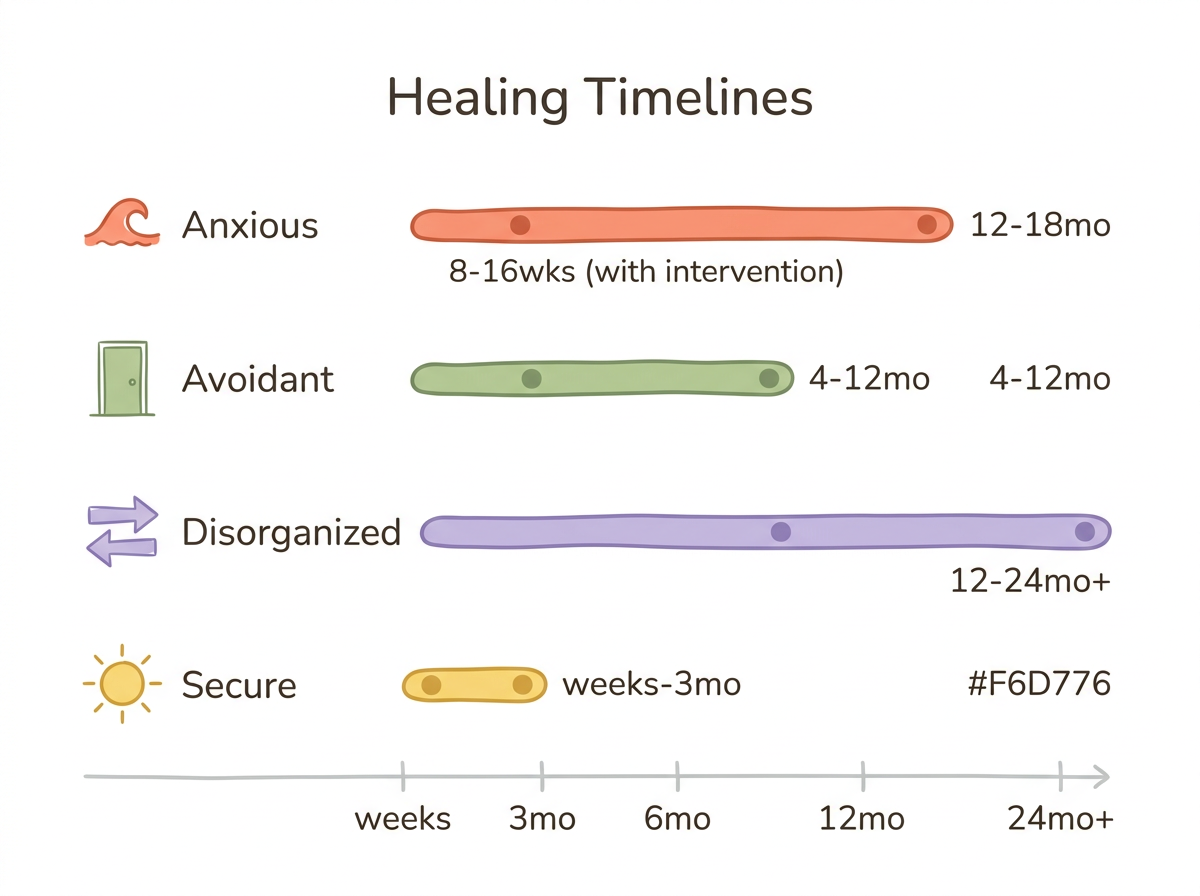
The timeline varies significantly by attachment style—a distinction no single answer can capture. Attachment patterns shape not just the intensity of anxiety but its rhythm, recognition speed, and responsiveness to treatment. Longitudinal research shows that attachment anxiety within relationships tends to decline as relationships persist (Fraley and Hudson, 2017), but the starting point and slope differ dramatically.
Anxious Attachment
Anxiety is the loudest and most constant. You feel it as a near-permanent hum of hypervigilance—scanning for signs of withdrawal, interpreting ambiguity as rejection. The good news: anxious attachment responds well to intervention. 8–16 weeks of CBT or EFT produce measurable shifts (PMC meta-analysis; ICEEFT). Higher baseline anxiety actually predicts better linear improvement in EFT specifically (ICEEFT). Without intervention, this pattern tends to persist chronically across relationships. For a deeper look at this pattern, see anxious attachment in relationships.
Avoidant Attachment
Anxiety here is masked as discomfort, irritation, or emotional withdrawal. It surfaces when closeness increases—after saying "I love you," moving in together, or when a partner expresses strong need. Because it does not look like "anxiety," avoidant patterns often go unrecognized for years. Once identified, treatment typically takes 4–12 months to shift deactivation patterns.
Disorganized/Fearful-Avoidant Attachment
The most variable timeline. Approach-avoidance cycling means anxiety never follows a clean trajectory—you oscillate between desperately wanting connection and feeling overwhelmed by it. Without trauma-informed treatment, this pattern persists indefinitely. With specialized therapy (EMDR, IFS, somatic experiencing), most people see meaningful shifts over 12–24 or more months.
Secure with Situational Anxiety
Resolves within weeks to a few months with honest partner communication. The nervous system recalibrates quickly because the baseline wiring supports trust.
Attachment Style Timeline Mapping (all styles)
- Draw a horizontal line representing your current relationship from beginning to now
- Mark moments when anxiety spiked (arguments, milestones, silences, transitions)
- Mark moments when you felt secure (repair conversations, physical closeness, consistency)
- Look at the ratio shift—are secure moments increasing over time, even slightly?
In an anxious moment, it feels like nothing has changed. This exercise gives you your actual trajectory rather than a snapshot. Even small ratio shifts toward security represent genuine nervous system rewiring—evidence your body is learning, even when your mind doubts it.
What Does the Healing Timeline Actually Look Like?
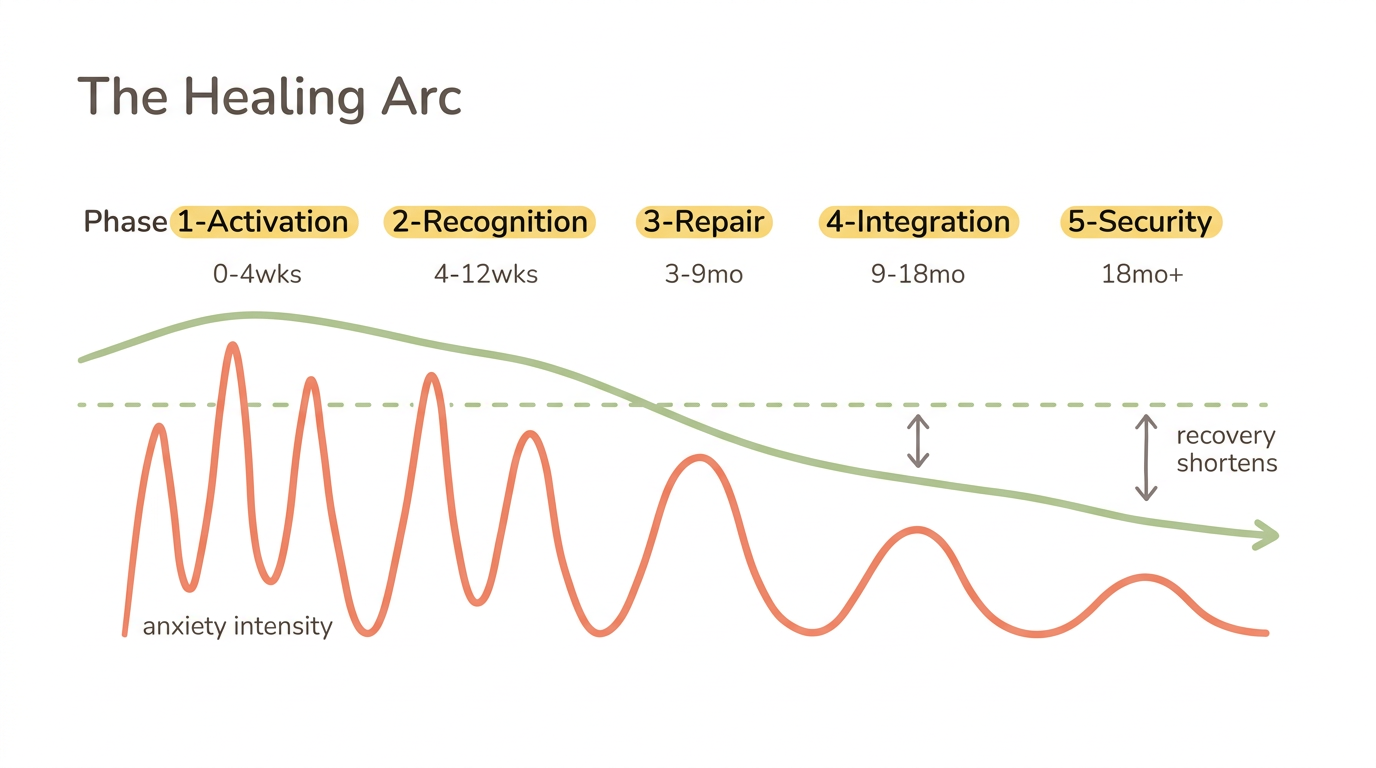
Healing from relationship anxiety is not linear—it follows a flare-up model where anxiety returns at milestones, stress points, and life transitions, even as your overall baseline improves. The goal is not eliminating spikes but expanding the baseline of calm between them. What changes is how quickly you recover—and that recovery time shortening is the healing.
The Five-Phase Framework
Phase 1: Acute Activation (0–4 weeks of awareness). Anxiety is at its loudest. You have started noticing your patterns—which paradoxically makes the anxiety feel worse, because now you see it everywhere. This is not backsliding. Awareness precedes change.
The next several weeks bring a shift that is subtle but significant. During Phase 2: Recognition (weeks 4–12), you begin identifying triggers, naming your attachment patterns, and catching yourself mid-spiral. The anxiety has not decreased much yet, but your relationship to it is shifting—you start recognizing "this is activation, not truth."
Phase 3: Active Repair (months 3–9) is where therapy, somatic work, and security priming produce measurable shifts. Research on security priming shows that once-weekly exercises over 8 weeks reduce anxiety with effects lasting 3 or more months (Mikulincer and Shaver, 2020; Springer, 2025). EFT gains are maintained up to 2 years post-treatment (2023 meta-analysis). Your nervous system is building new pathways.
Between months 9 and 18, new patterns start feeling more automatic. This is Phase 4: Integration—flare-ups still occur around milestones like saying "I love you," meeting families, or navigating your first major conflict, but they are shorter, less consuming, and you recover faster. The milestones that once derailed you for days now resolve in hours (Farragut Psychotherapy).
Eventually, anxiety becomes a signal you can read rather than an identity that defines you. Phase 5: Earned Security (18 or more months) is what Siegel's interpersonal neurobiology framework describes as relationships "removing the synaptic legacy of early social experience" through repeated attunement and co-regulation. This is earned secure attachment—not the absence of anxiety, but a fundamentally different relationship with it.
You do not rewire attachment in a single insight. You rewire it by noticing 10 percent earlier, responding 10 percent differently, 10 percent more often.
The Flare-Up Reframe (for anxious attachment)
- When anxiety returns after a period of calm, write: "This flare-up is happening because [name the milestone or stressor], not because I am back to square one"
- Rate the intensity from 1 to 10 and compare to your earliest anxiety episodes
- Note how long it takes to return to baseline—this recovery time shortening is the healing
The return of anxiety after progress often triggers catastrophic thinking: "I will never get better," "Nothing has changed." That catastrophizing is itself a hyperactivation pattern rooted in anxious attachment. Tracking your actual recovery arc interrupts the story your nervous system is telling and replaces it with data.
What Can Speed Up (or Slow Down) Recovery?
Several evidence-based factors meaningfully accelerate or delay the timeline. Your healing speed is not a measure of effort or willpower—it reflects the interaction between your nervous system, your relationships, and the interventions you access.
Accelerators
CBT for anxiety averages 11.4 sessions with gains enduring 12 or more months post-treatment (PMC meta-analysis). Attachment-focused therapy takes this further: EFT for couples produces a d=1.3 effect size—the largest of any couples intervention (ICEEFT). Notably, higher baseline attachment anxiety predicts better improvement in EFT, meaning the people who need it most benefit most.
What about between sessions? Repeated security priming exercises—once weekly for 8 weeks—reduce anxiety and perceived stress with effects lasting 3 or more months (Mikulincer and Shaver, 2020; Springer, 2025). This is the research behind many of the visualization and journaling exercises in attachment-focused apps.
Research demonstrates that social support from a romantic partner significantly lowers cortisol during psychosocial stress (Ditzen et al.). A secure, consistent partner does not "fix" your attachment patterns, but their steadiness provides the relational safety your nervous system needs to risk new responses. Partner co-regulation is not a luxury—it is a biological mechanism of change.
Your body learned the anxiety pattern, and your body needs to be part of unlearning it. Somatic practices provide the physiological foundation that cognitive insight alone cannot—nervous system regulation through body-based techniques that meet the anxiety where it actually lives.
Derailers
An avoidant partner doing no work of their own can lock you into the anxious-avoidant trap—a pursue-withdraw cycle that feeds anxiety rather than resolving it. Reassurance-seeking makes complete sense—your nervous system is trying to find safety the fastest way it knows how. The difficulty is that each reassurance lowers the threshold for the next spike, reinforcing the pattern over time rather than resolving it. Untreated ROCD mistaken for "normal" relationship anxiety leads people to apply the wrong strategies, often for years (IOCDF). And paradoxically, avoiding vulnerability to avoid anxiety extends the timeline—because earned security requires the very risk your nervous system is trying to prevent.
The 5-4-3-2-1 Co-Regulation Anchor (for anxious attachment — somatic/body-based)
- When anxiety spikes around your partner, pause and name 5 things you can see in the room
- Touch 4 different textures you can reach
- Listen for 3 distinct sounds
- Name 2 things you can smell
- Place your hand on your partner's arm or shoulder and take one slow breath together
The partner-touch step is the bridge from self-regulation to co-regulation, leveraging the cortisol-lowering effect of partner touch during stress activation (Ditzen et al.). For anxious attachment, sensory anchoring interrupts the hyperactivation spiral before it escalates to protest behavior—teaching your nervous system that another person's presence can be calming rather than threatening.
Relationship Anxiety Timeline by Type and Intervention
| Type of Anxiety | Without Intervention | With Active Intervention | Best-Fit Treatment |
|---|---|---|---|
| New relationship anxiety | 3–6 months (self-resolving) | 2–8 weeks with grounding practices | Self-help, journaling, communication |
| Anxious attachment–driven | Chronic/recurring across relationships | 8–16 weeks for measurable shifts; 12–18 months for earned security | CBT, EFT, security priming |
| Avoidant attachment–driven (masked) | Often unrecognized for years | 4–12 months to identify and shift deactivation patterns | Schema therapy, EFT |
| Disorganized attachment–driven | Persistent with approach-avoidance cycling | 12–24+ months with trauma-informed therapy | EMDR, IFS, somatic experiencing |
| ROCD | Chronic, worsening without treatment | 6–12+ months of ERP for significant improvement | ERP, CBT-based apps |
| Milestone-triggered flare-ups | Days to weeks per episode (recurring) | Hours to days with practiced regulation | Somatic grounding, co-regulation |
When Should You Seek Professional Help for Relationship Anxiety?
You should seek professional support when anxiety persists beyond 6 months without improvement despite active effort, or when it impairs your daily functioning—disrupting sleep, concentration at work, appetite, or your ability to be present with people you care about.
Your nervous system learned to be vigilant for good reason. That vigilance kept you safe in an earlier context. And now it may be running a program that no longer matches your current reality. A therapist trained in attachment can help you distinguish between protective activation and genuine relationship concerns—a distinction that is nearly impossible to make from inside the anxiety itself.
Specific Red Flags
Watch for these signs that self-help alone is not sufficient: obsessive doubting patterns where you compulsively compare your partner to others or mentally review "evidence" for or against the relationship (potential ROCD); dissociative responses during conflict such as going blank, feeling unreal, or leaving your body (potential disorganized attachment); and a partner reporting that they feel they are "walking on eggshells" around your anxiety.
ROCD vs. Attachment Anxiety
These two conditions look similar on the surface but require different treatments with different timelines. ROCD is obsessive, ego-dystonic (the doubts feel foreign, intrusive, unwanted), and driven by compulsions. Attachment anxiety is pattern-based, ego-syntonic (it feels like "just who I am"), and driven by hyperactivation. ERP is the gold-standard treatment for ROCD, typically requiring 6–12 or more months (IOCDF; ROCD.net). CBT-based apps have also shown sustained improvement for ROCD specifically (Doron et al., 2023). For a deeper exploration of this distinction, see how to tell the difference between anxiety and intuition.
The ROCD vs. Attachment Anxiety Checklist (all styles)
- Do your doubts feel intrusive and unwanted—like a thought you cannot stop—or familiar and "like you"?
- Do you perform mental rituals to neutralize the doubt (comparing your partner to others, seeking reassurance, reviewing evidence in your mind)?
- Does the doubt shift targets—sometimes about your partner, sometimes about yourself, sometimes about the relationship itself?
If you answered yes to all three, this may be ROCD territory rather than attachment anxiety. Share these observations with a therapist trained in OCD. The treatment pathways diverge significantly, and applying attachment strategies to ROCD—or OCD strategies to attachment anxiety—can inadvertently maintain the cycle.
Frequently Asked Questions
Does relationship anxiety ever go away?
Relationship anxiety rarely disappears completely but transforms with therapy, somatic practices, and secure relationship experiences. Your nervous system builds a wider window of tolerance, shifting from chronic hypervigilance to occasional flare-ups that resolve faster—what researchers call earned security.
How long does new relationship anxiety last?
New relationship anxiety typically peaks at weeks three to four and eight to ten, then subsides within three to six months as emotional safety and trust build (Feelset, 2025). If anxiety intensifies rather than easing after six months, it likely reflects deeper attachment patterns rather than normal new-relationship jitters. The key indicator is trajectory—anxiety should be trending downward, even if unevenly.
Can relationship anxiety ruin a good relationship?
Untreated relationship anxiety can strain even healthy partnerships through reassurance-seeking, conflict avoidance, or protest behaviors—anxious attachment is linked to approximately 2.5 times higher breakup rates (WiFi Talents). The threat is not the anxiety itself but the unexamined patterns it drives. With awareness and intervention, anxious individuals build secure, lasting relationships.
Do I have relationship anxiety or am I not in love?
Anxiety and love coexist more often than people realize. Relationship anxiety typically manifests as fear of losing connection, not absence of connection. If you feel distress at the thought of losing your partner but chronic doubt about the relationship, that pattern usually points to attachment anxiety or ROCD rather than incompatibility. A therapist can help you distinguish anxiety from genuine intuition.
What does relationship anxiety feel like physically?
Common physical symptoms include chest tightness, stomach knots, racing heart, shallow breathing, difficulty sleeping, and a persistent on-edge feeling. These reflect your nervous system's threat-detection system—the amygdala firing cortisol-driven stress responses to perceived relational danger, even when no real threat exists (Vrtička et al., 2008). Your body is trying to protect you using the only tools it has.
Does relationship anxiety go away with medication?
SSRIs and anti-anxiety medication can reduce symptom intensity, making therapy more effective, but medication alone does not address the underlying attachment patterns or nervous system wiring. Research supports medication as a complement to attachment-focused therapy, not a standalone solution for relationship-specific anxiety. The most effective approach combines pharmacological support with relational and somatic work.
How to help a partner with relationship anxiety?
Consistent, predictable responsiveness is the most powerful intervention. Partner co-regulation significantly lowers cortisol during stress (Ditzen et al.). Avoid dismissing their fears or over-accommodating through endless reassurance. Offer calm presence and encourage professional support—your steadiness helps rewire their nervous system over time.
Can anxiety make you fall out of love?
Anxiety does not erase love, but chronic hyperactivation can create emotional exhaustion that feels like falling out of love. When your nervous system is constantly in threat mode, it suppresses the calm ventral-vagal state where warmth and connection live. Treating the anxiety often restores access to loving feelings that were always underneath—they were not gone, just inaccessible behind the wall of activation.
Want to Go Deeper?
Meadow includes a structured assessment to help you understand your specific attachment patterns, followed by a 66-day program of daily practices designed to build earned security.
Start your free week →References
Attachment Theory and Longitudinal Research
- Fraley, R. C. (2002). Attachment stability from infancy to adulthood: Meta-analysis and dynamic modeling of developmental mechanisms. Personality and Social Psychology Review, 6(2), 123–151.
- Fraley, R. C., & Hudson, N. W. (2017). The development of attachment styles. In J. Specht (Ed.), Personality development across the lifespan (pp. 275–290). Elsevier Academic Press.
- WiFi Talents. (2026). Attachment style statistics. Retrieved from wifitalents.com
- YouGov. (2023). What do Americans say about their attachment style? Retrieved from today.yougov.com
Neuroscience and Biology
- Vrtička, P., Andersson, F., Grandjean, D., Sander, D., & Vuilleumier, P. (2008). Individual attachment style modulates human amygdala and striatum activation during social appraisal. PLoS ONE, 3(8), e2868.
- BMC Neuroscience. (2021). Neural basis of adult attachment anxiety: A resting-state fMRI study. BMC Neuroscience, 22, Article 17.
- Marazziti, D., Dell'Osso, B., Baroni, S., Mungai, F., Catena, M., Rucci, P., ... & Dell'Osso, L. (2006). A relationship between oxytocin and anxiety of romantic attachment. Clinical Practice and Epidemiology in Mental Health, 2, 28.
- Ditzen, B., Neumann, I. D., Bodenmann, G., von Dawans, B., Turner, R. A., Ehlert, U., & Heinrichs, M. Partner co-regulation and cortisol reduction during psychosocial stress. University of Zurich.
- Siegel, D. J. Bringing brain science into therapy. Mindsight Institute. Retrieved from mindsightinstitute.com
Treatment Outcomes
- PMC meta-analysis. (2023). Cognitive behavioral therapy for anxiety disorders: Number of sessions and effect size. PMC.
- ICEEFT. EFT research: Efficacy and clinical outcomes. Retrieved from iceeft.com
- Mikulincer, M., & Shaver, P. R. (2020). Broaden-and-build effects of contextually boosting the sense of attachment security in adulthood. Current Directions in Psychological Science, 29(1), 22–26.
- Springer. (2025). Long-term effect of secure attachment priming on anxiety and perceived stress. Current Psychology.
- Doron, G., et al. (2023). A randomized controlled trial of a CBT-based mobile app for relationship OCD. PMC.
ROCD and Clinical Guidance
- International OCD Foundation (IOCDF). Relationship OCD: Expert opinions. Retrieved from iocdf.org
- ROCD.net. Treatment timelines and recovery. Retrieved from rocd.net
- Medical News Today. Relationship anxiety: When worry signals something deeper. Retrieved from medicalnewstoday.com
Timeline and General
- Feelset. (2025). New relationship anxiety: The first 3 months. Retrieved from feelset.com
- Melina Alden MFT. New relationship anxiety: Overcome insecurities and build a secure connection. Retrieved from melinaaldenmft.com
- Farragut Psychotherapy. Does relationship anxiety go away? Retrieved from farragutpsychotherapy.com
- Conscious Transitions. Does relationship anxiety ever end? Retrieved from conscious-transitions.com
- Psychology Today. (2026, March). The flip: When your new love turns into anxiety. Retrieved from psychologytoday.com
This article is for educational purposes only and is not a substitute for professional mental health care. If you are experiencing persistent relationship anxiety that affects your daily functioning, please consult a licensed therapist or counselor who specializes in attachment-focused treatment.