An anxious-avoidant relationship is a pairing where one partner seeks closeness through pursuit while the other manages intimacy through withdrawal—creating the most common insecure relationship dynamic. The pursue-withdraw cycle appears in approximately 75 percent of distressed couples worldwide (Johnson, 2008). The direct answer is yes: this relationship pattern can shift toward earned security with intentional, sustained work from both partners.
If you're reading this, you're probably exhausted by the loop—the reaching, the pulling away, the arguments that circle back to the same wound wearing different masks. This guide goes beyond "just communicate better" to explain what actually needs to change at the nervous system level, which therapy has the strongest evidence, what each partner specifically needs to work on, and how to recognize whether real progress is happening.
Key takeaway: Yes, anxious-avoidant relationships can become secure when both partners commit to the work. Emotionally Focused Therapy research shows 70 to 75 percent of distressed couples recover. Success depends on role-specific effort: the anxious partner learning to self-soothe before pursuing, and the avoidant partner practicing emotional accessibility and staying present.
Why Do Anxious and Avoidant Partners Keep Finding Each Other?
Anxious and avoidant partners find each other largely because the dating pool becomes increasingly insecure over time. Levine and Heller (2010) estimate the general population breaks down to approximately 50 percent secure, 25 percent anxious, and 25 percent avoidant. Secure individuals form stable relationships and leave the dating pool, which means the longer someone is single, the more likely their next partner will have an insecure attachment style.
Statistics alone don't explain the magnetic pull, though. There's a neurochemical component. The avoidant partner's intermittent emotional availability—warm one moment, distant the next—triggers the anxious partner's dopamine sensitivity to intermittent reinforcement. That hot-cold pattern activates the same reward circuitry as a slot machine. The anxious partner experiences this activation as intense chemistry. The avoidant partner, meanwhile, is drawn to someone whose emotional expressiveness feels both exciting and familiar.
If you've wondered why you keep ending up in the same dynamic, that question makes sense—and the answer has more to do with neurobiology than personal failing. Your nervous system learned to seek specific relational patterns long before you had any say in the matter. The anxious partner's hypervigilance to emotional cues and the avoidant partner's comfort with distance both developed as adaptations to early caregiving environments. Recognizing the pattern is the first step toward choosing something different.
Pattern Recognition Journal (for both anxious and avoidant partners)
- Each partner independently writes down the last 3 conflicts
- For each conflict, note: what triggered your reaction, what you did (pursued or withdrew), and what you actually needed underneath
- Compare notes together without defending your position
- Look for the repeating structure beneath the surface-level content
This works for both attachment styles because it makes the pursue-withdraw pattern visible before trying to change it. You can't interrupt a cycle you can't see.
What Keeps the Pursue-Withdraw Cycle Locked in Place?
The pursue-withdraw cycle stays locked because each partner's protective response triggers the other's. When the anxious partner senses emotional distance, their nervous system activates—and they pursue through texts, questions, and escalating emotional bids. That pursuit feels engulfing to the avoidant partner, whose nervous system responds with deactivating strategies: stonewalling, emotional shutdown, or physical withdrawal. The withdrawal confirms the anxious partner's deepest fear, and the cycle intensifies.
Here's how the loop works in four steps:
- The anxious partner senses distance — their nervous system shifts into hyperactivation, scanning for threat
- Pursuit begins — texts multiply, questions increase, emotional bids escalate in urgency
- The avoidant partner feels overwhelmed — deactivating strategies engage automatically (checking out, going silent, finding reasons to leave the room)
- Withdrawal confirms the anxious partner's fear — "They don't care. I'm too much." The cycle starts again, louder
Attachment orientations predicted 22 percent of the variance in Gottman's Four Horsemen—criticism, defensiveness, contempt, and stonewalling—beyond what relationship satisfaction alone could explain (Saavedra et al., 2010). Those four communication patterns predict divorce with 94 percent accuracy (Gottman, 1994). The cycle isn't just painful. Left unaddressed, it erodes the relationship's foundation. For a deeper understanding of how this dynamic forms and self-reinforces, see What Is the Anxious-Avoidant Trap and How Do You Break the Cycle?
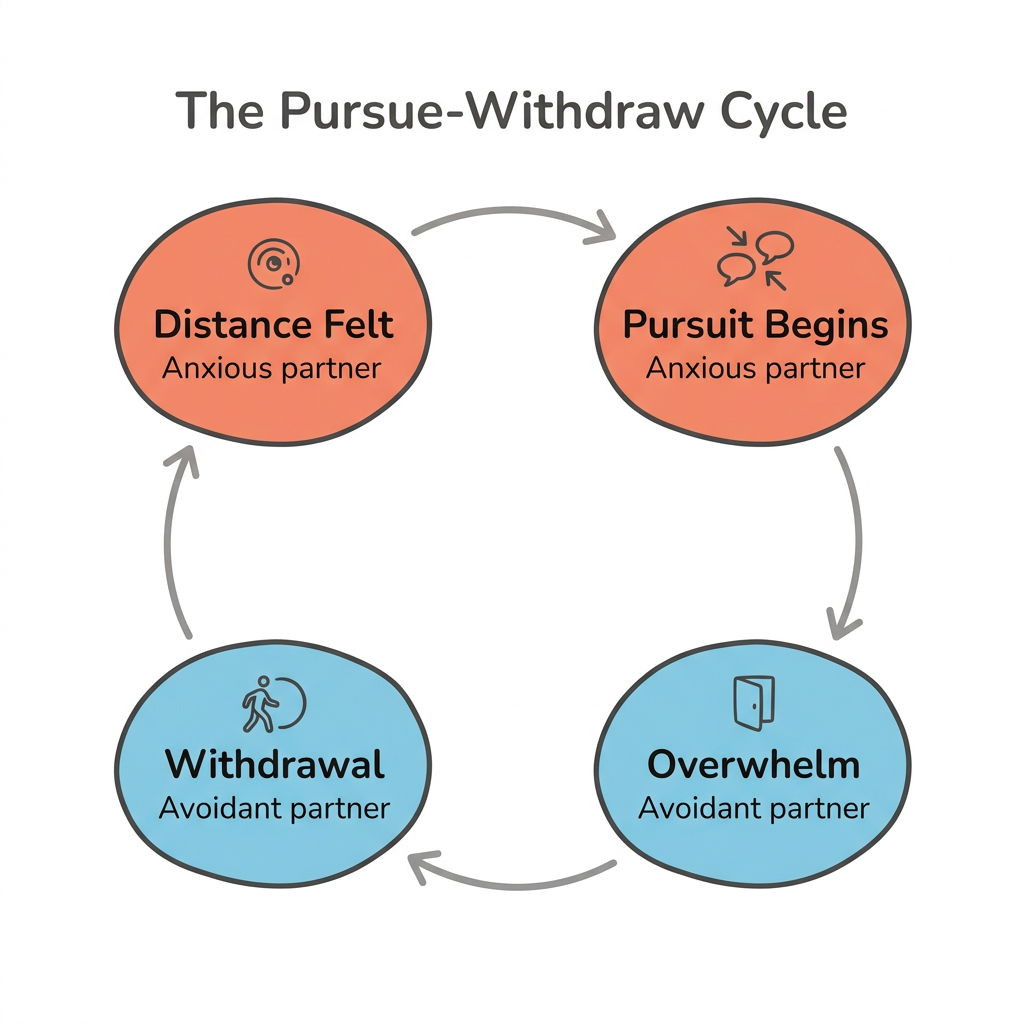
The critical reframe: the cycle is the enemy—not your partner. Both of you are caught in a pattern that predates this relationship.
Cycle Mapping Exercise (for couples)
- Draw a large circle on a piece of paper
- Together, label four points around the circle: the anxious partner's trigger, the anxious partner's reaction, the avoidant partner's trigger, the avoidant partner's reaction
- Under each reaction, write the underlying need (e.g., "I pursue because I need to know we're okay" or "I withdraw because I need to feel like I won't lose myself")
- Give the cycle a name—something slightly absurd helps ("The Tornado," "Round and Round")
- Post it somewhere visible so both partners can say, "We're doing The Tornado again"
Externalizing the cycle is a core EFT technique. It shifts blame from each other onto the pattern itself, giving both partners shared language for the dynamic instead of a reason to attack each other's character.
What Does the Neuroscience Say About Changing Attachment Patterns?
Neuroscience confirms that attachment patterns are stored in the brain and body—and that neuroplasticity enables rewiring them through new relational experiences. Fraley's (2002) meta-analysis found moderate stability in attachment over time, but approximately 25 percent of significant life events produced enduring attachment change (Fraley et al., 2020).
Three neural mechanisms explain why anxious-avoidant dynamics feel so intense:
Anxious attachment produces amygdala hyperactivation. Neuroimaging research shows increased activation in the amygdala, hippocampus, and dorsal anterior cingulate cortex when processing negative emotions—reflecting a threat-detection system that's working overtime (BMC Neuroscience, 2021).
Avoidant attachment suppresses social pain circuits. Brain scans reveal decreased anterior insula and dorsal ACC activation during social exclusion—meaning the avoidant partner genuinely experiences less distress from rejection at the neural level. This is the deactivating strategy operating in the brain itself.
The good news: oxytocin and dopamine form tighter crosstalk during bond formation, integrating reward salience with social focus to reorganize neural networks around new attachment patterns (Feldman, 2017). Security priming—visualizing a secure attachment figure—attenuates amygdala activation even in insecurely attached people (Mikulincer and Shaver, 2020). Earned security has a biological basis. Even epigenetic modifications to oxytocin receptor genes associated with attachment avoidance can potentially be altered (Ein-Dor et al., 2018). To understand more about how attachment styles affect your nervous system, including the polyvagal mechanisms involved, that article provides a thorough breakdown.
The same neural plasticity that encoded these patterns can reorganize them—and the research base for that claim is substantial. You can read more about the broader evidence for change in Can Your Attachment Style Change Over Time? and how the concept of earned secure attachment applies to couples.
Nervous System Check-In (somatic exercise for both partners)
- Before a difficult conversation, each partner places one hand on their chest
- Notice three things: heart rate, breathing depth, and muscle tension
- Rate your activation on a scale of 1 to 10
- If either partner is above a 7, pause for 20 minutes of individual self-regulation before continuing
- Use the pause for slow breathing, a short walk, or cold water on wrists—not for rehearsing arguments
The anxious partner's hyperactivation often completes before they realize it's happening—this exercise catches it at the body level. For the avoidant partner, it builds awareness of the numbness and mental fog that signals deactivation is beginning.
What Therapy Works Best for Anxious-Avoidant Couples?
Emotionally Focused Therapy is the gold standard for anxious-avoidant couples, with an effect size of 1.3—the largest of any couples intervention (Johnson et al., 1999). Between 70 and 75 percent of distressed couples move from distress to recovery, and up to 90 percent show significant improvements (Johnson, 2004). Notably, improvement continues after therapy ends: 50 percent of couples improved at post-test rose to 70 percent recovered at three-month follow-up (Johnson and Talitman, 1997).
EFT works across three stages in typically 8 to 20 weekly sessions:
- De-escalation (approximately 75 percent of sessions) — The therapist helps both partners identify the pursue-withdraw cycle and reduce conflict intensity. Each person learns to see their own reactive behavior as part of a pattern rather than a personal failing.
- Restructuring — Partners take emotional risks. The withdrawer becomes accessible and the pursuer becomes vulnerable. These are called "softening events"—the moment the avoidant partner reaches toward connection and the anxious partner expresses need without protest behavior.
- Consolidation — The couple practices new patterns in daily life and builds a shared narrative of how the relationship transformed.
Gottman Method therapy is also effective, particularly for building concrete communication antidotes: gentle startup instead of criticism, a culture of appreciation instead of contempt, taking responsibility instead of defensiveness, and self-soothing breaks instead of stonewalling. Both individual and couples work are typically needed. Individual therapy addresses each partner's attachment history, while couples therapy addresses the dynamic between them. For more on how therapy can change attachment patterns, that companion piece covers the individual therapy angle in depth.
Hold Me Tight Conversation Starter (adapted from Johnson's EFT)
- Each partner completes this sentence: "When [trigger], I feel [emotion], and what I really need from you is [need]"
- One partner speaks for 5 uninterrupted minutes
- The listener's only job is to reflect back what they heard—no rebuttals, no corrections
- Switch roles
- End by each naming one thing you heard that surprised you
The structure creates safety that makes emotional risk possible. For the avoidant partner, it practices accessibility—listening without shutting down. For the anxious partner, it practices expressing the actual need underneath the protest behavior rather than escalating to get a response.
What Should the Anxious Partner Work On?
The anxious partner's core work is learning to self-soothe before pursuing—not instead of pursuing. Your need for connection is legitimate. The goal isn't to stop needing your partner. The goal is to make requests from a grounded place rather than from the desperate urgency of an activated nervous system.
Your nervous system learned to treat distance as danger. That response kept you attuned to caregivers who were inconsistent—it was adaptive then. Now, it drives you to pursue in ways that push your partner further away. Simpson and Rholes (2017) found that anxious individuals' negative relationship behaviors were substantially diminished when their partners reported being more committed. That means your partner's consistency matters—but so does your ability to receive it without needing constant proof.
The shift looks like moving from protest behavior to request. A protest behavior says, "You never prioritize me!" A request says, "I'm feeling disconnected. Can we spend 20 minutes together tonight?" Same underlying need, completely different nervous system energy. Learning the difference between the two is essential—How to Communicate Your Needs Without Triggering Your Partner breaks this down in detail.
Building connection from desire rather than desperation takes practice. Self-soothing techniques for anxious attachment can help you develop a regulation toolkit so that when you reach for your partner, it's a choice rather than a compulsion. The anxious attachment complete guide explores the hyperactivation patterns underneath.
The 20-Minute Pause (for anxious attachment activation)
- When the urge to pursue hits—the fifth text, the demand for reassurance—set a timer for 20 minutes
- Name the emotion without acting on it: "I feel panicked that they're pulling away"
- Do 3 cycles of 4-7-8 breathing: inhale for 4 counts, hold for 7 counts, exhale for 8 counts
- Ask yourself: "What do I actually need right now—connection, or reassurance that I won't be abandoned?"
- After 20 minutes, decide if and how to reach out—from a calmer place
The anxious partner's hyperactivation hijacks the prefrontal cortex within seconds—this exercise builds a gap between activation and action. The goal isn't to suppress the need but to create enough space for deliberate choice to come back online.
What Should the Avoidant Partner Work On?
Li and Chan's (2012) meta-analysis of 73 studies with over 21,000 participants found that avoidance is more negatively associated with relationship satisfaction, connectedness, and support than anxiety—which means the avoidant partner's willingness to grow carries outsized weight in whether the relationship survives.
Your nervous system learned that emotional closeness was overwhelming, intrusive, or unsafe. Shutting down protected you from being engulfed. That adaptation made sense in its original context. And now it creates the exact distance that destabilizes your anxious partner and feeds the cycle. Recognizing this isn't about blame—it's about understanding the mechanics well enough to choose differently.
The shift starts with noticing deactivation signals in your body before they complete. Sudden mental fog during an emotional conversation. The urge to check your phone. A hollow feeling in your chest. Legs tensing as if to stand up and leave. These are your nervous system's early warning signals, and they appear seconds before full shutdown. Can Avoidant Attachment Be Healed? explores the avoidant growth trajectory in depth, including how deactivating strategies develop and what dismantling them looks like. Learning to say "I need space and I'll come back" instead of simply disappearing transforms withdrawal from an abandonment trigger into a regulation strategy both partners can trust.
Deactivation Body Scan (somatic exercise for avoidant attachment)
- During an emotional conversation, silently scan your body for these signals:
- Jaw clenching or throat tightening
- Chest feeling hollow or "far away"
- Sudden mental fog or urge to check your phone
- Legs tensing as though preparing to leave
- When you notice any of these, say out loud: "I'm noticing I'm starting to shut down. I want to stay present—can we slow down?"
- Take three slow breaths together before continuing
- If the shutdown is too strong, say: "I need 20 minutes, and I'll come back to finish this conversation"—then actually come back
Most avoidant individuals don't realize they're shutting down until they're already gone. This exercise builds interoceptive awareness of deactivation before it completes—catching it at the body level creates a choice point that didn't exist before.
How Can Partners Co-Regulate Each Other's Nervous Systems?
Partners co-regulate each other's nervous systems through eye contact, vocal prosody, and physical touch—when one partner is calm, their ventral vagal state can literally down-regulate the other's activation (Porges, 2022). This is the mechanism most relationship advice misses entirely.
Insecurely attached individuals tend to have weaker vagal tone, making self-regulation harder. That's precisely why co-regulation matters so much in anxious-avoidant dynamics. The anxious partner's hyperactivated system and the avoidant partner's shutdown state both respond to cues of safety from a regulated nervous system. When one partner can stay grounded during conflict, they become an anchor for the other's activation. For the full neuroscience behind this, see How Does Attachment Style Affect Your Nervous System?
Security priming offers a daily practice for building this capacity. Mikulincer and Shaver (2020) found that contextually activating attachment security representations—by visualizing a person who makes you feel safe—has measurable effects on emotion regulation and prosocial behavior, even for insecurely attached individuals. Research on inter-brain synchrony shows that neural patterns between partners become more aligned through therapeutic practice (Frontiers, 2022). You aren't just changing your own brain—you're changing the relational brain you share.
Co-Regulation Reset (somatic exercise for couples)
- When conflict escalates, pause and sit facing each other with knees touching
- One partner places their hand gently on the other's chest
- The calmer partner deliberately slows their breathing: 5-second inhales, 7-second exhales
- Maintain soft eye contact for 2 minutes without speaking
- The dysregulated partner's nervous system will begin to entrain to the regulated partner's rhythm—you may feel your heartbeat slow or your shoulders drop
Ventral vagal engagement works beneath conscious thought. The anxious partner's hyperactivation and the avoidant partner's shutdown both respond to co-regulation cues—warm eye contact, slow breathing, and physical touch signal safety at a level that words alone cannot reach.
What Are the Signs an Anxious-Avoidant Relationship Is Becoming Secure?
The clearest sign of progress is shorter conflict recovery time—arguments that once lasted days now resolve in hours. Security doesn't mean the absence of conflict. It means both partners can move through rupture and repair without the cycle consuming them.
Here are seven measurable progress markers to watch for:
- Conflict recovery shortens from days to hours — The emotional hangover after arguments becomes less intense and briefer
- The anxious partner can wait without spiraling — A delayed text no longer triggers a cascade of worst-case scenarios
- The avoidant partner initiates "how are we?" conversations — Emotional check-ins come voluntarily, not under pressure
- Repair attempts land instead of being rejected — When one partner reaches out after conflict, the other can receive it
- Physical affection increases outside of conflict and makeup cycles — Touch becomes about connection rather than reassurance or guilt
- Both partners can name the cycle in real-time — "We're doing the thing" becomes a shared signal to pause and de-escalate, and this real-time recognition is one of the strongest indicators that the pattern has shifted from unconscious to conscious
- Bids for connection feel calm rather than desperate or obligatory
You don't rewire a relationship in a single breakthrough conversation. You rewire it by noticing 10 percent earlier, responding 10 percent differently, 10 percent more often. For the individual growth journey that supports this couples work, see How to Develop Secure Attachment as an Adult.
Weekly Relationship Temperature Check (for both partners)
- Every Sunday, each partner independently rates three areas on a 1-to-10 scale: How safe did I feel this week? How well did we handle conflict? How connected do I feel right now?
- Share your ratings without defending or explaining—just the numbers
- Together, name one thing that went well and one thing to work on
- Track the numbers over weeks and months to see trends
The structured, time-limited format gives the avoidant partner predictability and a clear endpoint. The consistency and built-in reassurance of weekly check-ins gives the anxious partner something to count on rather than something to chase.
When Should You Leave an Anxious-Avoidant Relationship?
Not every anxious-avoidant relationship can or should be saved. Even reading this heading may have activated something—a spike of anxiety or a reflexive dismissal. Both responses make sense given what your nervous system has learned about loss. Acknowledging this isn't pessimism—sometimes the most secure choice is to leave.
Gottman's research identified contempt—not criticism, not even anger—as the strongest single predictor of divorce. When criticism has given way to contempt—eye-rolling, mockery, disgust—the relationship has crossed a threshold that is extremely difficult to return from. Contempt is the point of no return in most clinical frameworks.
The distinction that matters is hard but growing versus hard and harmful. A relationship where both partners are struggling but showing up for therapy, naming the cycle, and making imperfect attempts at change—that's hard but growing. A relationship where one partner refuses to examine their patterns, where the cycle is escalating rather than shortening, where your mental health is deteriorating despite genuine effort—that's hard and harmful.
Honest Assessment Inventory (for individual reflection)
- Is my partner willing to examine their own patterns—not just mine?
- Have we both actually tried therapy, not just talked about it?
- Is the cycle getting shorter and less intense over time, or escalating?
- Do I feel safe—physically and emotionally—in this relationship?
- Am I staying out of love, or out of fear of being alone?
If answers to questions 1 through 3 are consistently "no" over six or more months of genuine effort, that data matters. This targets both attachment styles by grounding the decision in observable patterns rather than the anxious partner's fear of abandonment or the avoidant partner's minimization of how bad things have become.
What Each Partner Needs to Work On
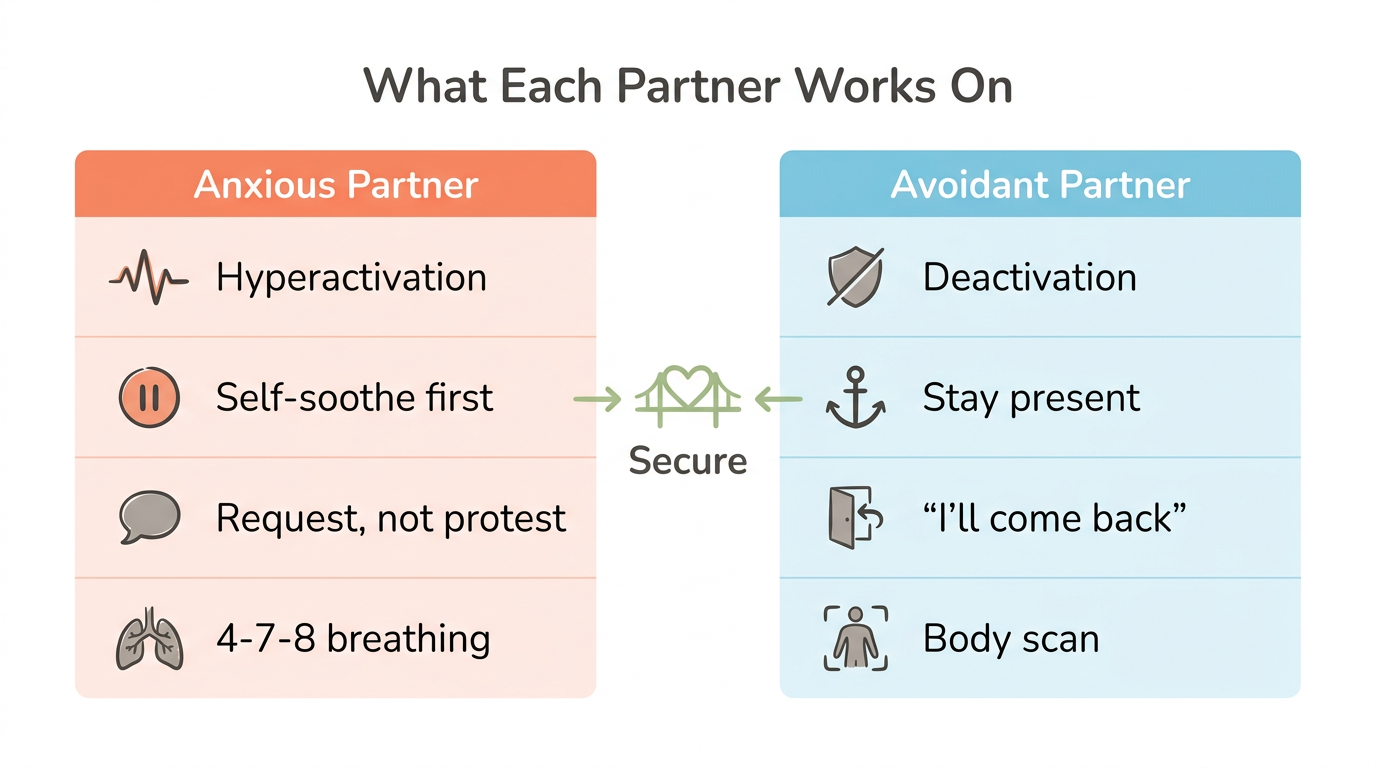
| Dimension | Anxious Partner's Work | Avoidant Partner's Work |
|---|---|---|
| Core challenge | Regulating pursuit intensity | Increasing emotional accessibility |
| Nervous system pattern | Hyperactivation (amygdala overdrive) | Deactivation (suppressed social pain circuits) |
| Key skill to build | Self-soothing before reaching out | Staying present during emotional conversations |
| Communication shift | Request instead of protest | "I need space and I'll come back" instead of withdrawal |
| Somatic practice | 4-7-8 breathing when the urge to pursue arises | Body scan for deactivation signals (numbness, fog, tension) |
| Biggest growth edge | Tolerating silence without catastrophizing | Tolerating closeness without shutting down |
| What helps most from partner | Consistent reassurance without being asked | Initiating emotional check-ins |
When to Seek Professional Help
If you've been working on these patterns for several months without visible progress—or if the cycle is escalating despite your best efforts—professional support can make the difference between spinning in place and actually shifting the dynamic.
Your nervous system learned these patterns in relationship, and it often needs the safety of a therapeutic relationship to unlearn them. That's not a failure of willpower. That's how attachment works. EFT therapists are specifically trained to work with the pursue-withdraw cycle, and the research on EFT outcomes is the strongest in the couples therapy field. You can find certified EFT therapists through the International Centre for Excellence in Emotionally Focused Therapy (ICEEFT) directory.
Individual therapy alongside couples work addresses each partner's attachment history separately—the anxious partner's hyperactivation patterns, the avoidant partner's deactivation strategies. Both layers of work reinforce each other.
Frequently Asked Questions
Can an anxious-avoidant relationship work long-term?
Yes, with sustained effort from both partners. EFT research shows 70 to 75 percent of distressed couples recover, and improvements often continue after therapy ends (Johnson et al., 1999). The key factor is mutual willingness—both partners must commit to understanding the pursue-withdraw cycle and doing their role-specific work.
Why do anxious and avoidant people attract each other?
Secure people pair off and stay together, leaving more insecure individuals in the dating pool (Levine and Heller, 2010). The avoidant partner's intermittent availability triggers the anxious partner's dopamine reward system, creating intense chemistry that is actually nervous system activation rather than compatibility.
How do you break the anxious-avoidant cycle?
Both partners must learn to recognize the pursue-withdraw pattern in real-time. The anxious partner practices self-soothing before pursuing, while the avoidant partner practices staying present instead of withdrawing. EFT helps couples externalize the cycle as the shared enemy rather than blaming each other.
What therapy is best for anxious-avoidant couples?
Emotionally Focused Therapy has the strongest evidence, with an effect size of 1.3—the largest of any couples intervention (Johnson et al., 1999). EFT specifically targets the pursue-withdraw cycle across 8 to 20 sessions. Gottman Method therapy is also effective for building communication antidotes to criticism, contempt, defensiveness, and stonewalling.
How long does it take for an anxious-avoidant couple to become secure?
EFT typically runs 8 to 20 weekly sessions, with meaningful shifts within 3 to 4 months. Full earned security as a couple may take 1 to 2 years of consistent practice. Johnson and Talitman (1997) found that 50 percent of couples improved at post-test rose to 70 percent recovered at three-month follow-up.
Can one partner become secure while the other stays insecure?
Yes—individual attachment growth does not require your partner to change at the same pace. One partner developing earned security can shift the entire dynamic by responding differently to the cycle. However, if only one partner is willing to do any work at all, the relationship's long-term viability becomes questionable.
Should I leave an anxious-avoidant relationship?
Not necessarily—most anxious-avoidant relationships can improve with mutual effort. Consider leaving if your partner refuses any self-examination or therapy, contempt has replaced criticism, the cycle is escalating rather than shortening, or your mental health is deteriorating despite genuine effort over six or more months.
What does a secure relationship look like after being anxious-avoidant?
Conflict still happens, but recovery takes hours instead of days. The formerly anxious partner tolerates uncertainty without spiraling. The formerly avoidant partner initiates emotional conversations. Repair attempts land. Bids for connection feel calm rather than desperate or obligatory. The cycle may still activate, but both partners can name it and de-escalate together.
Want to Go Deeper?
Meadow includes a structured assessment to help you understand your specific attachment patterns, followed by a 66-day program of daily practices designed to build earned security.
Start your free week →References
Attachment Theory and Change
- Levine, A., & Heller, R. (2010). Attached: The New Science of Adult Attachment and How It Can Help You Find—and Keep—Love. TarcherPerigee.
- Fraley, R. C. (2002). Attachment stability from infancy to adulthood: Meta-analysis and dynamic modeling of developmental mechanisms. Personality and Social Psychology Review, 6(2), 123–151.
- Fraley, R. C., Gillath, O., & Deboeck, P. R. (2020). Do life events lead to enduring changes in adult attachment styles? A naturalistic longitudinal investigation. Journal of Personality and Social Psychology, 120(6), 1567–1606.
- Simpson, J. A., & Rholes, W. S. (2017). Adult attachment, stress, and romantic relationships. Current Opinion in Psychology, 13, 19–24.
- Li, T., & Chan, D. K. S. (2012). How anxious and avoidant attachment affect romantic relationship quality differently: A meta-analytic review. European Journal of Social Psychology, 42(4), 406–419.
Therapy and Intervention Research
- Johnson, S. M., Hunsley, J., Greenberg, L., & Schindler, D. (1999). Emotionally focused couples therapy: Status and challenges. Clinical Psychology: Science and Practice, 6(1), 67–79.
- Johnson, S. M., & Talitman, E. (1997). Predictors of success in emotionally focused marital therapy. Journal of Marital and Family Therapy, 23(2), 135–152.
- Johnson, S. M. (2004). The Practice of Emotionally Focused Couple Therapy: Creating Connection (2nd ed.). Brunner-Routledge.
- Johnson, S. M. (2008). Hold Me Tight: Seven Conversations for a Lifetime of Love. Little, Brown and Company.
- Wiebe, S. A., & Johnson, S. M. (2016). A review of the research in emotionally focused therapy for couples. Family Process, 55(3), 390–407.
- Gottman, J. M. (1994). What Predicts Divorce? The Relationship Between Marital Processes and Marital Outcomes. Lawrence Erlbaum Associates.
Neuroscience and Somatic
- BMC Neuroscience (2021). Neural basis of individual differences in adult attachment: A voxel-based morphometry and fMRI study. BMC Neuroscience, 22, Article 617.
- Feldman, R. (2017). The neurobiology of human attachments. Trends in Cognitive Sciences, 21(2), 80–99.
- Mikulincer, M., & Shaver, P. R. (2020). Broaden-and-build effects of contextually boosting the sense of attachment security in adulthood. Current Directions in Psychological Science, 29(1), 22–26.
- Ein-Dor, T., Verbeke, W. J. M. I., Mokry, M., & Vrtička, P. (2018). Epigenetic modification of the oxytocin and glucocorticoid receptor genes is linked to attachment avoidance in young adults. Attachment & Human Development, 20(4), 439–454.
- Porges, S. W. (2022). Polyvagal theory: A science of safety. Frontiers in Integrative Neuroscience, 16, Article 871227.
- Frontiers in Human Neuroscience (2022). Inter-brain plasticity as a biological mechanism of change in psychotherapy. Frontiers in Human Neuroscience, 16, Article 955238.
Communication and Behavioral
- Saavedra, M. C., Chapman, K. E., & Rogge, R. D. (2010). Clarifying links between attachment and relationship quality: Hostile conflict and mindfulness as moderators. Communication Research Reports, 27(2), 131–143.
- Gottman Institute. The Four Horsemen: Recognizing criticism, contempt, defensiveness, and stonewalling. Retrieved from gottman.com.
This article is for educational purposes only and is not a substitute for professional mental health care. If you're experiencing relationship distress, please consult a licensed therapist or counselor. Crisis support is available through the 988 Suicide and Crisis Lifeline (call or text 988).