The anxious-avoidant trap is a self-reinforcing relationship cycle where one partner pursues closeness while the other withdraws, each behavior intensifying the other. First named by Levine and Heller (2010) in Attached, this dynamic is one of the most well-studied patterns in couples research. According to Gottman Institute research, couples stuck in this pursuer-distancer pattern in early marriage have a greater than 80 percent chance of divorcing within four to five years.
If you have ever felt like the harder you reach for connection, the further your partner pulls away — or if your partner's need for closeness makes you want to disappear — you are not broken. You are caught in one of the most common relationship dynamics in existence. Roughly 25 percent of people lean anxious and 25 percent lean avoidant (Levine and Heller, 2010), making this pairing statistically inevitable. The good news: neuroscience confirms that attachment patterns can change.
Key takeaway: The anxious-avoidant trap is a self-reinforcing relationship cycle where one partner pursues closeness while the other withdraws, escalating both partners' distress. Research shows couples stuck in this pattern face an 80 percent or higher divorce rate within four to five years. Breaking free requires recognizing the cycle, regulating your nervous system, communicating attachment needs directly, and working with a couples therapist trained in attachment-based approaches like Emotionally Focused Therapy.
What Exactly Is the Anxious-Avoidant Trap?
The anxious-avoidant trap is a relationship pattern where two opposing attachment strategies lock partners into a cycle of pursuit and withdrawal that neither can stop alone. The anxious partner uses hyperactivation — intensifying bids for closeness, reassurance, and emotional contact — while the avoidant partner uses deactivation — suppressing attachment needs, withdrawing emotionally, and creating distance (Mikulincer and Shaver, 2007).
These are not character flaws. They are attachment system strategies your nervous system learned early in life. The anxious partner learned that love required vigilance — monitoring the caregiver's availability and escalating signals when connection felt threatened. The avoidant partner learned that closeness brought overwhelm or disappointment, and that self-reliance was safer than depending on others.
The trap emerges when these two strategies meet. The anxious partner's pursuit confirms the avoidant partner's fear of engulfment. The avoidant partner's withdrawal confirms the anxious partner's fear of abandonment. Each partner's protective response becomes the other partner's trigger, creating a self-reinforcing loop that can persist for years.
If you recognize yourself as the pursuing partner, you may relate to these 12 signs of anxious attachment. If you tend to withdraw, explore these signs of avoidant attachment.
The Cycle Mapping Exercise
- Write down your most recent conflict with your partner
- Identify what you did — did you pursue or withdraw?
- Identify what your partner did in response
- Trace it back — what feeling came before your action? (Fear? Loneliness? Overwhelm?)
- What feeling do you think came before their action?
- Notice: both of you were trying to protect yourselves from pain
Why Do Anxious and Avoidant Partners Keep Attracting Each Other?
Anxious and avoidant partners attract each other because both unconsciously seek relationships that confirm their existing internal working models of love — a pattern psychologists call repetition compulsion. The anxious partner mistakes the avoidant partner's emotional unavailability for independence, confidence, or mystery. The avoidant partner appreciates the anxious partner's attentiveness and warmth without recognizing the underlying need for constant reassurance.
The attraction feels magnetic because it is familiar. Your nervous system registers familiar as safe, even when familiar means painful. If you grew up reaching for a caregiver who was inconsistently available, a partner who runs hot and cold will feel like home. If you grew up learning that closeness meant losing yourself, a partner who demands emotional engagement will trigger the same protective shutdown.
Research supports this dynamic. Candel and Turliuc (2019) studied 185 dating couples and 123 married couples and found that anxious individuals reported significantly lower trust, satisfaction, and commitment when paired with avoidant partners — yet these pairings persist. Data from longitudinal studies shows insecure attachment has increased from 51 percent to 58 percent between 1988 and 2011 (WifiTalents), meaning more people are entering relationships with activated attachment patterns, and the odds of this pairing continue to rise.
The key insight: familiar does not equal healthy. Recognizing this distinction is the first step toward choosing differently.
The Attraction Audit
- List your last three significant partners or crushes
- For each, note what initially attracted you to them
- Note what caused the most pain in the relationship
- Circle any patterns — are the traits that attracted you related to the traits that hurt you?
- Identify which parent or caregiver dynamic this echoes
- Sit with what you notice without judgment — awareness is the beginning of change
What Does the Anxious-Avoidant Cycle Look Like in Daily Life?
The anxious-avoidant cycle plays out not just in major conflicts but in micro-moments throughout every ordinary day — who initiates texts, how goodbyes happen, how bids for connection are received or ignored. Martín-María and colleagues (2022) found that avoidant attachment predicted withdrawal behavior (β=0.41), which in turn triggered partner demand and aggression (r=0.54 to 0.56), showing how small relational moments cascade into larger destructive patterns.
If you have ever panicked when your partner did not text back, you have felt the anxious-avoidant trap operating in a micro-moment. Here is how the full cycle unfolds:
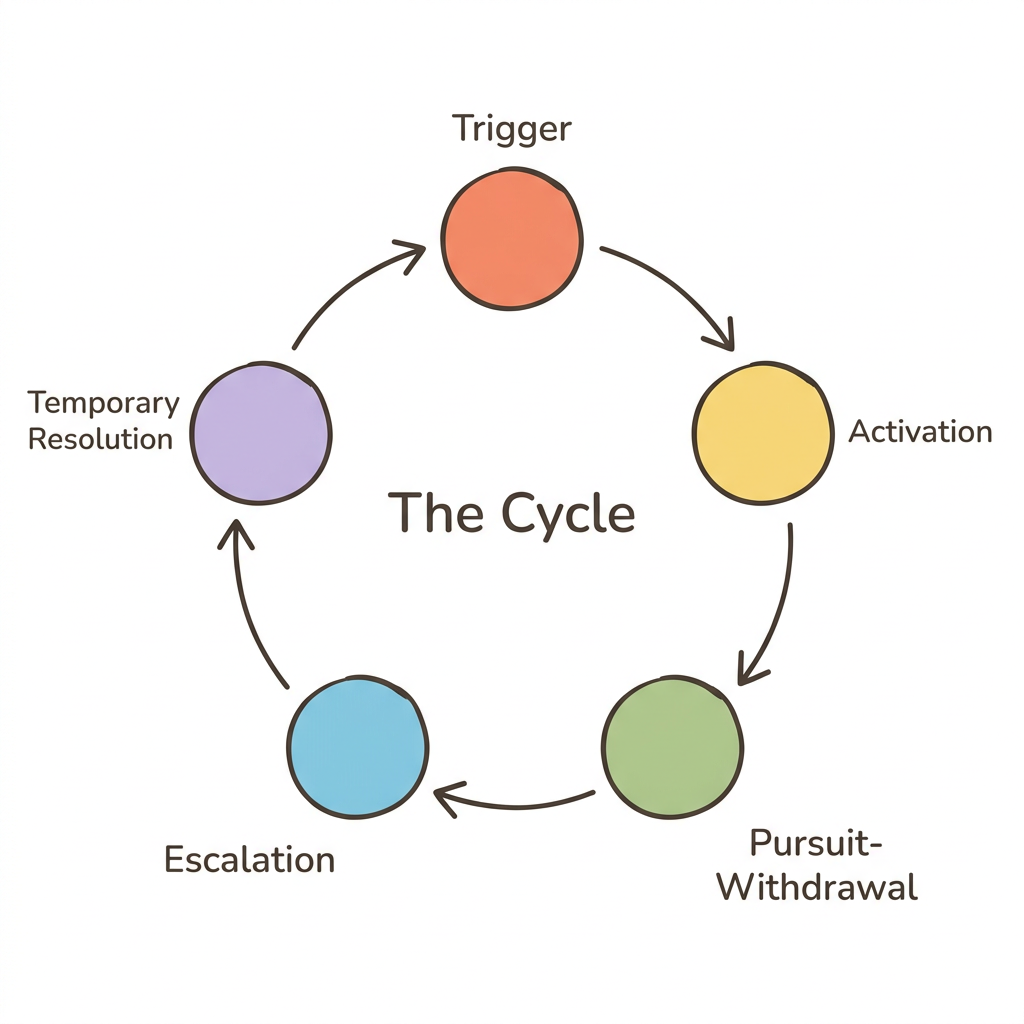
The 5-Stage Cycle
- Trigger — A bid for connection is missed or a perceived threat to closeness or autonomy arises. The anxious partner sends a text and gets no reply for hours. The avoidant partner is asked "Where is this going?" over dinner.
- Activation — The anxious partner enters sympathetic arousal: chest tightens, heart races, thoughts spiral. The avoidant partner begins deactivating: a sense of numbness, mental distancing, the urge to change the subject.
- Pursuit-Withdrawal — The anxious partner escalates with protest behaviors: more texts, emotional confrontation, seeking reassurance. The avoidant partner retreats into silence, staying late at work, or scrolling their phone in another room.
- Escalation — Protest behaviors intensify into criticism or ultimatums. Stonewalling deepens into emotional flatness or physical exit. Both partners are now fully outside their window of tolerance.
- Temporary Resolution — One partner capitulates, or exhaustion creates a ceasefire. The underlying attachment needs remain unaddressed, and the cycle resets — often within days.
Daily Trigger Journal For one week, note each moment you feel the urge to pursue or withdraw. Record:
- The situation (what happened)
- What you felt in your body (tightness, heat, numbness, restlessness)
- What you wanted to do (call them, check their location, leave the room, go silent)
- What you actually did
- Review at week's end — what patterns emerge?
How Does the Anxious-Avoidant Trap Affect Your Nervous System?
The anxious-avoidant trap is fundamentally a collision between two dysregulated nervous systems that cannot co-regulate — the process through which one person's calm, present state helps settle another person's distress. Research in attachment neuroscience reveals distinct neural signatures for each pattern, and understanding what is happening in your body can transform how you respond.
The Anxious Partner's Nervous System
Anxious attachment is associated with heightened amygdala and dorsal anterior cingulate cortex activation when processing negative emotional content (PMC, 2012). The anxious partner's brain is essentially stuck in threat-detection mode. The HPA axis becomes hyperactive, producing elevated cortisol under relational stress (BMC Neuroscience, 2021). In the body, this shows up as chest tightness, shallow breathing, racing heart, and shoulder tension. The nervous system is locked in sympathetic fight-or-flight — an amygdala hijack that makes rational conversation nearly impossible.
The Avoidant Partner's Nervous System
Avoidant attachment involves deactivating strategies that suppress attachment-related processing. Neural research shows reduced oxytocin release during bonding and diminished opioid receptor availability, which decreases social reward sensitivity (BMC Neuroscience, 2021). In polyvagal terms, the avoidant partner retreats into dorsal vagal shutdown — a freeze state that looks like calm but is actually a form of disconnection (Porges, 2011). In the body, this manifests as physical rigidity, emotional flatness, and numbness.
The trap keeps both partners outside their window of tolerance — the zone where you can feel emotions without being overwhelmed or shut down. The anxious partner is above it (flooded). The avoidant partner is below it (numb). Neither can reach the ventral vagal state — the social engagement system where genuine connection becomes possible.
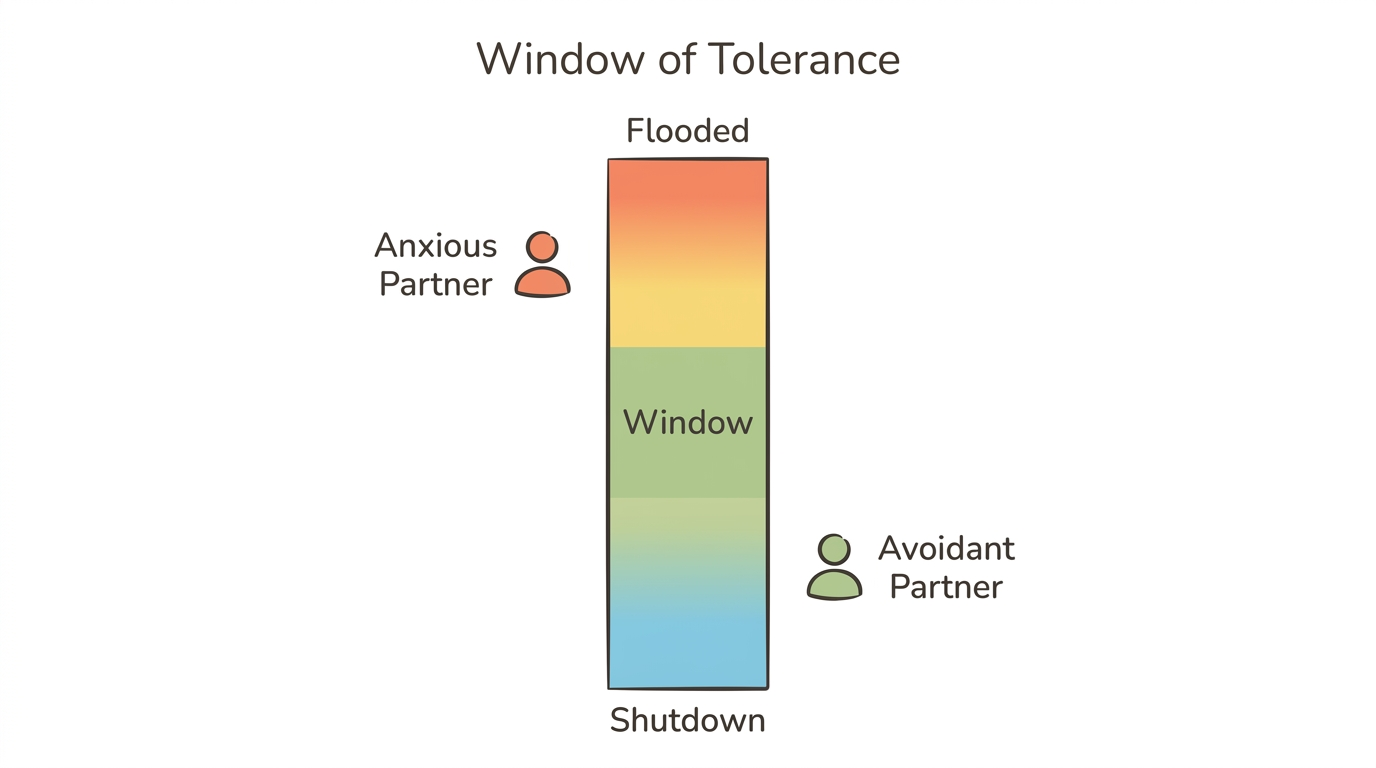
The Body Scan for Attachment Activation (Somatic Exercise)
- Sit comfortably and close your eyes
- Recall a recent moment of relational stress — not the most intense one, something moderate
- Scan slowly from your head to your feet — where do you feel tension, heat, numbness, or constriction?
- Place one hand gently on that area
- Breathe into the sensation for three slow breaths — inhale for four counts, exhale for six
- Name it aloud or silently: "This is my attachment system activating. I am safe right now."
- Notice if anything shifts — even slightly. That shift is your nervous system learning it has options.
How Do You Break the Anxious-Avoidant Cycle?
Breaking the anxious-avoidant cycle requires both partners to recognize the pattern as the problem rather than blaming each other. The meta-analysis by Schrodt, Witt, and Shimkowski (2014) — covering 74 studies and 14,255 participants — found that the demand-withdraw pattern predicted negative relationship outcomes with an effect size of r=.423, making it one of the strongest predictors of relationship distress. The cycle itself is the enemy, not your partner.
For the Anxious Partner
Your nervous system learned to pursue connection by escalating — and that strategy made sense when you were small. Now, your growth edge is learning to self-soothe before pursuing. This does not mean suppressing your needs. It means pausing long enough to express them clearly rather than desperately.
- Practice the 20-minute cool-off rule before sending the third text
- Replace "You never..." with "I feel scared when..."
- Build a support network beyond the relationship — friends, therapist, community
- Remind yourself: "I can feel anxious and still wait"
For the Avoidant Partner
Your nervous system learned that withdrawal kept you safe — and it did. Now, your growth edge is learning to stay present during emotional discomfort rather than disappearing. Withdrawal feels like self-preservation, but to your partner, it feels like abandonment.
- Recognize that your urge to leave the room is a pattern, not a preference
- Practice offering proactive reassurance — "I need space right now, and I'm coming back"
- Name one emotion per day, even when it feels unnecessary
- Remind yourself: "I can feel close and still be me"
Six Steps to Break the Cycle Together
- Name the cycle, not the blame — Say "We are in the cycle again" instead of "You always shut down" or "You are so needy"
- Pause and regulate — Use the 20-minute cool-off rule when either partner feels flooded (Gottman). This is not avoidance — it is strategic regulation with a commitment to return.
- Share the vulnerable feeling underneath — "I am scared you are pulling away" or "I feel overwhelmed and need space so I can come back to you"
- Make one small bid — Anxious partner: ask for one specific thing ("Can you hold my hand right now?"). Avoidant partner: offer one gesture of closeness ("I want to hear about your day").
- Create rituals of connection — A daily 15-minute emotional check-in, a goodbye kiss, a weekly date. Rituals provide structure that reduces the anxious partner's uncertainty and the avoidant partner's sense of being overwhelmed.
- Get professional support — EFT, Gottman Method, or IFS-informed couples therapy provides the guided container that most couples need to break deeply entrenched cycles.
The 15-Minute Check-In Protocol
- Set a timer for 15 minutes — the boundary helps the avoidant partner feel safe and the anxious partner feel heard
- Partner A shares for five minutes: "Today I felt..." (no problem-solving, no advice)
- Partner B reflects back: "What I heard you say is..."
- Switch roles
- Close with one appreciation: "Something I value about you is..."
- Practice this daily for two weeks and notice what shifts
What Therapy Works Best for Anxious-Avoidant Couples?
Emotionally Focused Therapy (EFT) is the gold standard for anxious-avoidant couples, with 64.5 percent of couples showing reliable improvement or recovery at the end of treatment (Wiebe and Johnson, 2016). EFT satisfaction increased by .39 points per weekly session, making it one of the most efficient evidence-based approaches for attachment-related distress.
Emotionally Focused Therapy
EFT, developed by Sue Johnson, works directly with the anxious-avoidant cycle. The therapist helps couples identify their "negative cycle," access the vulnerable attachment emotions underneath the surface behaviors, and restructure interactional patterns. The key change mechanism is the softening event — the moment when the withdrawing partner reaches toward the pursuing partner from a place of vulnerability, and the pursuing partner softens their demand in response. A 2019 systematic review confirmed EFT's effectiveness across diverse populations.
The Gottman Method
The Gottman Method provides concrete behavioral tools for replacing destructive patterns. John Gottman's research identified the "Four Horsemen" — criticism, contempt, defensiveness, and stonewalling — and their specific antidotes: gentle startup, building a culture of appreciation, taking responsibility, and physiological self-soothing. The "Dreams Within Conflict" intervention helps couples understand the meaning behind each partner's position in the pursuer-distancer dynamic.
Internal Family Systems
IFS parts work offers a unique lens on the anxious-avoidant trap. The anxious partner's "protector parts" drive pursuit behavior to shield exile parts carrying abandonment wounds. The avoidant partner's protectors enforce distance to shield exile parts carrying engulfment or inadequacy wounds. When each partner can access and unburden their exiles, the protectors relax — and the cycle loses its fuel. A pilot study found that 92 percent of adult trauma survivors no longer met PTSD criteria at one-month follow-up using IFS (IFS Institute).
The concept of earned secure attachment confirms that insecure patterns are not permanent. A 2024 scoping review by Pinto and colleagues documented that earned security is achieved through coherent narrative integration of adverse early experiences. Neuroplasticity research shows that therapeutic relationships and secure partnerships can rewire attachment neural pathways throughout life (Siegel).
The Parts Dialogue (IFS-Informed)
- When you notice yourself pursuing or withdrawing, pause
- Ask internally: "Which part of me is driving this right now?"
- Get curious: "What is this part afraid will happen if it does not pursue or withdraw?"
- Ask: "What does this part need to hear to feel safe?"
- Offer that reassurance internally: "I see you. You are trying to protect me. I have got this."
- Notice if the urgency to pursue or withdraw softens — even by 10 percent. That is progress.
When Should You Stay and When Should You Leave?
Deciding whether to stay in an anxious-avoidant relationship is one of the hardest questions you will face, and there is no universal right answer. Gottman's research found that contempt — not conflict — is the number one predictor of divorce, with 94 percent accuracy in predicting which couples would separate. The presence of contempt, not the presence of the cycle itself, is often the clearest signal.
Signs the relationship can work:
- Both partners acknowledge the cycle exists
- Both are willing to seek individual or couples therapy
- Emotional and physical safety is maintained
- Moments of genuine connection, humor, and warmth still occur
- At least one partner can sometimes step out of the pattern
Signs it may be time to leave:
- One partner consistently refuses to engage with the cycle or seek help
- Contempt has replaced conflict — eye-rolling, mockery, disgust
- Emotional or physical safety is compromised
- You have lost a sense of who you are outside the relationship
- You have exhausted what is available to try — therapy, communication tools, honest conversations — and the pattern has not shifted
Leaving an anxious-avoidant relationship does not mean failure. Sometimes growth is not always together. Research shows that anxious attachment correlates with 2.5 times higher breakup rates in longitudinal studies (WifiTalents) — and many of those endings create the space for earned security with a future partner or within yourself.
The Clarity Compass
- Draw four quadrants on a piece of paper: "What I Need," "What I Am Getting," "What I Have Tried," "What Is Left to Try"
- Fill each quadrant honestly — take your time
- If "What Is Left to Try" is empty and "What I Need" does not match "What I Am Getting," that is information worth honoring
- Share this exercise with a therapist or trusted friend before making any major decisions
Anxious vs. Avoidant: How Each Partner Experiences the Trap
| Dimension | Anxious Partner | Avoidant Partner |
|---|---|---|
| Core fear | Abandonment, being unloved | Engulfment, losing autonomy |
| Attachment strategy | Hyperactivation (pursue, escalate) | Deactivation (withdraw, suppress) |
| Nervous system state | Sympathetic arousal (fight or flight) | Dorsal vagal (freeze or shutdown) |
| Body sensations | Chest tightness, racing heart, shallow breathing | Physical rigidity, numbness, emotional flatness |
| Protest behavior | Excessive texting, emotional confrontation, ultimatums | Silence, staying busy, stonewalling, physical exit |
| Underlying need | "Show me I matter to you" | "Give me space to come to you" |
| Growth edge | Self-soothe before pursuing; tolerate uncertainty | Stay present during discomfort; offer proactive reassurance |
| Healing statement | "I can feel anxious and still wait" | "I can feel close and still be me" |
When Should You Seek Professional Help?
You should seek professional help when the anxious-avoidant cycle persists despite your best self-help efforts, or when emotional flooding prevents productive conversation more often than not. EFT research shows satisfaction increases by .39 points per weekly session (Wiebe and Johnson, 2016), meaning professional support accelerates change in measurable ways.
Specific indicators that therapy would help:
- You recognize the cycle but cannot stop it on your own
- Conversations about needs reliably escalate into pursuit-withdrawal
- Stonewalling or contempt has become the default response to conflict
- One or both partners feel hopeless about the relationship
- Childhood attachment wounds are surfacing in the relationship — you are reacting to your partner as if they were your parent
- You have read the books, tried the exercises, and still feel stuck
When looking for a therapist, seek someone who is EFT-certified, Gottman-trained, or IFS-informed. Ask potential therapists: "Do you work with attachment dynamics in couples?" An attachment-informed therapist understands that the cycle — not either partner — is the problem, and will help you both develop earned security together.
The Meadow app can serve as a daily complement to therapy, helping you track your attachment patterns, practice nervous system regulation, and build awareness between sessions. Therapy provides the relational container. Daily practice rewires the neural pathways.
Frequently Asked Questions
What is the anxious-avoidant trap?
The anxious-avoidant trap is a self-reinforcing relationship cycle where one partner pursues closeness while the other withdraws, each behavior intensifying the other. Coined by Levine and Heller in Attached (2010), the dynamic affects roughly half of insecurely attached couples and is linked to a greater than 80 percent divorce rate if left unaddressed (Gottman Institute).
Why do anxious and avoidant people attract each other?
Anxious partners are drawn to avoidant partners' independence, mistaking emotional unavailability for strength. Avoidant partners appreciate anxious partners' warmth without recognizing the underlying need for reassurance. Both unconsciously seek partners who confirm their childhood attachment models — a pattern called repetition compulsion. Familiar feels safe to the nervous system, even when familiar means painful.
Can an anxious-avoidant relationship work?
Yes, but only when both partners recognize the cycle and commit to changing it. Research on earned secure attachment (Pinto et al., 2024) shows insecure patterns are not permanent. Emotionally Focused Therapy achieves a 64.5 percent reliable recovery rate for distressed couples, and neuroplasticity research confirms attachment neural pathways can be rewired throughout life.
What are the signs of an anxious-avoidant relationship?
Common signs include one partner constantly initiating contact while the other pulls away, recurring arguments that follow a pursuit-withdrawal pattern, difficulty discussing emotions without flooding or shutting down, cycles of intense closeness followed by sudden distance, and a persistent sense that your needs are fundamentally incompatible. The pattern often shows up in small daily moments like texting, goodbyes, and bids for attention.
How do you break the anxious-avoidant cycle?
Start by naming the cycle together — "We are in the pattern again" — instead of blaming each other. Practice nervous system regulation during conflict with a 20-minute cool-off period. Share the vulnerable feeling underneath your behavior rather than the protest behavior itself. Create structured rituals of connection like daily 15-minute check-ins. Seek attachment-informed couples therapy such as EFT or the Gottman Method.
What therapy is best for anxious-avoidant couples?
Emotionally Focused Therapy is the gold standard, with 64.5 percent reliable recovery in research (Wiebe and Johnson, 2016). The Gottman Method provides practical tools for replacing destructive communication patterns with gentle startup and appreciation. Internal Family Systems helps each partner understand the protective parts driving pursuit or withdrawal. Many therapists integrate multiple approaches for the best results.
How does the anxious-avoidant trap affect your nervous system?
The anxious partner experiences chronic sympathetic arousal — elevated cortisol, amygdala hyperactivation, chest tightness, and racing thoughts. The avoidant partner enters dorsal vagal shutdown — emotional numbing, physical rigidity, and reduced oxytocin release. Together, the two partners fail to co-regulate, keeping both nervous systems outside their window of tolerance and making genuine connection physiologically difficult.
Can you change your attachment style?
Yes. Research on earned secure attachment (Pinto et al., 2024) shows people can develop secure attachment patterns through therapy, mindful self-awareness, and healthy relational experiences. Neuroplasticity allows attachment neural pathways to be rewired throughout life (Siegel). You do not rewire attachment in a single insight — you rewire it by noticing 10 percent earlier, responding 10 percent differently, 10 percent more often.
Want to Go Deeper?
Meadow includes a structured assessment to help you understand your specific attachment patterns, followed by a 66-day program of daily practices designed to build earned security.
Start your free week →References
Foundational Attachment Theory
- Levine, A., & Heller, R. (2010). Attached: The New Science of Adult Attachment and How It Can Help You Find—and Keep—Love. TarcherPerigee.
- Mikulincer, M., & Shaver, P. R. (2007). Attachment in Adulthood: Structure, Dynamics, and Change. Guilford Press.
- Pinto, T. M., et al. (2024). Earned secure attachment: A scoping review. PubMed. https://pubmed.ncbi.nlm.nih.gov/39207034/
Couples Research and Statistics
- Candel, O.-S., & Turliuc, M. N. (2019). Dyadic patterns of anxiety and avoidance and their associations with relationship quality. PMC. https://pmc.ncbi.nlm.nih.gov/articles/PMC8336265/
- Martín-María, N., et al. (2022). Avoidant attachment, withdrawal, and partner aggression in heterosexual couples. Frontiers in Psychology. https://pmc.ncbi.nlm.nih.gov/articles/PMC8841843/
- Schrodt, P., Witt, P. L., & Shimkowski, J. R. (2014). A meta-analytical review of the demand/withdraw pattern of interaction and its associations with individual, relational, and communicative outcomes. Communication Monographs, 81(1), 28–58.
- Gottman Institute. The pursuer-distancer dynamic. https://www.gottman.com/blog/the-pursuer-distancer-dynamic/
- Dieperink, M., et al. (2015). Attachment style and mental health service utilization. PubMed. https://pubmed.ncbi.nlm.nih.gov/26213376/
- WifiTalents. (2026). Attachment style statistics. https://wifitalents.com/attachment-style-statistics/
Neuroscience
- Vrticka, P., & Vuilleumier, P. (2012). Neuroscience of human social interactions and adult attachment style. PMC. https://pmc.ncbi.nlm.nih.gov/articles/PMC3398354/
- Zhang, X., et al. (2021). Neural basis of attachment anxiety and avoidance. BMC Neuroscience. https://bmcneurosci.biomedcentral.com/articles/10.1186/s12868-021-00617-4
- Porges, S. W. (2011). The polyvagal theory: Neurophysiological foundations. PMC. https://pmc.ncbi.nlm.nih.gov/articles/PMC3490536/
- Siegel, D. J. The verdict is in: The case for attachment theory. https://drdansiegel.com/wp-content/uploads/2020/09/1271-the-verdict-is-in-1.pdf
Therapeutic Approaches
- Wiebe, S. A., & Johnson, S. M. (2016). A review of the research in Emotionally Focused Therapy for couples. Family Process, 55(3), 390–407. https://pubmed.ncbi.nlm.nih.gov/27273169/
- Dalgleish, T. L., et al. (2019). A systematic review of Emotionally Focused Therapy. PubMed. https://pubmed.ncbi.nlm.nih.gov/30605013/
- IFS Institute. Internal Family Systems model outline. https://ifs-institute.com/resources/articles/internal-family-systems-model-outline
- Bay Area CBT Center. Exploring somatic-based therapy for attachment issues. https://bayareacbtcenter.com/exploring-somatic-based-therapy-for-attachment-issues/
- Trauma Solutions. Attachment styles and the nervous system: A polyvagal primer. https://traumasolutions.com/attachment-styles-and-the-nervous-system-a-polyvagal-primer-for-therapists/
Clinical and Popular Sources
- Simply Psychology. The anxious-avoidant cycle. https://www.simplypsychology.org/anxious-avoidant-cycle.html
- Psychology Today. Why anxious and avoidant attachment attract each other. https://www.psychologytoday.com/us/blog/here-there-and-everywhere/202306/why-anxious-and-avoidant-attachment-attract-each-other
This article is for educational purposes only and is not a substitute for professional mental health advice, diagnosis, or treatment. If you or your partner are experiencing relationship distress, please consult a licensed therapist or counselor. If you are in an unsafe relationship, contact the National Domestic Violence Hotline at 1-800-799-7233.