Earned secure attachment is a term from Mary Main's Adult Attachment Interview (AAI) describing individuals who experienced insecure or difficult attachment in childhood but developed secure attachment patterns in adulthood through positive relationships, therapy, and intentional self-reflection. Research by Chopik (2024) in Social and Personality Psychology Compass found that approximately 50 percent of participants shifted attachment styles over a two-year period, establishing that attachment is not a fixed trait.
If you have identified as anxiously attached or recognized avoidant patterns in yourself, you may wonder whether you are stuck with that pattern for life. The answer is no — but the path to security is more nuanced than pop psychology suggests. Earned security is real, well-researched, and achievable. It may even give you strengths that people who were securely attached from childhood do not have.
Key takeaway: Earned secure attachment describes people who experienced insecure attachment in childhood but developed secure patterns in adulthood through therapy, healthy relationships, and self-reflection. Research shows approximately 50 percent of people shift attachment styles over time. Earning security builds exceptional mentalization skills, but the journey requires ongoing emotional work, not a single breakthrough moment.
What Is Earned Secure Attachment and Where Does the Term Come From?
Earned secure attachment is a classification that emerged from Mary Main's Adult Attachment Interview (AAI), a structured interview that asks adults to describe their childhood relationships with caregivers (Main, Goldwyn & Hesse, 2003). Individuals classified as earned-secure report negative or difficult childhood experiences but discuss them with coherence, balance, and reflective capacity — the hallmark of attachment security on the AAI.
The AAI distinguishes earned-secure individuals from "continuous-secure" individuals, who report warm, responsive childhoods and demonstrate coherent narratives about those positive experiences. The key difference is not what happened in childhood, but how a person makes sense of it now. An earned-secure person can say "My mother was emotionally unavailable" without minimizing the pain or becoming overwhelmed by it.
Earned secure attachment remains a relatively young area of study. Filosa, Sharp, Gori, and Musetti (2024) conducted a scoping review and found only 24 empirical studies on earned security as of 2023, published in Psychological Reports. Their review concluded that secondary attachment figures and reflective functioning are the clearest contributing factors to earning security — but much remains understudied, including the role of fathers and developmental pathways.
The Coherent Narrative Check
- Write 3-4 sentences about a difficult childhood memory
- Read what you wrote aloud slowly
- Notice: Can you acknowledge the pain without being overwhelmed or minimizing it?
- Can you hold compassion for both yourself and your caregiver simultaneously?
- This balance — acknowledging difficulty while maintaining perspective — is what coherence looks like on the AAI
How Is Earned Secure Different from Continuous Secure Attachment?
Earned-secure and continuous-secure individuals function almost identically in adult relationships and parenting, but they differ in childhood history, emotional vulnerability, and one surprising strength. Research by Roisman et al. (2002) in a 23-year longitudinal study published in Child Development found that earned-secure adults parent as effectively as continuous-secures — a powerful finding that means your childhood does not determine your children's attachment security.
The Depression Nuance Most Sources Leave Out
Roisman's study also uncovered a finding that most pop psychology sources omit: 40 percent of earned-secure individuals exceed clinical depression cutoffs, compared to only 10 percent of continuous-secures and 30 percent of insecure individuals. Earned security is real — and it comes with ongoing emotional work. Your nervous system learned its original patterns for good reason. Rewiring those patterns does not erase the sensitivity that made them necessary in the first place.
Mentalization as a Superpower
Fonagy et al. (1997) established in Development and Psychopathology that reflective functioning — the capacity to understand behavior in terms of underlying mental states — is central to secure attachment. Earned-secure individuals show higher mentalization than both insecure and continuously secure groups. The work of earning security builds mentalization as a superpower: the kind of exceptional emotional intelligence that comes from having to consciously learn what others absorbed intuitively.
| Dimension | Earned Secure | Continuous Secure |
|---|---|---|
| Childhood experience | Insecure or difficult (though may include "good enough" parenting) | Consistently warm and responsive |
| AAI narrative style | Coherent despite painful content | Coherent with positive memories |
| Parenting effectiveness | Equal to continuous secure | Baseline secure parenting |
| Reflective functioning | Higher than continuous secure | High |
| Depressive symptoms | 40 percent exceed clinical cutoff | 10 percent exceed clinical cutoff |
| Relationship quality | Comparable to continuous secure | Baseline secure relating |
| Key strength | Exceptional mentalization from doing the work | Intuitive emotional regulation |
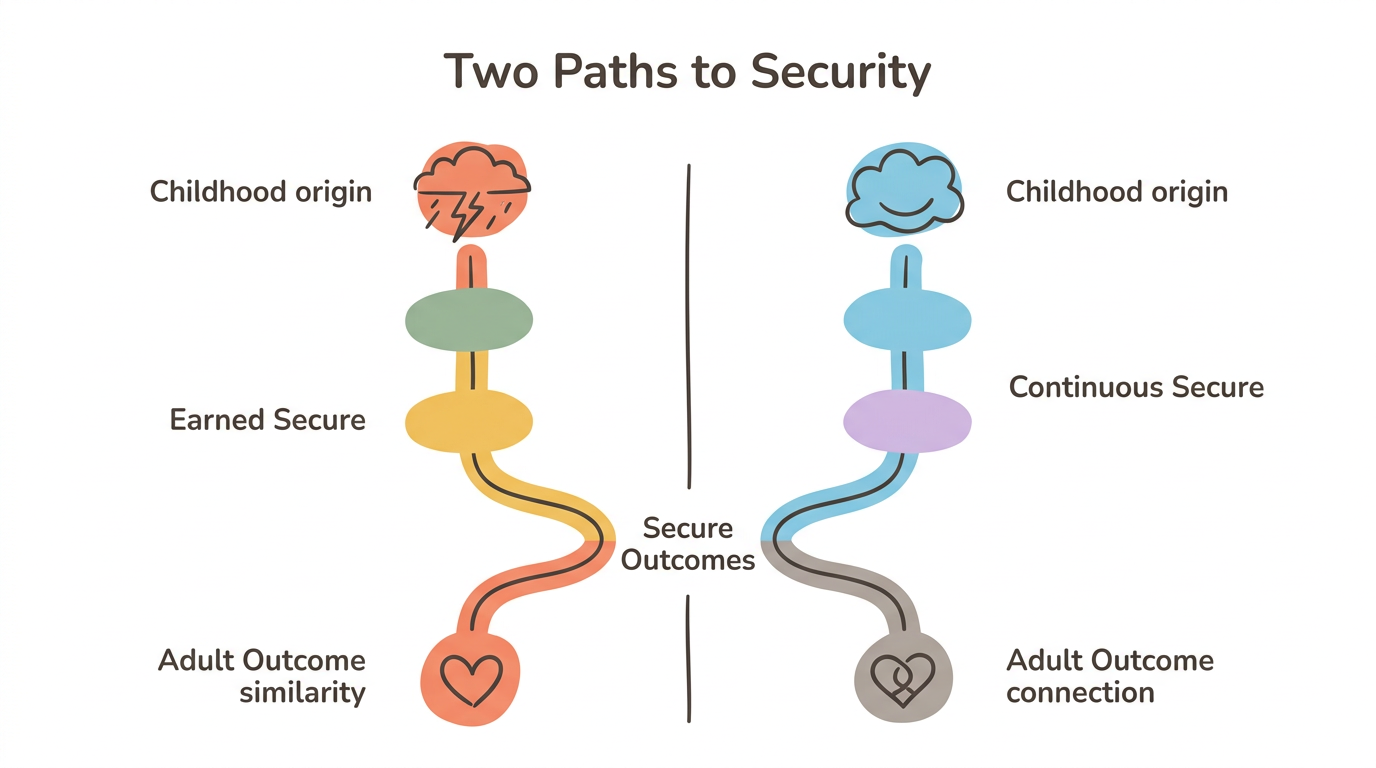
One additional nuance worth noting: Roisman et al. (2002) found that earned-secures were not more likely to have been anxiously attached in infancy. Many had actually received relatively supportive maternal parenting, challenging the simple "terrible childhood overcome" narrative. Earned security may be less about overcoming neglect and more about integrating complex, mixed experiences into a coherent story.
The Mentalization Moment
- Think of a recent conflict with someone you care about
- Write what you think they were feeling and why
- Write what you were feeling and why
- Notice where you can hold both perspectives simultaneously without dismissing either one
- This dual-perspective capacity is mentalization — and practicing it is one of the core skills of earned security
What Are the Pathways to Earning Secure Attachment?
Research identifies four primary pathways to earned security: therapy, secure romantic relationships, alternative support figures, and intentional self-reflection. Chopik (2024) found that people tend to change in the direction of their goals, meaning that simply wanting to become more secure — and taking action toward that goal — is itself a meaningful factor.
Secure Romantic Relationships
Main and Hesse's research suggests that if one partner has a secure attachment style, the insecure partner can develop earned security in 3-5 years without therapeutic intervention (cited in Firestone, 2018). A secure partner provides a living, breathing corrective experience — consistent responsiveness that gradually rewires your expectations of relationships.
Alternative Support Figures
Saunders et al. (2011) found in Attachment & Human Development that alternative support figures play a critical role in pathways to earned security. Grandparents, teachers, coaches, mentors, and close friends can serve as secondary attachment figures. Their research showed that insecure attachers as young as 20 can benefit from healthy romantic relationships — you do not need decades of therapy to begin shifting.
Evidence-Based Therapeutic Approaches
For those seeking professional support, six therapeutic modalities have the strongest evidence base for attachment healing:
- Emotionally Focused Therapy (EFT) — targets attachment bonds directly through corrective emotional experiences between partners, with a 70-75 percent recovery rate for distressed couples (Johnson)
- Internal Family Systems (IFS) — builds Self-leadership that mirrors secure attachment, helping protective parts feel safe, seen, soothed, and secure
- Schema Therapy — uses limited reparenting where the therapist models reliable attunement and secure base functioning
- EMDR — processes relational trauma through bilateral stimulation and reprocessing of attachment memories
- Mentalization-Based Treatment (MBT) — Fonagy's approach that directly builds the reflective functioning capacity central to earned security
- Polyvagal-Informed Therapy — uses co-regulation where the therapist's calm nervous system helps the client's nervous system learn safety
The Secure Base Inventory
- List 3-5 people in your life, past or present, who made you feel genuinely safe
- For each person, write one specific moment they showed attunement — a time they noticed what you needed without you having to explain
- Notice: these are your alternative attachment figures, and their influence lives in your nervous system
- Consider: who in your current life could serve this role going forward?
What Does Earned Security Feel Like in Your Body?
Earned security feels like your nervous system developing the flexibility to move through activation and return to calm — what polyvagal theory calls vagal flexibility. Your body learns that connection is safe, that conflict is survivable, and that you can tolerate vulnerability without shutting down or spiraling.
Polyvagal theory describes three nervous system states. Dorsal vagal shutdown — numbness, withdrawal, emotional flatness — is common in avoidant attachment. Sympathetic activation — hypervigilance, racing heart, scanning for threats — is common in anxious attachment. Ventral vagal engagement — warmth, openness, social connection — is the state associated with security. What earned security feels like in the body is not permanent ventral vagal calm. It is the capacity to notice when you leave it and find your way back.
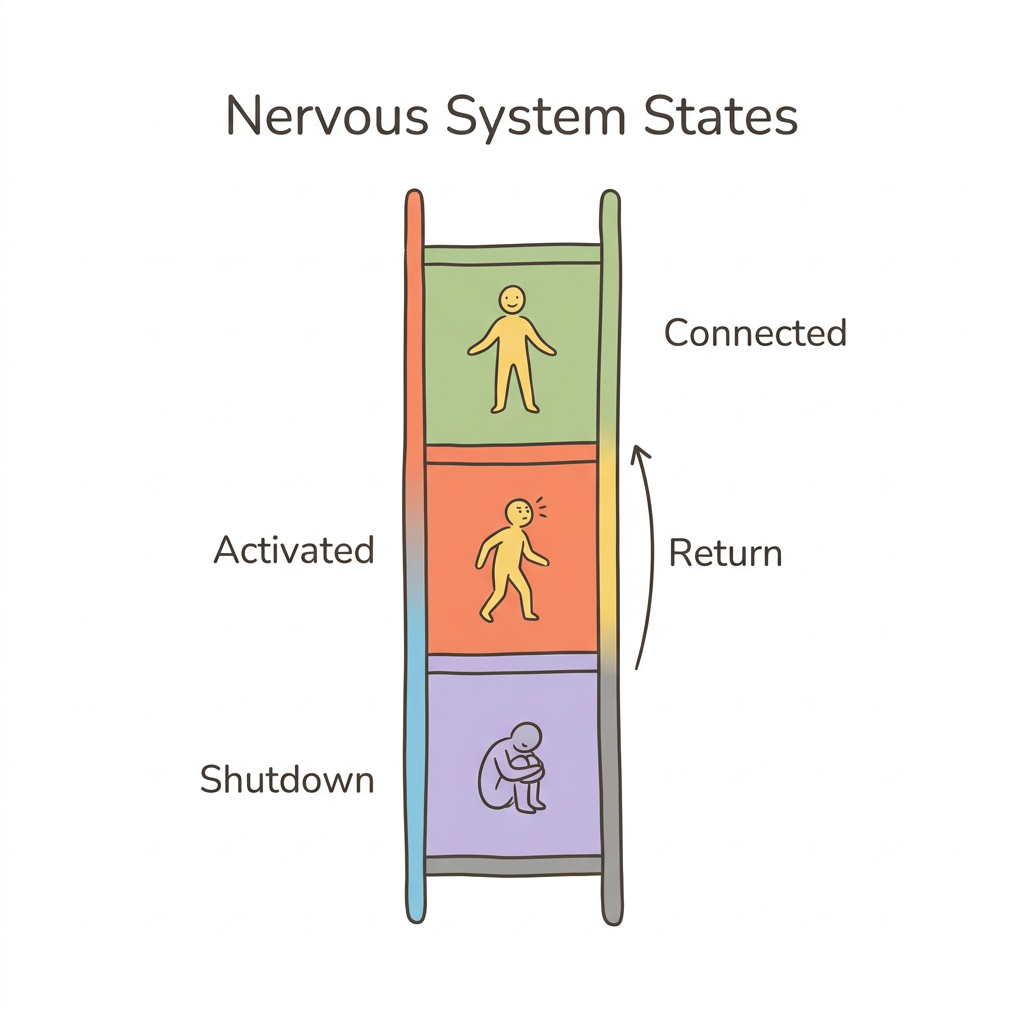
The neuroscience supports this felt experience. Lemche et al. (2006) found through fMRI that bilateral amygdala activity is highly positively correlated with attachment insecurity — earned security likely involves dampening this threat reactivity over time. Kidd et al. (2013) showed that secure attachment optimizes the oxytocin system, which inhibits HPA-axis stress reactivity, meaning your cortisol response to relational stress literally changes. Schore's research on neuroplasticity demonstrates that the brain can literally rewire through later benevolent relationships — top-down processing enables repair of early maladaptive attachment patterns.
The Vagal Flexibility Body Scan
- Sit comfortably and close your eyes for 30 seconds
- Recall a mildly stressful relational moment — notice where tension lands in your body (jaw, chest, stomach, shoulders)
- Now recall a moment of genuine connection with someone safe — notice what shifts in those same areas
- Practice toggling between the two memories slowly, noticing your body's capacity to return to the settled state
- This toggle is vagal flexibility — the somatic signature of earned security. Your nervous system is learning that activation does not have to be permanent
How Long Does It Take to Develop Earned Secure Attachment?
Developing earned secure attachment typically takes years of consistent relational experience, not weeks or months. Main and Hesse's research indicates 3-5 years with a secure partner as a timeline for developing earned security without formal therapy (cited in Firestone, 2018). With therapy, Emotionally Focused Therapy shows a 70-75 percent recovery rate for distressed couples, though individual timelines vary based on attachment history and trauma complexity.
Chopik (2024) found that approximately 50 percent of people shift attachment styles over a two-year period. This suggests that meaningful change is common — but earned security is not a finish line but an ongoing practice. The Roisman et al. (2002) finding about elevated depressive symptoms in earned-secure individuals underscores this point: earning security does not mean your nervous system forgets what it learned in childhood. It means you build new capacities alongside those old sensitivities.
You do not rewire attachment in a single insight. You rewire it by noticing your pattern 10 percent earlier, responding 10 percent differently, 10 percent more often. Progress is not the absence of activation — it is the speed of your recovery.
The Progress Markers Journal
- Write down 3 situations from the past year where you responded to relational stress differently than you would have before
- Note what you did instead of your old pattern — did you speak up instead of withdrawing? Pause instead of pursuing? Ask for reassurance directly instead of testing?
- These shifts are evidence of your nervous system rewiring
- Revisit this list monthly to track your trajectory — earned security becomes visible in retrospect
How Does Earned Security Break Intergenerational Attachment Patterns?
Earned-secure parents raise securely attached children at the same rate as continuously secure parents (Roisman et al., 2002). This finding is among the most powerful in attachment research: your childhood does not have to become your child's childhood. The mechanism behind intergenerational transmission is reflective functioning — parents who can mentalize their own childhood pain do not unconsciously repeat it with their children.
Fonagy's research on reflective functioning shows that a parent's capacity to understand their own mind — why they react the way they do, what their triggers are, what their unmet needs look like — directly predicts their child's attachment security. The parent does not need a perfect childhood. The parent needs a coherent narrative about their imperfect one.
A case study published in the American Journal of Psychotherapy (2016) documented avoidant personality disorder remission through the earned-security pathway, demonstrating that even deeply entrenched relational patterns can shift. The work you do on yourself directly protects your children — not by eliminating your wounds, but by preventing those wounds from operating outside your awareness.
Letter to Your Inner Child
- Write a brief letter to yourself at age 7 — tell that child what you needed to hear from a caregiver
- Now write what you would say to your own child, real or imagined, in a similar situation
- Notice: the gap between what you received and what you can now offer is your earned security
- This capacity to give what you did not get is not weakness or overcompensation — it is the direct result of your reflective work
When Should You Seek Professional Help for Attachment Healing?
Professional support becomes important when attachment patterns cause persistent relationship distress that self-reflection alone cannot resolve, when trauma history is complex — especially for those with disorganized attachment — or when depressive symptoms accompany the journey toward earned security.
Seeking help IS a secure behavior. The willingness to trust another person with your vulnerability — to let a therapist see your pain and help you make sense of it — is itself a corrective attachment experience. It demonstrates the exact capacity that earned security requires: reaching toward connection instead of managing everything alone.
Specific evidence-based modalities for attachment healing include Emotionally Focused Therapy for couples seeking to rebuild trust and communication, Internal Family Systems or Schema Therapy for individual attachment work, Mentalization-Based Treatment for building reflective functioning, and EMDR for processing specific attachment traumas. For those with disorganized attachment — a combination of anxious and avoidant patterns often rooted in frightening or unpredictable caregiving — professional guidance is especially valuable, as the contradictory impulses of "come close" and "go away" can be difficult to untangle without support.
The Roisman et al. (2002) finding that 40 percent of earned-secures exceed clinical depression cutoffs is not a reason to avoid the journey — it is a reason to have support along the way. Your nervous system learned its original patterns for good reason. It kept you safe. A skilled therapist helps you honor that adaptation while building something new.
Therapy Readiness Reflection
- Rate your current relationship distress on a scale from 1 to 10
- List your top 3 attachment-related struggles — the patterns you keep repeating
- Write what you hope would change with professional support
- Use this as a starting point for an initial therapy session — arriving with clarity about what you want to work on is itself a sign of reflective capacity
Frequently Asked Questions
Can you change your attachment style?
Yes. Research by Chopik (2024) found that approximately 50 percent of people shift attachment styles over a two-year period, and people tend to change in the direction of their goals. Therapy, secure relationships, and intentional self-reflection are the primary pathways to earned security. Attachment is a pattern shaped by experience, not a permanent personality trait.
How long does it take to develop earned secure attachment?
Research by Main and Hesse suggests 3 to 5 years with a secure romantic partner without therapy. With therapeutic support, Emotionally Focused Therapy shows a 70 to 75 percent recovery rate for distressed couples. Most people notice meaningful shifts within 1 to 2 years of consistent relational and reflective work, though earning security is an ongoing practice rather than a fixed endpoint.
Is earned secure attachment the same as secure attachment?
Functionally, earned-secure individuals parent, relate, and regulate emotions comparably to continuously secure people. Earned-secures may even outperform continuous-secures on reflective functioning (Fonagy et al., 1997). The main differences are elevated depressive symptoms in earned-secures and the conscious, intentional quality of their relational skills versus the more intuitive regulation of continuous-secures.
Can you become securely attached without therapy?
Yes. Saunders et al. (2011) found that alternative support figures — grandparents, teachers, mentors, and romantic partners — play a critical role in pathways to earned security. Healthy relationships and intentional self-reflection can foster earned security without formal therapy. However, complex trauma histories, especially those involving disorganized attachment, often benefit from professional guidance.
What does earned secure attachment look like in relationships?
Earned-secure individuals communicate needs clearly, tolerate closeness without losing independence, repair conflicts effectively, and mentalize their partner's perspective. They may still feel activated by old triggers — a flash of anxiety when a partner withdraws, a pull toward shutting down during conflict — but they can regulate that activation and return to connection rather than defaulting to anxious or avoidant patterns.
How do I know if I have earned secure attachment?
Key signs include discussing painful childhood memories with coherence rather than overwhelming emotion or dismissal, maintaining stable adult relationships, seeking support when distressed rather than isolating, and reflecting on your own relational patterns with curiosity instead of shame. The formal assessment is Mary Main's Adult Attachment Interview, which evaluates the coherence of your autobiographical narrative.
Can avoidant attachment be healed?
Yes. A case study published in the American Journal of Psychotherapy (2016) documented avoidant personality disorder remission through the earned-security pathway. Key mechanisms include building tolerance for vulnerability, developing reflective functioning, and experiencing corrective relational experiences where reaching toward others is met with consistent responsiveness. You can learn more about recognizing avoidant patterns as a starting point.
How does earned security affect parenting?
Earned-secure parents raise securely attached children at the same rate as continuously secure parents, according to Roisman et al. (2002). The mechanism is reflective functioning — parents who have processed their own attachment wounds can attune to their children's emotional needs without unconsciously projecting unresolved pain. The work of earning security directly benefits the next generation.
Want to Go Deeper?
Meadow includes a structured assessment to help you understand your specific attachment patterns, followed by a 66-day program of daily practices designed to build earned security.
Start your free week →References
Foundational Attachment Research
- Main, M., Goldwyn, R., & Hesse, E. (2003). Adult Attachment Interview classification system. University of California, Berkeley.
- Roisman, G. I., Padrón, E., Sroufe, L. A., & Egeland, B. (2002). Earned-secure attachment status in retrospect and prospect. Child Development, 73(4), 1204–1219.
- Fonagy, P., Target, M., Steele, H., & Steele, M. (1997). Reflective functioning and attachment. Development and Psychopathology, 9(4), 679–700.
Recent Reviews and Longitudinal Studies
- Filosa, M., Sharp, C., Gori, A., & Musetti, A. (2024). Earned secure attachment: A scoping review of 24 empirical studies. Psychological Reports.
- Chopik, W. (2024). Attachment style change across the lifespan. Social and Personality Psychology Compass.
- Saunders, R., Jacobvitz, D., Zaccagnino, M., Beverung, L. M., & Hazen, N. (2011). Pathways to earned security: The role of alternative support figures. Attachment & Human Development, 13(4), 403–420.
- Cassidy, J., Stern, J. A., Mikulincer, M., Martin, D. R., & Shaver, P. R. (2019). Influences on care for others: Earned security, self-compassion, and grounded theory study of earned security.
Neuroscience
- Lemche, E., Giampietro, V. P., Surguladze, S. A., Amaro, E. J., Andrew, C. M., Williams, S. C. R., ... & Phillips, M. L. (2006). Human attachment security is mediated by the amygdala: Evidence from combined fMRI and psychophysiological measures. Human Brain Mapping, 27(8), 623–635.
- Kidd, T., Hamer, M., & Steptoe, A. (2013). Examining the association between adult attachment style and cortisol responses to acute stress. Psychoneuroendocrinology, 36(6), 771–779.
- Schore, A. N. Attachment, affect regulation, and the developing right brain. Various publications on neuroplasticity and attachment.
Therapeutic Approaches
- Johnson, S. M. Emotionally Focused Therapy: 70–75% recovery rate for distressed couples. Various publications.
- Firestone, L. (2018). Attachment in couple therapy. Presentation at California Psychological Association of Psychoanalysis (CPAP).
- American Journal of Psychotherapy (2016). Avoidant personality disorder remission via earned-security pathway. American Journal of Psychotherapy, 70(3), 233–250.
Polyvagal and Somatic
- Porges, S. W. Polyvagal theory and attachment integration. Via Unyte/Integrated Listening Systems.
- Graham, L. Neuroscience of attachment rewiring. Linda Graham, MFT.
This article is for educational purposes only and is not a substitute for professional mental health care. If you are experiencing significant distress related to attachment patterns, please consult a licensed therapist who specializes in attachment-based approaches. Meadow content is informed by research but does not constitute clinical advice.