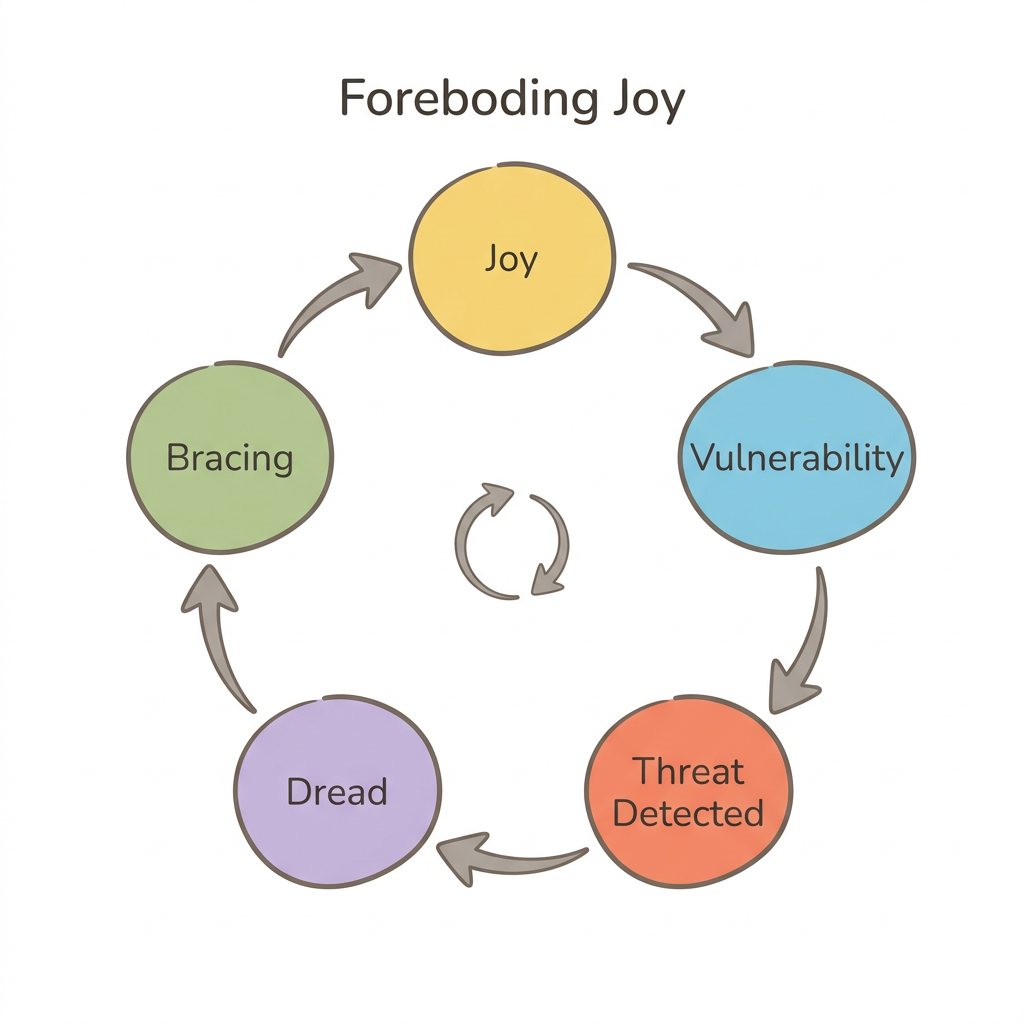
Feeling anxious when your relationship is going well is a recognized psychological phenomenon called foreboding joy — the experience of dreading loss at the very moment you feel happiest. Approximately 20 percent of adults have an anxious attachment style (Hazan & Shaver, 1987), and a meta-analysis of 42 studies found a significant correlation between insecure attachment and anxiety, with an effect size of r = 0.31 (Zhang et al., 2025).
If you have ever felt a sudden wave of dread while cuddling on the couch, or had the thought "this is too good to last," you are not broken. Your nervous system learned to associate closeness with vulnerability — and vulnerability with danger. This article explains the neuroscience and attachment science behind that pattern, and offers body-based and psychological tools to rewire it. The hopeful truth is that earned security is real, measurable, and available to you.
Key takeaway: Feeling anxious when your relationship is going well is called foreboding joy. Your nervous system learned early that happiness signals vulnerability and potential loss. This is not a flaw in you or your relationship. It is your attachment system trying to protect you. With somatic practices, parts work, and gradual exposure to safety, you can build earned security and let yourself feel joy without bracing for disaster.
What Is Foreboding Joy and Why Does Happiness Trigger Anxiety?
Foreboding joy is what researcher Brené Brown calls "dress-rehearsing tragedy" — the moment happiness arrives, your mind immediately fast-forwards to losing it. Brown's research found that 95 percent of parents in her study experienced this phenomenon. As she puts it: "When we lose our tolerance for vulnerability, joy becomes foreboding."
This experience is amplified in people with insecure attachment. Bowlby's concept of internal working models explains why: early inconsistent caregiving creates mental blueprints where love equals danger. If a caregiver was sometimes warm and sometimes absent, your developing brain learned that good moments are unreliable — that happiness is the setup before the letdown. As an adult, these models run in the background, unconsciously scanning every tender moment for evidence of coming loss.
The mechanism is straightforward. Joy requires vulnerability. Vulnerability means something can be taken away. And your attachment system, shaped by years of experience, would rather brace for impact than be blindsided. If you recognize yourself in these 12 signs of anxious attachment, foreboding joy may be especially familiar to you.
Your nervous system learned this response for good reason. It kept you safe. And now you can begin teaching it something new.
"Name the Rehearsal" Journaling Exercise
- When you notice anxiety during a good moment, pause
- Write: "Right now I am happy about ___"
- Write: "The disaster I am rehearsing is ___"
- Write: "The evidence this disaster is happening right now is ___"
- Practice Brown's antidote: write one specific thing you are grateful for in this moment
- Repeat this whenever foreboding joy appears — gratitude practiced in the moment of joy is what builds resilience
Why Does Your Nervous System Treat Safety as a Threat?
Your nervous system can perceive danger even when no actual threat exists — a process Stephen Porges calls neuroception. Neuroception is the unconscious evaluation your body constantly performs, scanning for cues of safety or danger well below conscious awareness (Porges, 2022). When developmental trauma or inconsistent caregiving has calibrated this system toward threat detection, the ventral vagal state — the branch of your nervous system that enables calm connection — feels unfamiliar and even alarming.
Safety feels unfamiliar to a nervous system trained on unpredictability. When your earliest experiences taught you that calm moments preceded storms, your body learned to read relationship stability as "the calm before the storm." A quiet evening together, a kind text for no reason, a partner who shows up consistently — these signals of safety can paradoxically trigger your threat response. This is the same nervous system activation that fires when your partner does not text back, except now it is firing in the absence of any problem at all.
Your body is protecting you from a danger that no longer exists. This is not weakness. This is activation. And the path forward is not forcing yourself to relax — it is gradually teaching your nervous system that connection can be safe.
"Ventral Vagal Activation" Body Exercise
- Place one hand on your chest and one on your belly
- Take 3 slow breaths where the exhale is twice as long as the inhale — for example, 4 seconds in, 8 seconds out
- Hum gently on each exhale (humming stimulates the vagus nerve)
- Notice any shift in your body — warmth, softness, settling
- Practice this during a calm moment with your partner to train your nervous system that connection equals safety
- Even 30 seconds of this can begin shifting your nervous system out of threat mode
What Happens in Your Brain When Love Feels Dangerous?
Neuroscience research reveals three specific brain mechanisms that drive relationship anxiety, even in objectively safe partnerships. Understanding what is happening in your brain can help you respond to anxiety with curiosity rather than fear.
Three brain mechanisms driving relationship anxiety:
-
Amygdala hyperactivation — Anxiously attached individuals show heightened activation in the amygdala when processing social and emotional stimuli. Research published in PLOS ONE found that higher attachment anxiety correlates with greater amygdala response to negative social scenes, even during passive viewing. Your threat detector fires at full volume even during safe moments.
-
Reduced prefrontal regulation — Higher attachment anxiety predicts reduced theta power in the right dorsolateral prefrontal cortex during emotional reappraisal (BMC Neuroscience, 2021). In plain language, your thinking brain has less capacity to regulate your feeling brain. The brake pedal for emotions has less power.
-
Cortisol dysregulation — Powers and colleagues (2006) found that anxiously attached women showed elevated cortisol levels that remained high longer, even when receiving positive support from their partner. Cortisol stays elevated even during reassurance. Your stress response system does not downregulate normally in response to comfort.
These are not character flaws. They are neural patterns shaped by experience — and experience can reshape them.
"Brain Narration" Mindfulness Technique
- When anxiety spikes in a good moment, silently narrate: "My amygdala is activating right now"
- Add: "This is a learned response, not current-moment danger"
- Engage your prefrontal cortex by naming 3 specific, concrete things you can see or touch right now
- Notice the shift from emotional reactivity to observational awareness
- This takes approximately 30 seconds and directly activates the brain region that regulates your threat response
Is Your Anxiety a Protective Part Trying to Keep You Safe?
The anxiety is not you — it is a part of you. Internal Family Systems (IFS), a therapeutic model recognized as evidence-based by SAMHSA, offers a powerful reframe. Rather than treating relationship anxiety as a disorder to eliminate, IFS understands it as a protective part — an inner manager that learned during childhood that scanning for danger kept you safe.
Richard Schwartz, IFS founder, emphasizes that all parts have positive intent. Your anxious part is not sabotaging you. It is working overtime to prevent the kind of pain you experienced early in life. The part that whispers "do not trust this" or "something bad is coming" developed that strategy because, at some point, it was right. The problem is not the part — it is that the part does not know the situation has changed.
IFS helps you access what Schwartz calls Self energy — a core state of compassion, curiosity, and calm that exists beneath all protective parts. From this place, you can relate to your anxiety with understanding rather than frustration. If your partner shows signs of avoidant attachment, your protective parts may be working especially hard, interpreting their need for space as confirmation of your deepest fears.
"Parts Dialogue" Exercise
- Find a quiet space. Close your eyes and locate the anxiety in your body — is it in your chest, stomach, or throat?
- Internally say to that part: "I see you. I know you are trying to protect me."
- Ask: "What are you afraid will happen if I let myself be happy?"
- Listen without judgment. Write down what comes up.
- Respond: "Thank you for protecting me. I am safe right now. You can rest."
- You may not feel an immediate shift. That is normal. The practice is the relationship-building with your own inner system.
How Can You Tell the Difference Between Anxiety and Intuition?
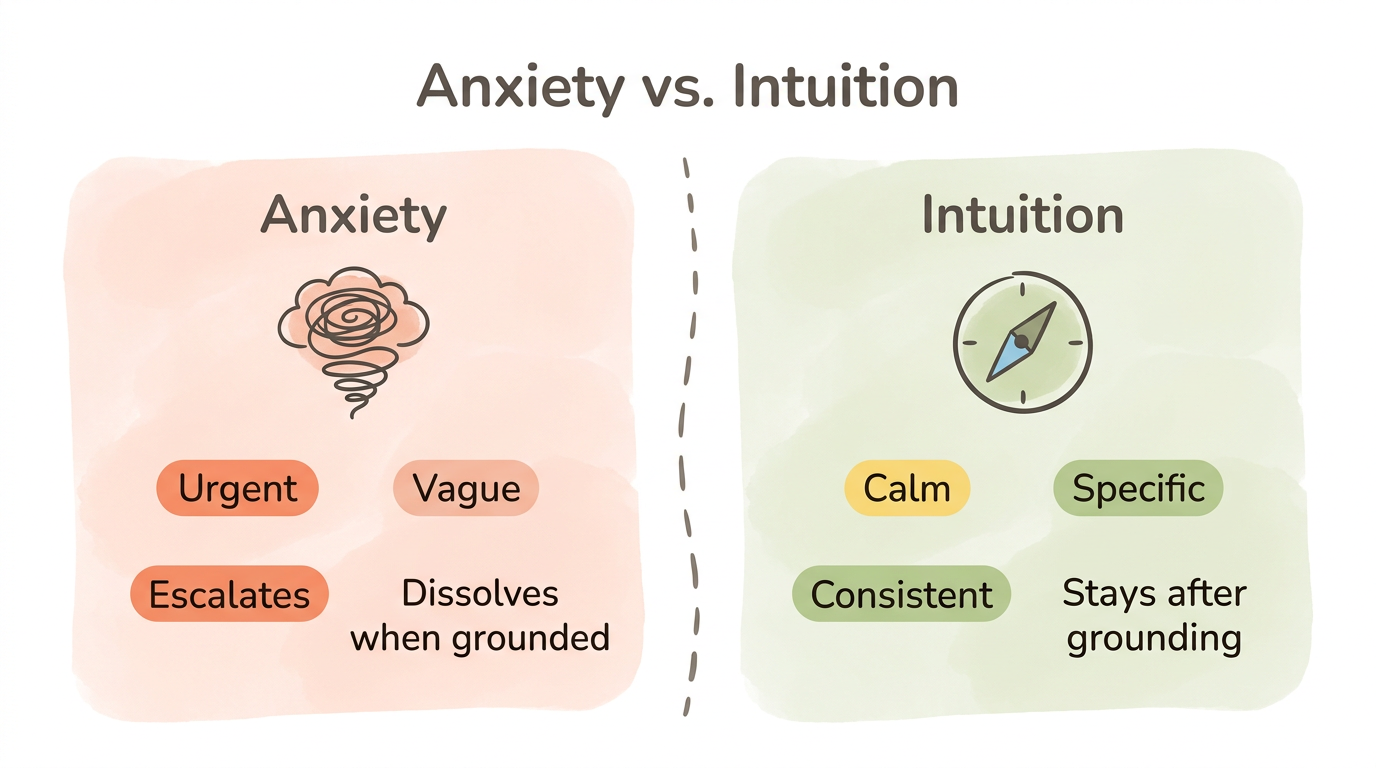
Anxiety is a story about the past projected onto the present. Intuition is a quiet signal rooted in present-moment observation. This distinction matters enormously, because anxious attachment can make every nervous feeling seem like a warning sign — when most of the time, it is your attachment system replaying old patterns.
Your attachment style is the filter through which all relationship signals pass. If you have anxious attachment, your default signal is much more likely anxiety than intuition. That does not mean you should ignore all uncomfortable feelings. It means you need a framework for sorting them.
Five distinctions between anxiety and intuition:
- Anxiety feels urgent and panicky; intuition feels calm and steady
- Anxiety generalizes ("everything will go wrong"); intuition is specific ("this particular thing concerns me")
- Anxiety escalates when you pay attention to it; intuition stays consistent
- Anxiety often connects to a childhood pattern you can identify; intuition does not trace back to old wounds
- Anxiety responds to soothing and grounding; genuine intuition remains after you have calmed down
| Feature | Relationship Anxiety | Genuine Intuition |
|---|---|---|
| Emotional tone | Panicky, urgent, desperate | Calm, steady, clear |
| Focus | Past patterns projected forward | Present-moment observations |
| Specificity | Vague, catastrophic ("everything will fall apart") | Specific, concrete ("this behavior concerns me") |
| Body sensation | Tight chest, racing heart, whole-body activation | Quiet knowing, gut sense without panic |
| When you ground yourself | Diminishes with breathing and soothing | Remains consistent after calming |
| Connection to history | Mirrors childhood experiences | Unrelated to past patterns |
| Response to reassurance | Temporarily helps, then returns | Reassurance does not change the feeling |
Intuition arrives with clarity; anxiety arrives with chaos. If you ground yourself using the ventral vagal breathing exercise above and the feeling dissolves, it was almost certainly anxiety. If it remains — quiet, specific, and unchanged — pay attention.
What Is Earned Security and How Do You Build It?
Earned security is the capacity to develop secure attachment patterns as an adult, even if you did not have them growing up. This is not wishful thinking — it is documented in neuroscience research. A study published in Social Cognitive and Affective Neuroscience found that security priming — simply visualizing a person who makes you feel safe — reduces amygdala activation to social threat. Your brain can be rewired through repeated experiences of safety.
The clinical evidence is equally compelling. Emotionally Focused Therapy (EFT) has the largest effect size of any couples intervention at d = 1.3, and Wiebe and colleagues (2016) found these results were maintained at two-year follow-up. EFT works by identifying the negative interaction cycles driven by attachment fears and creating new bonding experiences that gradually update your internal working models.
You do not rewire attachment in a single insight. You rewire it by noticing 10 percent earlier, responding 10 percent differently, 10 percent more often. Earned security is built through:
- Consistent safe relationships — with a partner, therapist, friend, or community
- Somatic practices that teach your nervous system new baselines
- Therapy modalities like EFT, IFS, or Somatic Experiencing that address the root patterns
- Daily micro-practices that accumulate over weeks and months
"Security Priming" Visualization
- Close your eyes and bring to mind someone who has made you feel truly safe — a partner, friend, therapist, or even a pet
- Visualize a specific moment with them in detail — what you saw, heard, and felt
- Notice where safety lives in your body. Place a hand there.
- Breathe into that sensation for 60 seconds
- Practice daily — research shows this literally reduces amygdala threat response over time
- You can do this before a difficult conversation, during a moment of foreboding joy, or as a morning practice
When Should You Seek Professional Help for Relationship Anxiety?
Self-help tools are a meaningful starting point, and they are not always enough. You deserve support, not just strategies. Professional help is not a sign of failure — it is often the fastest path to earned security.
Five signs it is time to seek professional support:
- Your anxiety persists despite consistent use of grounding and somatic techniques
- You find yourself avoiding intimacy or actively sabotaging relationships to manage the anxiety
- You experience physical symptoms such as insomnia, appetite changes, or panic attacks connected to relationship stress
- Your anxiety is affecting your partner — they feel they cannot reassure you enough, or they are walking on eggshells
- You recognize that your patterns repeat across multiple relationships regardless of the partner
Therapy is not a sign of failure — it is the fastest path to earned security. Specific modalities to look for include Emotionally Focused Therapy for couples work, Internal Family Systems or Somatic Experiencing for individual attachment work, and DBT skills training for managing acute anxiety spikes. When choosing a therapist, ask whether they have specific training in attachment theory — not all therapists do.
Frequently Asked Questions
Is it normal to have anxiety in a healthy relationship?
Yes — roughly 20 percent of adults have anxious attachment, and a meta-analysis of 42 studies found insecure attachment significantly correlates with anxiety at r = 0.31 (Zhang et al., 2025). Feeling anxious in a good relationship often reflects your attachment history, not your relationship quality. Relationship anxiety is common, treatable, and not a sign something is wrong with your partnership.
Do I have relationship anxiety or is it a gut feeling?
Relationship anxiety tends to feel urgent, generalized, and connected to past patterns — it often eases with grounding techniques like extended exhale breathing. Genuine intuition feels calm, specific, and persists even after you have self-soothed. If you have anxious attachment, your default signal is more likely anxiety than intuition. Use the grounding exercises in this article as a test.
Why do I self-sabotage when things are going well?
Self-sabotage is often a protective strategy driven by your attachment system. When happiness feels unfamiliar or dangerous, your nervous system may push you to create conflict or distance to return to a familiar emotional state — even if that state is painful. Internal Family Systems therapy calls this a protective part trying to minimize future hurt by ending things on your terms. Recognizing signs of anxious attachment can help you identify this pattern.
Can relationship anxiety go away?
Yes. Research on earned security shows that adults can develop secure attachment patterns through therapy and consistent safe relationships. Emotionally Focused Therapy has an effect size of 1.3 — the largest of any couples intervention — with results maintained at two-year follow-up (Wiebe et al., 2016). Change is gradual and non-linear, but it is neurologically real and measurable.
Why does love feel scary?
Love requires vulnerability, and vulnerability activates the attachment system. If early caregiving was inconsistent, your brain learned that love signals potential loss. Brené Brown's research found that 95 percent of people in her study experienced foreboding joy — dreading loss at the peak of happiness. Your amygdala is treating joy as a threat cue, not because love is actually dangerous, but because your nervous system was calibrated by early experience.
How can I stop overthinking in my relationship?
Overthinking is a hyperactivating strategy — your attachment system scanning for threats that are not present. Body-based techniques like extended exhale breathing and vagal toning are more effective than thought-based strategies alone because they directly regulate the nervous system driving the overthinking. The "Brain Narration" technique in this article can also help shift you from emotional reactivity to observational awareness in approximately 30 seconds.
Why do I push people away when I love them?
Pushing away can be a preemptive strike against anticipated abandonment. If your internal working model says "good things end painfully," creating distance feels safer than waiting for the other shoe to drop. IFS therapy frames this as a protective part that would rather end something on your terms than risk being blindsided. This pattern often intensifies when a partner shows avoidant attachment patterns.
Why do I feel like something bad is going to happen in my relationship?
This feeling is foreboding joy — a well-documented phenomenon where happiness triggers anticipatory dread. Your amygdala, calibrated by past experiences, treats joy as a vulnerability signal rather than a reward signal. Neuroscience research shows that anxiously attached individuals have heightened amygdala activation even during positive social moments. Gratitude practices and somatic grounding can gradually retrain this response over time.
Want to Go Deeper?
Meadow includes a structured assessment to help you understand your specific attachment patterns, followed by a 66-day program of daily practices designed to build earned security.
Start your free week →References
Attachment Theory and Psychology
-
Mikulincer, M., & Shaver, P. R. (2008). Adult attachment and cognitive and affective reactions to positive and negative events. Social and Personality Psychology Compass, 2(5), 1844–1865.
-
Bowlby, J. (1969/1982). Attachment and loss: Vol. 1. Attachment. Basic Books.
-
Hazan, C., & Shaver, P. (1987). Romantic love conceptualized as an attachment process. Journal of Personality and Social Psychology, 52(3), 511–524.
-
Bartholomew, K., & Horowitz, L. M. (1991). Attachment styles among young adults: A test of a four-category model. Journal of Personality and Social Psychology, 61(2), 226–244.
-
Zhang, J., et al. (2025). The relationship between insecure attachment and social anxiety: A three-level meta-analysis. Journal of Social and Personal Relationships.
-
Dagan, O., et al. (2020). Attachment and anxiety: A meta-analytic review of the Adult Attachment Interview. Journal of Anxiety Disorders, 70, 102188.
Neuroscience
-
Vrtička, P., et al. (2008). Individual attachment style modulates human amygdala and striatum activation during social appraisal. PLOS ONE, 3(8), e2868.
-
Zhang, X., et al. (2021). Neural basis of individual differences in attachment anxiety and avoidance. BMC Neuroscience, 22, 41.
-
Powers, S. I., et al. (2006). Dating couples' attachment styles and patterns of cortisol reactivity and recovery in response to a relationship conflict. Journal of Personality and Social Psychology, 90(4), 613–628.
-
Norman, L., et al. (2015). Activating the attachment system modulates neural responses to threat. Social Cognitive and Affective Neuroscience, 16(12), 1244–1258.
-
Porges, S. W. (2022). Polyvagal theory: A science of safety. Frontiers in Integrative Neuroscience, 16, 871227.
Clinical Approaches
-
Johnson, S. M. (2019). Attachment theory in practice: Emotionally focused therapy with individuals, couples, and families. Guilford Press.
-
Wiebe, S. A., et al. (2016). Two-year follow-up outcomes in emotionally focused couple therapy. Journal of Marital and Family Therapy, 43(4), 635–648.
-
Schwartz, R. C. (2001). Introduction to the Internal Family Systems model. Trailheads Publications. See also: IFS Institute model outline.
-
Payne, P., Levine, P. A., & Crane-Godreau, M. A. (2015). Somatic experiencing: Using interoception and proprioception as core elements of trauma therapy. Frontiers in Psychology, 6, 93.
-
Linehan, M. M. (2015). DBT skills training manual (2nd ed.). Guilford Press.
Foreboding Joy and Fear of Happiness
-
Brown, B. (2012). Daring greatly: How the courage to be vulnerable transforms the way we live, love, parent, and lead. Avery.
-
Joshanloo, M. (2014). Eastern conceptualizations of happiness: Fundamental differences with Western views. Journal of Happiness Studies, 15(2), 475–493. Cross-cultural study of fear of happiness across 14 countries.
-
Gilbert, P., et al. (2012). Fear of happiness and compassion in relationship with depression, alexithymia, and attachment security. PMC — Fear of Happiness Among College Students.
This article is for educational purposes only and is not a substitute for professional mental health advice, diagnosis, or treatment. If you are experiencing persistent anxiety that interferes with your daily life or relationships, please consult a licensed mental health professional.