Relationship anxiety is persistent worry about a partner's feelings, the relationship's stability, or your own worthiness of love—distinct from the normal butterflies of early dating. Thirty-four percent of Americans identify romantic relationships as their leading source of mental health concerns (Thriveworks Survey), making this far from a niche experience.
If you're reading this, you're likely exhausted by the constant vigilance, the reassurance-seeking, the pit in your stomach when a text goes unanswered. The good news from attachment science is clear—your brain built these patterns, and your brain can rebuild them. What follows is the evidence-based path from hyperactivation to earned security.
Key takeaway: Yes, relationship anxiety can significantly diminish. Research shows 44 percent of people shift attachment classifications over time, and therapies like Emotionally Focused Therapy produce large, lasting reductions in attachment distress. The path involves understanding your attachment system, regulating your nervous system, and building new neural pathways through repeated experiences of safety.
What Causes Relationship Anxiety in the First Place?
Relationship anxiety most often stems from hyperactivation of the attachment system—a learned survival strategy where your nervous system amplifies distress signals to keep a caregiver or partner close. Mikulincer and Shaver (2003/2008) describe this pattern as a chronic intensification of emotions like jealousy, fear, and anger that once served a protective function. Your body learned that love required vigilance, so it stayed vigilant.
Not all relationship anxiety has the same root. Competitors lump everything together, but three distinct sources drive the experience—and each responds to different interventions.
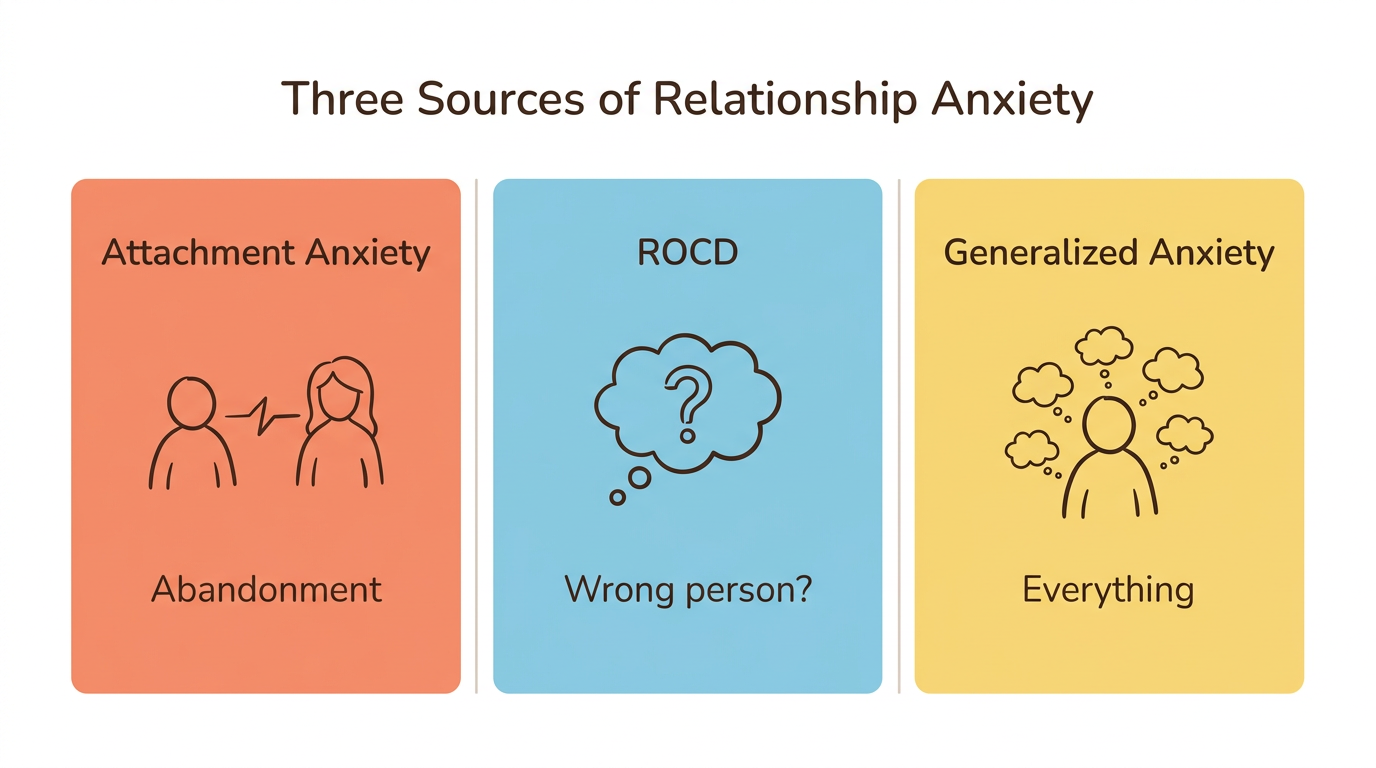
Attachment-driven anxiety involves protest behaviors like excessive texting, scanning for signs of withdrawal, or picking fights to test a partner's commitment. The underlying fear is abandonment.
Over 50 percent of OCD sufferers identify with ROCD symptoms (Doron et al., 2014)—intrusive, unwanted doubts like "Do I really love them?" or "Are they really right for me?" Unlike attachment anxiety, these thoughts feel ego-dystonic, meaning they clash with what you actually feel and want.
Generalized anxiety disorder shows up differently still. With 19.1 percent of US adults experiencing an anxiety disorder in any given year (NIMH), many people carry diffuse worry into their partnerships without it being attachment-specific.
Wondering which pattern fits you? This self-assessment can help clarify whether anxious attachment is at play, and learning to distinguish anxiety from intuition offers another lens.
The Three-Source Check-In is a quick way to identify which driver is strongest for you. Ask yourself three questions: (1) "Is my anxiety focused on my partner leaving or pulling away?" — if yes, attachment-driven anxiety is likely the root. (2) "Do my doubts feel intrusive and unwanted—like they don't match what I actually feel?" — if yes, ROCD is worth exploring. (3) "Do I worry this intensely about other areas of life too—health, work, finances?" — if yes, generalized anxiety may be the driver. Whichever question resonates most strongly can guide which sections of this article matter most for you. Identifying the source matters because attachment-driven anxiety responds to security priming and EFT, while ROCD requires Exposure and Response Prevention—applying the wrong strategy can actually reinforce the pattern.
What Does the Research Say About Whether Relationship Anxiety Can Change?
Attachment anxiety is modifiable, not permanent. Forty-four percent of individuals changed attachment classifications from infancy to early adulthood when exposed to significant life events, compared to only 22 percent without such events (Waters et al., 2000). Your attachment pattern is not a life sentence—it is a probability that shifts with experience.
A comprehensive scoping review of earned secure attachment confirmed that people with insecure childhood histories can develop secure patterns in adulthood through reflective functioning and coherent narrative integration (Filosa et al., 2024). Earned security means arriving at a secure way of relating not because your childhood gave it to you, but because you built it yourself. You can read more about what earned secure attachment actually looks like and the broader question of whether attachment style can change over time.
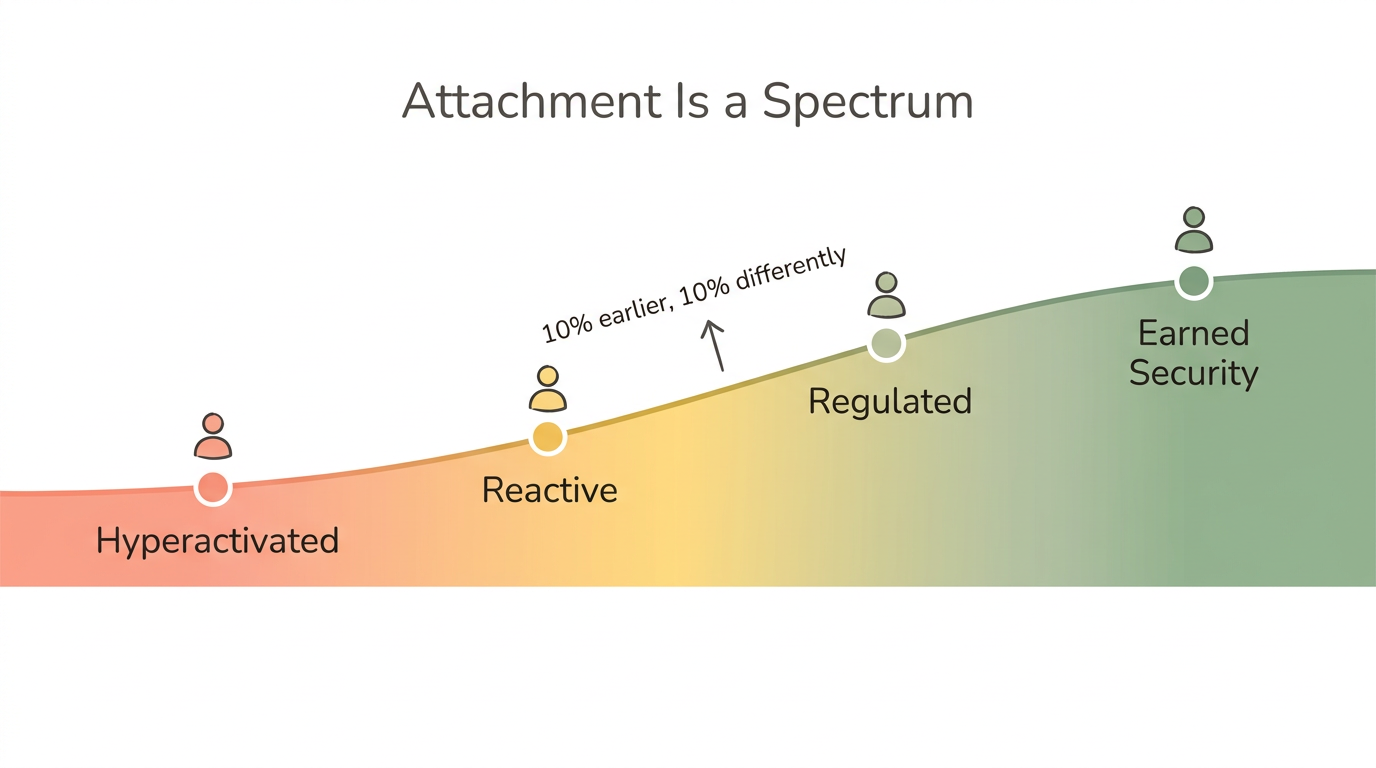
Here is the honest nuance most articles skip: relationship anxiety does not "go away" the way a cold resolves. Attachment is a spectrum, not a box. The hyperactivated system calms significantly with sustained work, but awareness and self-regulation become ongoing practices—more like maintaining physical fitness than curing an infection. That can feel discouraging when you want the anxiety to just stop. You do not rewire attachment in a single insight. You rewire it by noticing 10 percent earlier, responding 10 percent differently, 10 percent more often.
Your Attachment Timeline (for anxious attachment)
- List 5 significant relationships across your life—romantic, family, friendships
- For each one, rate your felt sense of security from 1 to 10
- Note what conditions were present in higher-security relationships (consistency? communication? shared humor?)
- Notice the variation—your system already shifts based on context
- Write one sentence about what you learn from the pattern
Anxiously attached individuals often catastrophize their pattern as permanent. Seeing variation across relationships demonstrates that your nervous system already knows how to feel safer—it just needs the right conditions more consistently.
What Happens in Your Brain and Body During Relationship Anxiety?
Your brain responds to relationship threats the same way it responds to physical danger—with activation that is fast, automatic, and hard to override with logic alone. Amygdala hyperactivation is a hallmark of insecure attachment, with anxiously attached individuals showing overactive bilateral amygdala responses during stress (Lemche et al., 2016). This makes sense when you consider the environment your nervous system was shaped by—one where love felt unreliable, so hypervigilance became the default.
That alarm system creates real, measurable changes in your body. Cortisol dysregulation—a flattened, elevated cortisol profile indicating chronic HPA axis activation—is associated with anxious attachment (Frontiers in Human Neuroscience). Your stress response stays partially activated even during calm moments. This deep dive into how attachment affects your nervous system explains the full polyvagal picture.
The oxytocin pathway offers another piece. Early relational stress can inhibit oxytocin production, leading to a hyperactive amygdala with poor prefrontal cortex connectivity (Feldman, 2017). Structural brain differences also appear—attachment anxiety correlates with ventral anterior cingulate volume (BMC Neuroscience, 2021). These are not signs of damage. They are signs of adaptation.
The pivot toward hope is neuroplasticity. These circuits can be rewired through repeated experiences of safety. Research identifies four conditions for neural rewiring: repetition, emotional engagement, attention, and safety. When those conditions are met—through therapy, secure relationships, or consistent self-practice—your brain literally builds new pathways for connection.
Ventral Vagal Anchor (somatic exercise for anxious attachment)
- Place one hand on the center of your chest
- Close your eyes and recall a specific moment when you felt genuinely safe with another person—a friend, family member, therapist, or partner
- Notice what happens in your body as you hold that memory: warmth, softening, a deeper breath
- Breathe slowly into the area under your hand—inhale for 4 counts, exhale for 6 counts
- Stay with this felt sense for 2 minutes, letting your body register safety without needing to analyze it
- When your mind wanders to worry, gently return to the memory and the sensation under your hand
This exercise activates the ventral vagal pathway—your social engagement system—counteracting the sympathetic activation that drives anxious protest behavior. Anxiously attached individuals often have a hyperactive threat detection loop; anchoring to a felt memory of safety gives your nervous system a competing signal that connection does not require vigilance.
Which Therapies Are Most Effective for Relationship Anxiety?
Emotionally Focused Therapy is the gold standard for couples dealing with attachment anxiety, with a meta-analytic effect size of d = 0.93 (Wiebe and Johnson, 2016). An earlier meta-analysis found an even larger effect of d = 1.3 (Johnson et al., 1999)—larger than any other couples intervention at the time. Treatment gains were maintained up to two years post-treatment (Johnson, 2020).
One finding stands out: higher attachment anxiety at therapy start predicted greater linear improvement in relationship satisfaction across EFT sessions (Predicting Follow-up Outcomes in EFT, 2016). The more anxious you are going in, the more you may benefit. EFT works by accessing the attachment emotions underneath defensive behaviors, restructuring negative interaction cycles, and creating new bonding events. You can explore more about how therapy changes attachment patterns.
| Therapy | Best For | Effect Size | Key Mechanism |
|---|---|---|---|
| EFT | Couples with attachment anxiety | d = 0.93 to 1.3 | Restructures attachment bonds |
| CBT | Cognitive patterns (catastrophizing, core beliefs) | g = 0.74 | Challenges abandonment beliefs |
| Attachment-Based Therapy | Individual attachment patterns | d = 1.25 | Repairs internal working models |
| ERP | Relationship OCD specifically | Strong clinical evidence | Exposure to doubts without compulsive checking |
CBT addresses the cognitive dimension effectively, with effect sizes of g = 0.74 for anxiety disorders (Carpenter et al., 2018). When combined with interpersonal and emotional processing, CBT showed added benefit beyond supportive listening alone for people with attachment anxiety and generalized anxiety (Newman et al., 2015).
For relationship OCD, Exposure and Response Prevention is the recommended treatment (IOCDF). ERP involves gradual exposure to anxiety-provoking relationship thoughts while resisting the urge to seek reassurance—a fundamentally different approach than attachment-focused work.
4 Questions to Ask When Choosing a Therapist for Relationship Anxiety:
- Do you work from an attachment framework?
- Are you trained in EFT, and if so, at what certification level?
- How do you distinguish between attachment anxiety and ROCD?
- What does your approach to nervous system regulation look like?
What Can You Do on Your Own to Reduce Relationship Anxiety?
You can reduce relationship anxiety through security priming, nervous system regulation, and cognitive reframing of protest behaviors—all of which have research support. Of these, security priming is the most studied. A systematic review of 30 studies with 3,459 participants found that security priming effectively reduces negative affect and increases positive affect, with medium-to-large effect sizes of η² = 0.18 to 0.22 (Carnelley and Rowe, 2020). Your nervous system learned insecurity through repeated experience—security priming teaches it something new through the same mechanism.
Repeated priming shows cumulative benefits. Effects lasted up to one month post-intervention in research settings, and multi-session designs were more effective at overcoming defensive patterns than single exposures (Carnelley and Rowe, 2020). Security priming also attenuates the intense rejection feelings that anxiously attached individuals typically report (Mikulincer and Shaver, 2007).
Nervous system regulation is the other essential pillar. Your attachment anxiety lives in your body as much as your thoughts—learning to self-soothe addresses the somatic dimension that cognitive strategies alone cannot reach. Combining body-based regulation with strategies to interrupt overthinking creates a more complete approach.
One honest caveat: you cannot fully heal an attachment wound in isolation. Self-help strategies build capacity and reduce reactivity, but attachment patterns formed in relationship ultimately shift most in relationship—with a therapist, a secure partner, or trusted friends who can offer consistent attunement. The goal of self-work is not to become self-sufficient, but to develop the internal foundation that allows you to receive connection when it is offered.
Daily Security Priming Practice (for anxious attachment)
- Close your eyes and recall a specific person who made you feel genuinely safe and accepted—someone whose presence settled your nervous system
- Notice what happens in your body as you hold them in mind: warmth, softening, deeper breath, relaxed shoulders
- Open your eyes and write 3 sentences about what made this person feel safe—be specific about behaviors, not just qualities
- Read your sentences aloud, slowly enough to let each one land
- Repeat daily for 21 days, using the same person or rotating among secure figures
Security priming directly counteracts the hyperactivated attachment system by activating mental representations of safety. Research shows cumulative repetition builds lasting change—each session is not a standalone exercise but a deposit in your nervous system's security account. This works for anxious attachment because it interrupts the chronic scanning-for-threat pattern and gives your brain repeated evidence that safe connection exists.
When Should You Seek Professional Help for Relationship Anxiety?
Your relationship anxiety warrants professional support when it begins to impair your daily functioning—not because something is wrong with you, but because your attachment system is signaling a need that self-help alone cannot meet. Seeking a therapist is not weakness. Seeking help is the attachment system working as designed—reaching toward a safe figure when distress exceeds your capacity to manage alone.
Specific thresholds to watch for: reassurance-seeking creating conflict cycles with your partner, anxiety disrupting your sleep or appetite, intrusive doubts that feel ego-dystonic (a potential signal of ROCD, which affects over 50 percent of OCD sufferers according to Doron et al., 2014), or the same anxiety pattern repeating across multiple relationships regardless of partner. Functional impairment—struggling to concentrate at work, withdrawing from friendships, or avoiding commitment entirely—is another clear signal.
Your nervous system learned to stay hypervigilant for good reason. There was a time when that vigilance kept you connected to someone you depended on. And now, a therapist trained in attachment can support you in building more of the safety your system has been searching for.
The Threshold Assessment below can help you gauge whether professional support would be beneficial. Answer yes or no to each: (1) Does your relationship anxiety interfere with your ability to focus at work or engage in other life areas? (2) Has reassurance-seeking become a source of conflict with your partner? (3) Do you experience intrusive, unwanted thoughts about your relationship that feel distressing and unlike your true feelings? (4) Are you experiencing physical symptoms—insomnia, appetite changes, chest tightness, or panic attacks—connected to relationship worry? (5) Has the same anxiety pattern shown up in three or more relationships, regardless of partner? Two or more "yes" answers suggest professional support would be beneficial. Anxiously attached individuals often either minimize their distress—believing everyone feels this way—or catastrophize it, believing they are fundamentally flawed. A structured threshold bypasses both tendencies and helps you see your experience clearly.
Relationship Anxiety vs. Relationship OCD vs. Generalized Anxiety
Understanding which type of anxiety you are experiencing determines which strategies will actually help. Applying attachment-focused techniques to ROCD, or treating generalized anxiety as though it were attachment-driven, can reinforce the very patterns you are trying to change.
| Attachment-Driven Anxiety | Relationship OCD (ROCD) | GAD in Relationships | |
|---|---|---|---|
| Core fear | Abandonment or partner leaving | "Am I with the right person?" or "Do I really love them?" | Catastrophizing about everything, including the relationship |
| Thought quality | Ego-syntonic (feels like "me") | Ego-dystonic (feels intrusive, unwanted) | Diffuse, shifts between topics |
| Primary trigger | Perceived distance or threat to bond | Can occur even when relationship is stable | Not relationship-specific |
| Key behavior | Protest behaviors, reassurance-seeking about partner's feelings | Mental checking, comparing partner to others, reassurance about own feelings | Worry spirals across life domains |
| Attachment system | Hyperactivated | May or may not involve insecure attachment | Not attachment-specific |
| Best treatment | EFT, attachment-based therapy, security priming | ERP (Exposure and Response Prevention) | CBT, medication if indicated |
| Can it diminish? | Shifts toward earned security with sustained work | Manageable with ERP; may recur under stress | Manageable with CBT or medication; often chronic |
Frequently Asked Questions
Does relationship anxiety go away on its own?
Rarely. Without intervention, attachment anxiety tends to remain stable or intensify over time. Research shows 44 percent of people changed attachment classifications, but this required significant life experiences—not passive waiting (Waters et al., 2000). Intentional work through therapy, self-regulation practices, or a consistently secure relationship accelerates change.
Is relationship anxiety normal?
Very common—34 percent of Americans cite romantic relationships as their top source of mental health concerns (Thriveworks Survey). Some nervousness early in relationships is expected and even healthy. Persistent anxiety that disrupts daily functioning, drives reassurance-seeking cycles, or repeats across relationships signals an attachment pattern worth addressing rather than dismissing.
How long does relationship anxiety last?
Without intervention, attachment patterns can persist for decades. With consistent effort—therapy, self-regulation practices, and secure relational experiences—meaningful shifts typically emerge within six to twelve months. EFT research shows treatment gains maintained up to two years post-therapy (Johnson, 2020). Full earned security is a gradual, ongoing process rather than a fixed destination.
Is relationship anxiety a sign you should break up?
Not necessarily. Attachment anxiety often intensifies in otherwise healthy relationships because closeness activates the attachment system's threat detection. The key question is whether your anxiety reflects a real incompatibility or a pattern you would carry into the next relationship. Learning to distinguish anxiety from intuition can help you evaluate this, and a therapist can support the discernment process.
Do I have relationship anxiety or am I not in love?
ROCD can make you doubt your feelings even when you love your partner deeply. The key differentiator: if the doubts feel intrusive, unwanted, and distressing—and you find yourself mentally checking whether you "really" love them—that points toward ROCD rather than genuine lack of feeling. Over 50 percent of OCD sufferers report relationship-focused symptoms (Doron et al., 2014).
Can relationship anxiety ruin a relationship?
Untreated relationship anxiety can create cycles of reassurance-seeking, protest behaviors, and emotional withdrawal that erode trust and intimacy over time. When you feel anxious even when things are going well, the resulting behaviors can push a partner away. However, when both partners understand the attachment dynamics, vulnerability can deepen connection rather than destroy it.
What triggers relationship anxiety?
Common triggers include perceived distance—delayed texts, canceled plans, a partner seeming distracted—as well as relationship transitions like moving in or getting engaged. A partner's friendships with potential rivals activate threat detection. Paradoxically, things going well can trigger anxiety too, because your nervous system may not trust stability if instability was your baseline.
Is relationship anxiety the same as anxious attachment?
Related but not identical. Anxious attachment is a broader relational pattern affecting how you approach closeness and separation across all relationships. Relationship anxiety is a symptom that can stem from anxious attachment, ROCD, generalized anxiety, or situational factors like a partner's actual unreliability. Identifying the source determines the most effective response.
Want to Go Deeper?
Meadow includes a structured assessment to help you understand your specific attachment patterns, followed by a 66-day program of daily practices designed to build earned security.
Start your free week →References
Attachment Theory and Change
- Mikulincer, M., & Shaver, P. R. (2003/2008). An overview of adult attachment theory. In Attachment Processes in Couple and Family Therapy. Guilford Press.
- Waters, E., Merrick, S., Treboux, D., Crowell, J., & Albersheim, L. (2000). Attachment security in infancy and early adulthood: A twenty-year longitudinal study. Child Development, 71(3), 684–689.
- Filosa, M., et al. (2024). Earned secure attachment: A scoping review. Psychological Reports. https://doi.org/10.1177/00332941241277495
- Fraley, R. C. Attachment stability and change. University of Illinois. https://labs.psychology.illinois.edu/~rcfraley/attachment.htm
Therapy Efficacy
- Wiebe, S. A., & Johnson, S. M. (2016). A review of the research in emotionally focused therapy for couples. Family Process, 55(3), 390–407.
- Johnson, S. M., Hunsley, J., Greenberg, L., & Schindler, D. (1999). Emotionally focused couples therapy: Status and challenges. Clinical Psychology: Science and Practice, 6(1), 67–79.
- Johnson, S. M. (2020). The practice of emotionally focused couple therapy: Creating connection. Current Opinion in Psychology, 36, 56–60.
- Carpenter, J. K., Andrews, L. A., Witcraft, S. M., Powers, M. B., Smits, J. A. J., & Hofmann, S. G. (2018/2023). Cognitive behavioral therapy for anxiety and related disorders: A meta-analysis. Journal of Anxiety Disorders. https://doi.org/10.1016/j.janxdis.2018.02.001
- Diamond, G. S., et al. (2016). Attachment-based family therapy for depressed adolescents. Family Process, 55(3), 595–610.
- Newman, M. G., Castonguay, L. G., Jacobson, N. C., & Moore, G. A. (2015). Adult attachment as a moderator of treatment outcome for GAD. Journal of Clinical Psychology, 71(12), 1172–1182.
- Predicting follow-up outcomes in emotionally focused couple therapy. (2016). Journal of Marital and Family Therapy, 42(4), 625–641.
Security Priming
- Carnelley, K. B., & Rowe, A. C. (2020). Priming a sense of security: What goes through people's minds? International Journal of Environmental Research and Public Health, 17(6), 2093.
- Mikulincer, M., & Shaver, P. R. (2007). Boosting attachment security to promote mental health, prosocial values, and inter-group tolerance. Psychological Inquiry, 18(3), 139–156.
Neuroscience
- Lemche, E., et al. (2016). Attachment anxiety and amygdala response in adults. Social Neuroscience, 11(2), 125–135.
- Feldman, R. (2017). The neurobiology of human attachments. Trends in Cognitive Sciences, 21(2), 80–99.
- BMC Neuroscience. (2021). Attachment dimensions and brain structure. BMC Neuroscience, 22, Article 17.
- Frontiers in Human Neuroscience. (2017). Cortisol dysregulation and adult attachment. Frontiers in Human Neuroscience, 11, Article 136.
- Porges, S. W. The polyvagal theory. Polyvagal Institute. https://www.polyvagalinstitute.org/whatispolyvagaltheory
Relationship OCD
- Doron, G., Derby, D. S., Szepsenwol, O., & Talmor, D. (2014). Tainted love: Exploring relationship-centered obsessive compulsive symptoms in two non-clinical cohorts. Journal of Obsessive-Compulsive and Related Disorders, 1(1), 16–24.
- International OCD Foundation. Relationship OCD. https://iocdf.org/expert-opinions/relationship-ocd/
Prevalence
- National Institute of Mental Health. Any anxiety disorder. https://www.nimh.nih.gov/health/statistics/any-anxiety-disorder
- Thriveworks. Research: Widespread relationship anxiety. https://thriveworks.com/blog/research-widespread-relationship-anxiety/
This article is for educational purposes only and is not a substitute for professional mental health treatment. If you are experiencing significant distress related to relationship anxiety, please consult a licensed therapist or counselor who specializes in attachment-based approaches.