You might have anxious attachment if you find yourself constantly monitoring relationships for signs of withdrawal, seeking frequent reassurance, and experiencing intense distress when connection feels uncertain. This pattern typically develops when early caregivers were inconsistently responsive, teaching your nervous system that love is unpredictable and must be vigilantly guarded.
Recognizing these patterns is not a diagnosis. It is information you can use.
What Anxious Attachment Actually Is
Anxious attachment—also called anxious-preoccupied or anxious-ambivalent—is an attachment style characterized by a strong desire for closeness paired with heightened sensitivity to rejection and a tendency to seek frequent reassurance. It is one of three insecure attachment styles first identified through Ainsworth's Strange Situation research (Ainsworth et al., 1978).
More specifically, anxious attachment is characterized by:
- A strong desire for closeness and intimacy
- Heightened sensitivity to signs of rejection or abandonment
- A tendency to seek frequent reassurance
- Difficulty trusting that relationships will last
Research suggests approximately 20–25% of adults have an anxious attachment pattern (Fraley & Shaver, 2000). It is common. It is also workable.
The 12 Signs
1. You Monitor Your Partner's Emotional State Constantly
You notice subtle shifts in tone, texting speed, or facial expression. A delayed response or a period of quiet feels like information you must decode. This hypervigilance was adaptive in childhood—helping you anticipate an unpredictable caregiver's availability. Now it creates exhaustion.
2. You Seek Reassurance Frequently—and It Never Quite Lasts
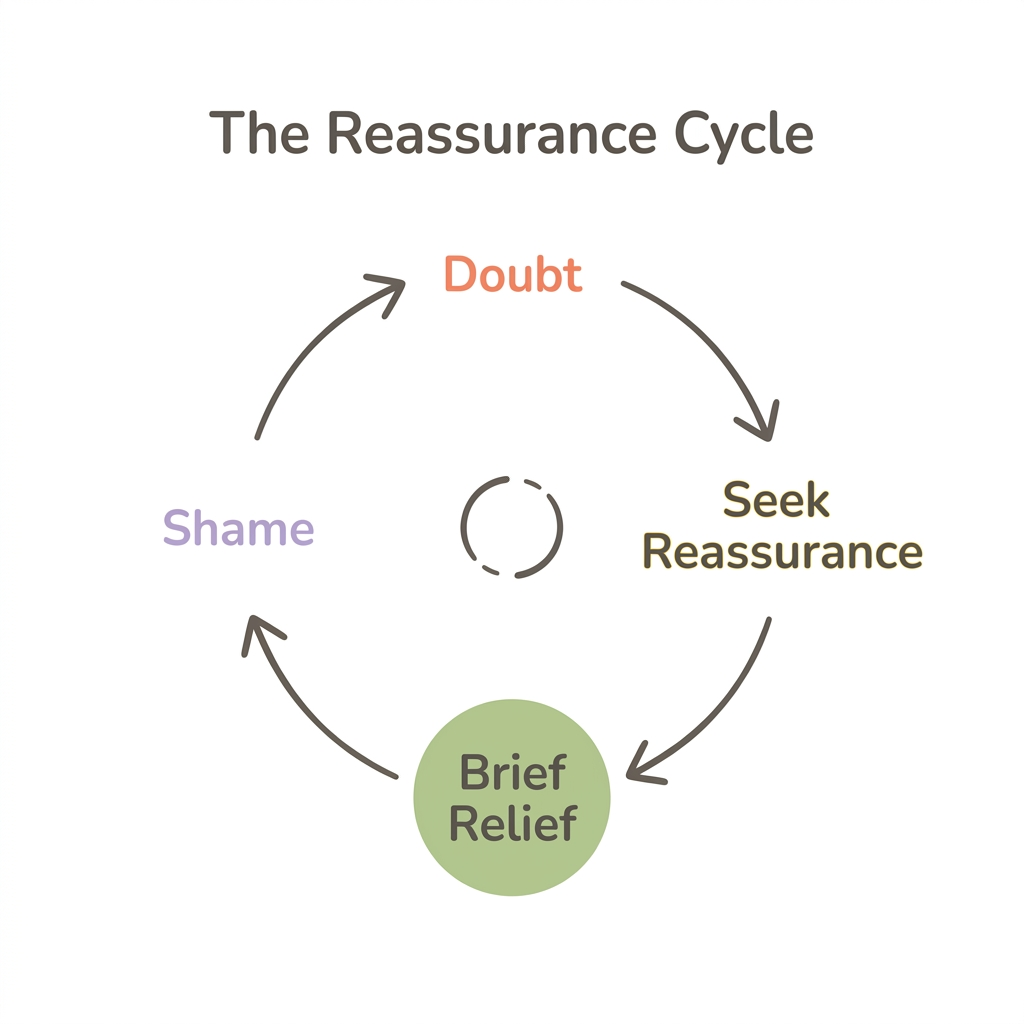
You ask if everything is okay. If they love you. If they are angry. They reassure you. You feel relief, briefly. Then the doubt returns, and you need reassurance again. The reassurance soothes the immediate anxiety but does not change the underlying expectation that connection is fragile.
3. Silence Feels Like Abandonment
When your partner is quiet, distracted, or unresponsive, your body responds as if to threat. Heart racing, mind spinning, urgent need to re-establish contact. Attachment system activation treats uncertainty as danger.
4. You Have a Relief-Shame Cycle
They respond. You feel intense relief—sometimes disproportionate to the situation. Then shame follows. You feel bad about how much you needed that response. You promise yourself to be "less needy." The pattern repeats.
5. You Overthink and Analyze Interactions
You replay conversations. You scrutinize texts for hidden meaning. You construct narratives about what they meant, what they felt, what will happen next. This rumination is an attempt to predict and control an unpredictable relational environment.
6. You Fear Being "Too Much"
You edit yourself. You hide the intensity of your feelings. You apologize for having needs. You have learned—perhaps implicitly—that your emotional needs burden others, so you try to make yourself smaller.
7. You Are Drawn to People Who Are Distant
There is often a pattern: you want closeness, yet you are most activated by partners who are less available. The uncertainty triggers the attachment system, which mistakes activation for connection. Secure, consistent partners may feel "boring" because they do not trigger the familiar vigilance.
8. You Test the Relationship
You might pull back to see if they will chase. You might create conflict to see if they will stay. These protest behaviors are attempts to prove that the connection is real—by forcing the other person to demonstrate it.
9. You Experience Physical Symptoms of Anxiety
Racing heart, tight chest, difficulty sleeping, loss of appetite when the relationship feels uncertain. Your body is responding to perceived threat with the same cascade it would use for physical danger.
10. You Struggle to Focus on Other Areas of Life
When the relationship feels uncertain, work, hobbies, and friendships fade in importance. Your attention narrows to the source of potential abandonment. This is not weakness. It is your nervous system prioritizing what it perceives as survival.
11. You Have Intense Fear of Being Alone
Being single or the thought of breakup triggers panic. You might stay in relationships that are not working because the alternative feels unbearable. The fear is not about the specific person. It is about the absence of connection itself.
12. You Notice a Pattern Across Relationships
These dynamics show up repeatedly, with different people. The common thread is you—and the attachment system you developed. This is actually hopeful. Patterns can be recognized. Recognized patterns can be shifted.
How This Differs From Normal Relationship Concern
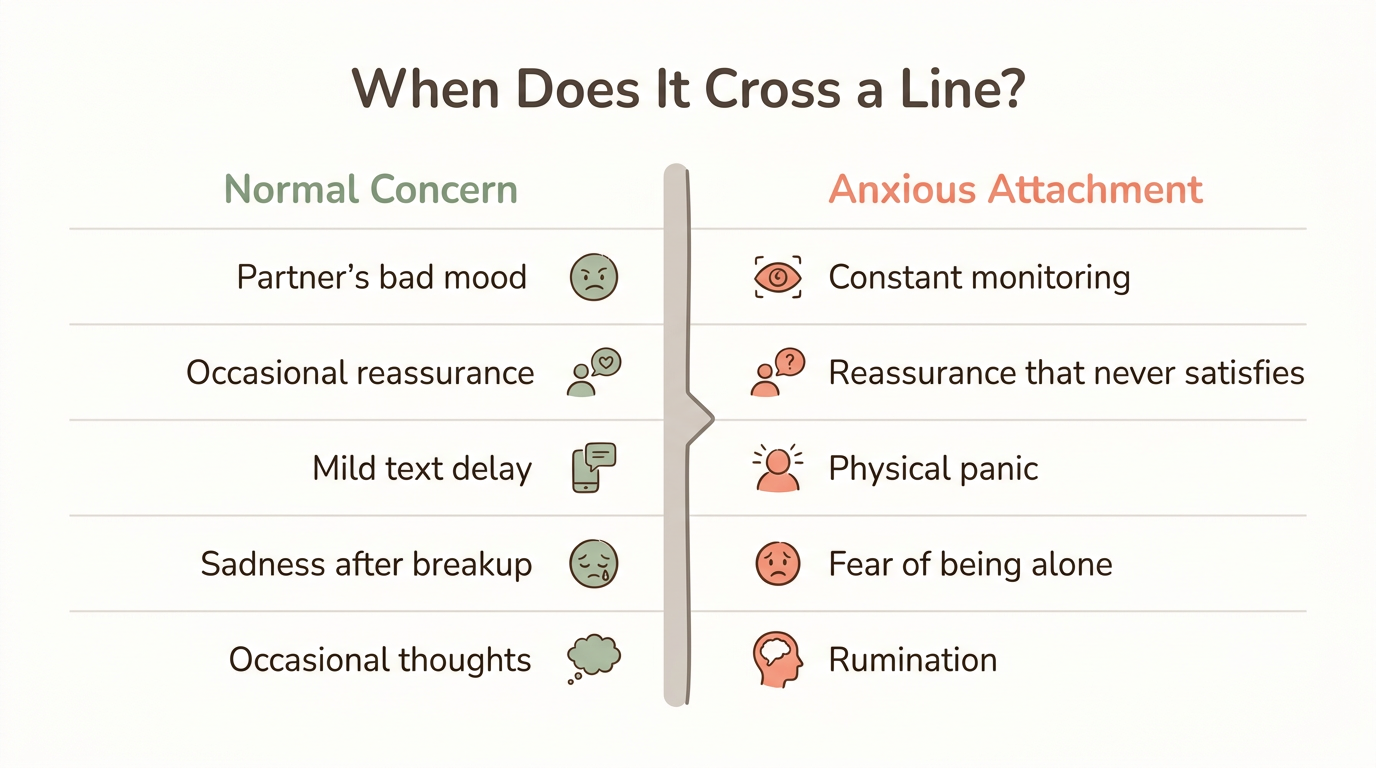
Everyone cares about their relationships. Everyone feels anxious sometimes. The difference is in the intensity, frequency, and impact.
| Normal Concern | Anxious Attachment Pattern |
|---|---|
| Noticing a partner's bad mood | Constant monitoring for any shift |
| Occasionally seeking reassurance | Frequent reassurance-seeking that never fully satisfies |
| Disappointment at delayed texts | Physical panic, inability to focus until they respond |
| Sadness after a breakup | Fear of being alone that keeps you in unhealthy relationships |
| Thinking about the relationship sometimes | Rumination that interferes with work and sleep |
The question is not whether you experience these feelings. It is whether they dominate your experience and limit your choices.
Where These Patterns Come From
Anxious attachment typically develops when early caregivers were inconsistently responsive. Sometimes present, attuned, and warm. Sometimes distant, distracted, or unavailable. The child learns that connection is unreliable and must be vigilantly monitored.
This is not about blame. Caregivers are often doing their best, sometimes with their own attachment wounds, sometimes in difficult circumstances. The pattern develops as an adaptation to a specific environment. It persists because the nervous system does not automatically update when circumstances change.
What to Do With This Information
Recognizing anxious attachment is not a sentence. It is a starting point.
Understand the mechanism. When you feel panic about a delayed text, that is your attachment system activating. Naming it creates space between the feeling and your reaction.
Practice small experiments. Wait thirty minutes before sending that follow-up text. Notice that the world does not end. Small repetitions of safety begin to rewire the pattern.
Communicate directly. Many anxious attachers hide their needs to avoid seeming "too much." Paradoxically, this creates more anxiety. Learning to say "I feel anxious when I do not hear back" can reduce the trigger.
Choose consistency where you can. Partners who are reliable and responsive provide earned security—experiences that gradually teach your nervous system a different expectation.
Consider structured support. Meadow's approach is built on 66 days of practice—not because security arrives on day 66, but because consistency matters more than intensity. Daily exercises, tracked progress, and tools for moments of activation.
When to Seek Professional Help
Consider working with a therapist if:
- These patterns severely impact your daily functioning
- You experience panic attacks or physical symptoms that interfere with work or sleep
- You remain in unhealthy relationships because the fear of being alone feels unbearable
- You use substances or other behaviors to manage relationship anxiety
A licensed therapist can provide personalized support and evidence-based treatments including attachment-based therapy (Johnson, 2019), CBT, or EMDR.
Want to Go Deeper?
Meadow includes a structured assessment to help you understand your specific attachment patterns, followed by a 66-day program of daily practices designed to build earned security.
Start your free week →References
Foundational Works
Ainsworth, M. D. S., Blehar, M. C., Waters, E., & Wall, S. (1978). Patterns of Attachment: A Psychological Study of the Strange Situation. Lawrence Erlbaum Associates.
Mikulincer, M., & Shaver, P. R. (2016). Attachment in Adulthood: Structure, Dynamics, and Change (2nd ed.). Guilford Press.
Research Studies
Fraley, R. C., & Shaver, P. R. (2000). Adult romantic attachment: Theoretical developments, emerging controversies, and unanswered questions. Review of General Psychology, 4(2), 132–154.
Clinical and Applied Sources
Johnson, S. M. (2019). Attachment Theory in Practice: EFT with Individuals, Couples, and Families. Guilford Press.
Levine, A., & Heller, R. (2010). Attached: The New Science of Adult Attachment and How It Can Help You Find—and Keep—Love. TarcherPerigee.
Last updated: February 17, 2025. This article is for educational purposes only and is not a substitute for professional mental health advice.