Your nervous system treats a delayed response as a threat. When someone you depend on goes quiet, your brain activates the same alarm system that responds to physical danger—flooding your body with cortisol and adrenaline, preparing you to fight for connection before it disappears.
This is attachment system activation. It has a logic to it.
What Your Brain Is Doing
Your brain is treating silence as a survival threat. The amygdala—your threat detection center—processes relationship uncertainty the same way it processes a predator in the grass (LeDoux, 2003). It cannot distinguish between a delayed text and actual abandonment because evolution did not prioritize that distinction. Both register as threats to survival.
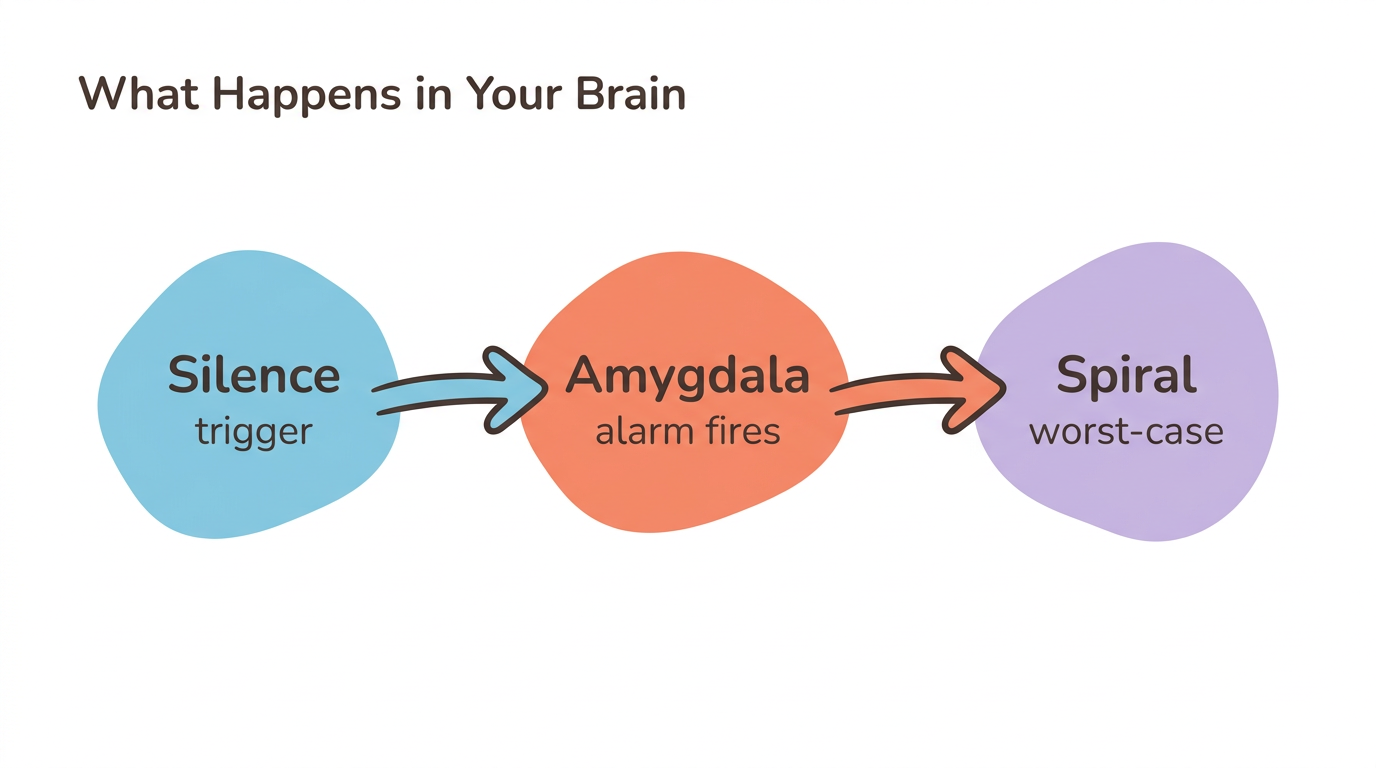
Your body responds accordingly. Cortisol and adrenaline prepare you for fight-or-flight (Sapolsky, 2004). Your heart races. Your stomach knots. Your mind generates worst-case scenarios to anticipate danger before it arrives.
A 2008 study found that people with anxious attachment styles show heightened amygdala reactivity to relationship threats compared to securely attached individuals (Vrtička et al., 2008). Your brain is not malfunctioning. It learned to scan for disconnection, and it is scanning.
Where This Pattern Comes From
Anxious attachment typically develops when early caregivers were inconsistently responsive. Sometimes present, sometimes distant—attention that arrived without pattern, love that felt reliable only in retrospect.
You learned to monitor. To anticipate withdrawal before it happened. To treat silence as information, even when it was not.
That vigilance served a purpose. It helped you navigate unpredictability. Now it shows up as 2am spirals about read receipts, as the shame that follows when you have "overreacted," as the exhaustion of maintaining constant vigilance over someone else's attention.
What This Looks Like
The spiral. You send a message. An hour passes. Your mind moves from "they are busy" to "they are annoyed" to "they have decided to leave." By the time they respond—"Sorry, was in a meeting"—you have already lived through the abandonment.
The double-text. You send follow-ups you know you should not send. Each message increases your anxiety, but not sending feels physically impossible.
The relief-shame cycle. They respond. You feel intense relief, followed immediately by shame about how much you needed that relief.
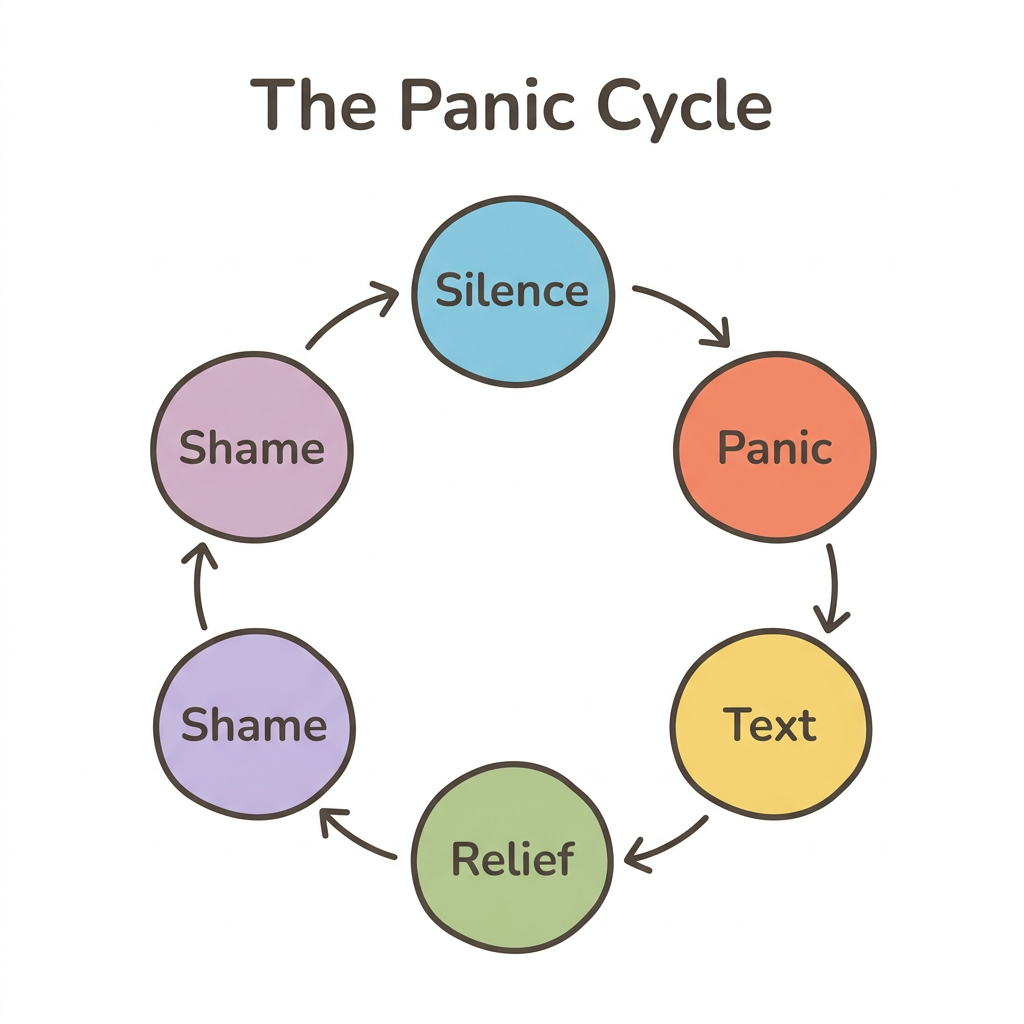
The preemption. You withdraw first to avoid being abandoned, testing whether they will chase—creating the very distance you fear.
What You Can Do Today
Name the Pattern
Say to yourself: "This is attachment system activation." Naming creates space between the feeling and the reaction. It does not stop the panic, but it gives you something to hold onto while the panic passes.
Ground Your Nervous System
Use 5-4-3-2-1 grounding: five things you see, four you can touch, three you hear, two you smell, one you taste. Return to the present moment, where the threat is imagined, not real.
Set a Waiting Timer
When you feel the urge to send another message, set a timer for thirty minutes. Tell yourself you can send it when the timer ends. Often, the urge passes. If it does not, you have practiced sitting with discomfort—which, repeated, begins to rewire the pattern.
Question the Narrative
Your mind says: "They are losing interest." Ask:
- What evidence supports this?
- What contradicts it?
- What is a more neutral explanation?
- What would you tell a friend in this situation?
Self-Soothe
Place a hand on your heart. Remind yourself: "I am here. I am safe." The goal is not to need no one. It is to not need them right this second to feel okay.
When These Steps Feel Impossible
Sometimes the panic is too loud. You know the techniques and cannot access them. You are already three texts deep and spiraling.
This is normal. Your nervous system is doing what it learned to do. The goal is not to execute these tools perfectly every time. It is to catch yourself ten percent earlier, ten percent more often.
If you read this and thought, "This will not work for me," that is the attachment speaking. The part that learned hope was dangerous is trying to protect you from trying.
Start with one technique. One time. Small repetitions accumulate.
The Longer Work
Understanding the mechanism helps. Mechanisms do not rewire themselves. That requires repetition—new experiences, accumulated over time, that teach your nervous system something different (Siegel, 2012).
Some of this happens in relationships with consistent, responsive people. Some happens in therapy. Some happens in moments like this, when you choose to wait instead of text, to breathe instead of spiral.
Meadow's approach is built on 66 days of practice—not because security arrives on day 66, but because consistency matters more than intensity. Small actions, repeated, move you toward earned security.
When to Seek Professional Help
Consider professional support if:
- The panic severely impacts daily functioning
- You experience panic attacks or physical symptoms that interfere with work or sleep
- You remain in unhealthy relationships because the fear of being alone feels unbearable
- You use substances or other behaviors to manage the anxiety
A licensed therapist can provide personalized support and evidence-based treatments including attachment-based therapy (Johnson, 2019), CBT, or EMDR.
Want to Go Deeper?
Meadow includes a structured assessment to help you understand your specific attachment patterns, followed by a 66-day program of daily practices designed to build earned security.
Start your free week →References
Neuroscience and Stress
LeDoux, J. E. (2003). The emotional brain, fear, and the amygdala. Cellular and Molecular Neurobiology, 23(4-5), 727–738.
Sapolsky, R. M. (2004). Why Zebras Don't Get Ulcers (3rd ed.). Henry Holt and Company.
Siegel, D. J. (2012). The Developing Mind: How Relationships and the Brain Interact to Shape Who We Are (2nd ed.). Guilford Press.
Research Studies
Vrtička, P., Andersson, F., Grandjean, D., Sander, D., & Vuilleumier, P. (2008). Individual attachment style modulates human amygdala and striatum activation during social appraisal. PLoS ONE, 3(8), e2868.
Clinical and Applied Sources
Johnson, S. M. (2019). Attachment Theory in Practice: EFT with Individuals, Couples, and Families. Guilford Press.
Last updated: February 17, 2025. This article is for educational purposes only and is not a substitute for professional mental health advice.