Relationship anxiety is a pattern of persistent fear, hypervigilance, and doubt within a romantic partnership—even when nothing is actually wrong. Research shows that 34 percent of Americans identify romantic relationships as the leading cause of their mental health concerns (Thriveworks). The anxiety is not a reflection of the relationship's quality. It is a reflection of the nervous system's threat-detection settings.
If you have ever spiraled about a partner who has done nothing wrong—scanning their tone for distance, rereading texts for hidden meaning, bracing for abandonment that never comes—you are not broken. Your nervous system is running a protective program that once made sense. This article traces exactly how anxiety damages good relationships, the neuroscience behind that damage, and evidence-based ways to interrupt the cycle before it becomes the thing you feared most.
Key takeaway: Relationship anxiety can erode even healthy partnerships through a self-fulfilling prophecy: fear of abandonment drives protest behaviors that push partners away, confirming the original fear. Research shows reassurance seeking actually lowers next-day trust. Evidence-based approaches like Emotionally Focused Therapy demonstrate approximately 70 percent recovery rates.
How Does Relationship Anxiety Damage an Otherwise Healthy Relationship?
Relationship anxiety damages healthy relationships through a self-fulfilling prophecy—your fear of losing the relationship generates the very behaviors that drive your partner away. The destruction does not come from real problems. It comes from anxiety manufacturing threats that did not exist.
You may recognize this pattern before you can name it. Here is how the cycle works. Your nervous system detects a perceived threat—a delayed reply, a distracted tone, a moment of distance. Mikulincer and Shaver (2003, 2016) call the response a hyperactivating strategy: your attachment system floods you with intensified fear, jealousy, and urgency to close the gap. That flood produces protest behaviors—clinging, testing, emotional escalation, demands for reassurance. Your partner, overwhelmed or confused, pulls back. Their withdrawal lands as confirmation: See? They are leaving.
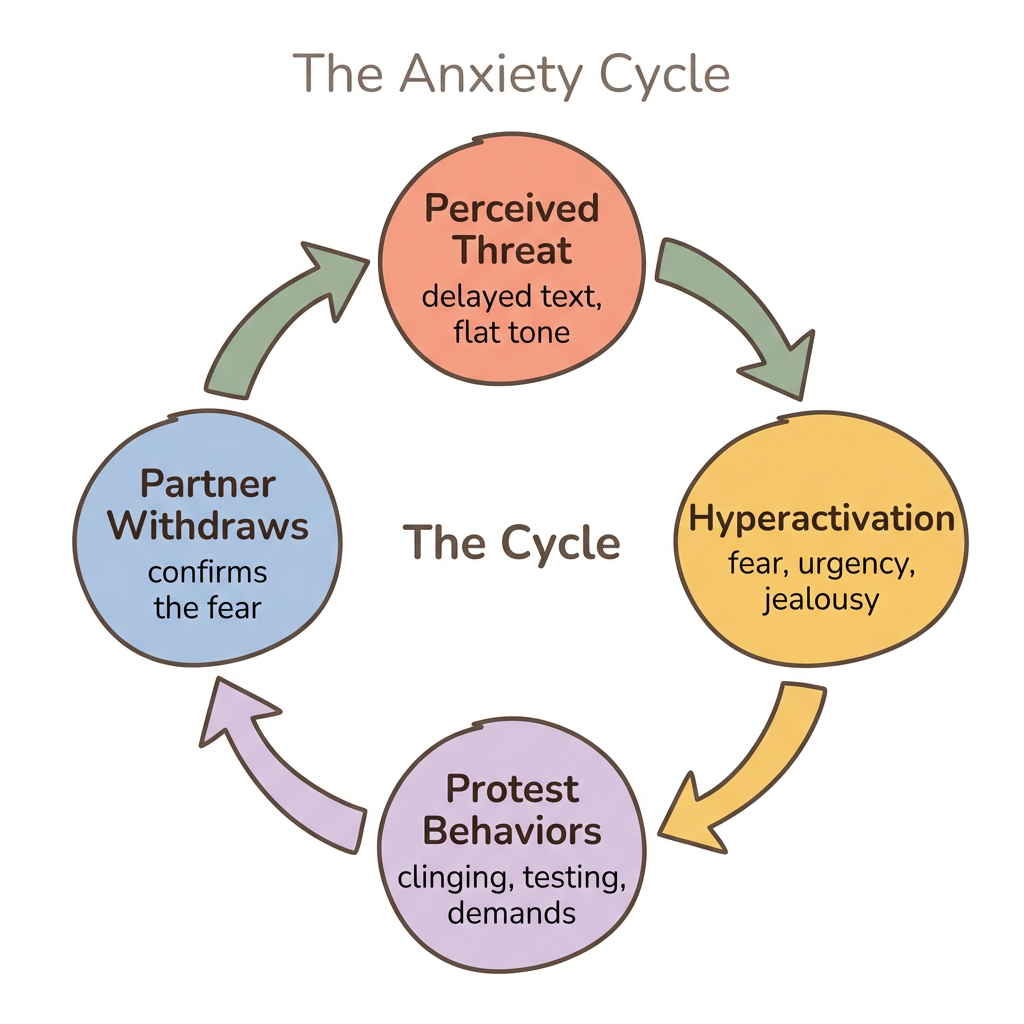
Levine and Heller (2010) describe this as the anxious-avoidant trap, where the anxious partner's strategies for seeking closeness are the very strategies that create distance. People with generalized anxiety are two times more likely to experience significant relationship problems and three times more likely to avoid intimacy altogether (HealthyPlace). The relationship was never the problem. Threat neuroception—your nervous system misreading safety as danger—was the problem.
If your anxiety spikes precisely when things are going well, that pattern has a name: foreboding joy. Understanding what triggers your relationship anxiety is the first step toward recognizing the cycle from outside it rather than living trapped inside it.
The Anxiety Cycle Map (for anxious attachment)
- Write down a recent anxiety episode in your relationship
- Identify the trigger—what happened right before the anxiety spiked?
- Name the story your mind created ("They're pulling away," "They don't really love me")
- Record what you did in response (texted repeatedly, withdrew, picked a fight, asked for reassurance)
- Note how your partner reacted to your response
- Ask: did their reaction confirm or disconfirm your original fear?
This works for anxious attachment because it externalizes the hyperactivation loop. When you can see the cycle on paper, you are observing it rather than fusing with it—and observation is the first break in the chain.
What Does Research Say About Anxiety's Impact on Relationship Quality?
Multiple meta-analyses confirm that attachment anxiety significantly predicts lower relationship satisfaction—and the damage operates through specific, measurable daily processes rather than dramatic blowups.
Candel and Turliuc (2019) conducted a meta-analysis finding that both attachment anxiety and avoidance negatively predict relationship satisfaction. Critically, the actor effect—your own anxiety predicting your own dissatisfaction—is stronger than the partner effect. Your anxiety shapes your experience of the relationship more than your partner's actual behavior does.
Li and Chan (2012) confirmed this in a separate meta-analytic review: anxious and avoidant attachment both erode cognitive, emotional, and behavioral dimensions of relationship quality, though through different mechanisms.
Five Research-Backed Ways Relationship Anxiety Erodes Connection
-
Zaider, Heimberg, and Iida (2010) tracked 33 couples over 14 days and found something striking: on days when wives experienced elevated anxiety, husbands reported significantly lower positive relationship quality—not because of fights, but because of diminished warmth.
-
The reassurance-seeking paradox. Rodriguez, Knee, and Neighbors (2022) found that for women high in anxious attachment, excessive reassurance seeking predicted lower next-day trust. The very behavior meant to secure the bond actively undermined it.
-
Consider that your internal threat system—not your partner's actions—is the primary driver of how you experience the relationship. The actor effect from Candel and Turliuc (2019) means your anxiety predicts your dissatisfaction more than your partner's behavior does.
-
Accommodation strengthens the cycle. When partners walk on eggshells, provide constant reassurance, or rearrange their lives around the anxiety, the Zaider et al. (2010) study found this strengthened rather than reduced the negative cycle.
-
While avoidance damaged general satisfaction more broadly, Candel and Turliuc (2019) found that anxiety uniquely harmed the emotional quality of the relationship—the felt sense of closeness, safety, and warmth.
Your nervous system learned to seek reassurance because, at some point, that strategy worked. It kept you connected to someone you needed. That adaptation made sense then. And now it is producing the opposite of what you want.
The Reassurance Pause (for anxious attachment)
- Notice the urge to seek reassurance without acting on it—just name it: "There's the urge"
- Identify the feeling underneath: "I feel scared that..."
- Set a 20-minute timer on your phone
- During the pause, do one self-soothing action—place a hand on your chest, slow your breathing, or hold something warm
- When the timer ends, check in—is the urge still as intense?
This interrupts the excessive reassurance seeking to trust erosion loop identified by Rodriguez et al. (2022). Building even 20 minutes of distress tolerance at the peak of hyperactivation begins rewiring the pattern. You are not suppressing the need—you are building capacity to hold it.
Why Does Your Brain Treat a Good Relationship as Dangerous?
Your brain treats a good relationship as dangerous because your neuroception—the nervous system's below-conscious-awareness threat scanner—is calibrated toward detecting danger in ambiguous social cues. A delayed text, a flat tone, a moment of silence: for a securely attached person, these register as neutral. For someone with attachment anxiety, they register as threat.
Stephen Porges' polyvagal theory explains why. Your nervous system constantly evaluates whether the environment is safe, dangerous, or life-threatening. When early attachment experiences involved inconsistent caregiving, neuroception becomes threat-biased—tuned to catch the faintest signal of rejection, even when no rejection exists.
Neuroimaging research reveals what this looks like in the brain. fMRI studies show that the amygdala—the brain's fear center—is deactivated during positive romantic love experiences but activates sharply during relationship threat or dissolution (Frontiers in Human Neuroscience, 2015). In relationship anxiety, the amygdala stays chronically active, blocking the very safety signals that secure love provides. Research on brainstem activity suggests this anxiety response originates from primitive survival circuits, not just cortical worry (Journal of Neuropsychiatry).
The neurochemistry compounds the problem. Securely attached individuals show lower baseline cortisol and higher oxytocin levels. Attachment anxiety produces the opposite: a hyperactive, oxytocin-deprived amygdala with poor prefrontal cortex connectivity, driving threat-biased social perception (Attachment Project). Oxytocin—the bonding neurochemical—does not operate the same way across attachment styles; anxiously attached individuals respond differently to oxytocin than securely attached individuals do (PMC).
How your attachment style shapes your nervous system explains this in greater depth. Overthinking in relationships is the cognitive expression of this same neural pattern—the prefrontal cortex trying to think its way out of what is fundamentally a body-level alarm.
Neuroception Reset (somatic exercise for anxious attachment)
- Place one hand on your chest, one on your belly
- Exhale longer than you inhale—breathe in for 4 counts, out for 7 counts—for 6 full breaths
- Soften your jaw and the muscles around your eyes (these areas hold social threat tension)
- Orient to the room—name 3 things you can see, 2 you can hear, 1 you can feel
- Now bring your partner's face to mind and notice what shifts in your body
This directly engages the ventral vagal pathway—the neural circuit responsible for social engagement and felt safety. When neuroception is stuck in threat mode, the extended exhale activates parasympathetic braking, and orienting to the environment retrains the system to distinguish actual danger from perceived danger. The final step begins pairing your partner's image with a regulated nervous system state rather than an activated one.
Is It Relationship Anxiety or Relationship OCD?
Relationship anxiety rooted in attachment insecurity and relationship OCD (ROCD) share surface-level features—doubt, distress, reassurance seeking—but they arise from different mechanisms and require different treatment approaches. Distinguishing them matters because the wrong intervention can make things worse.
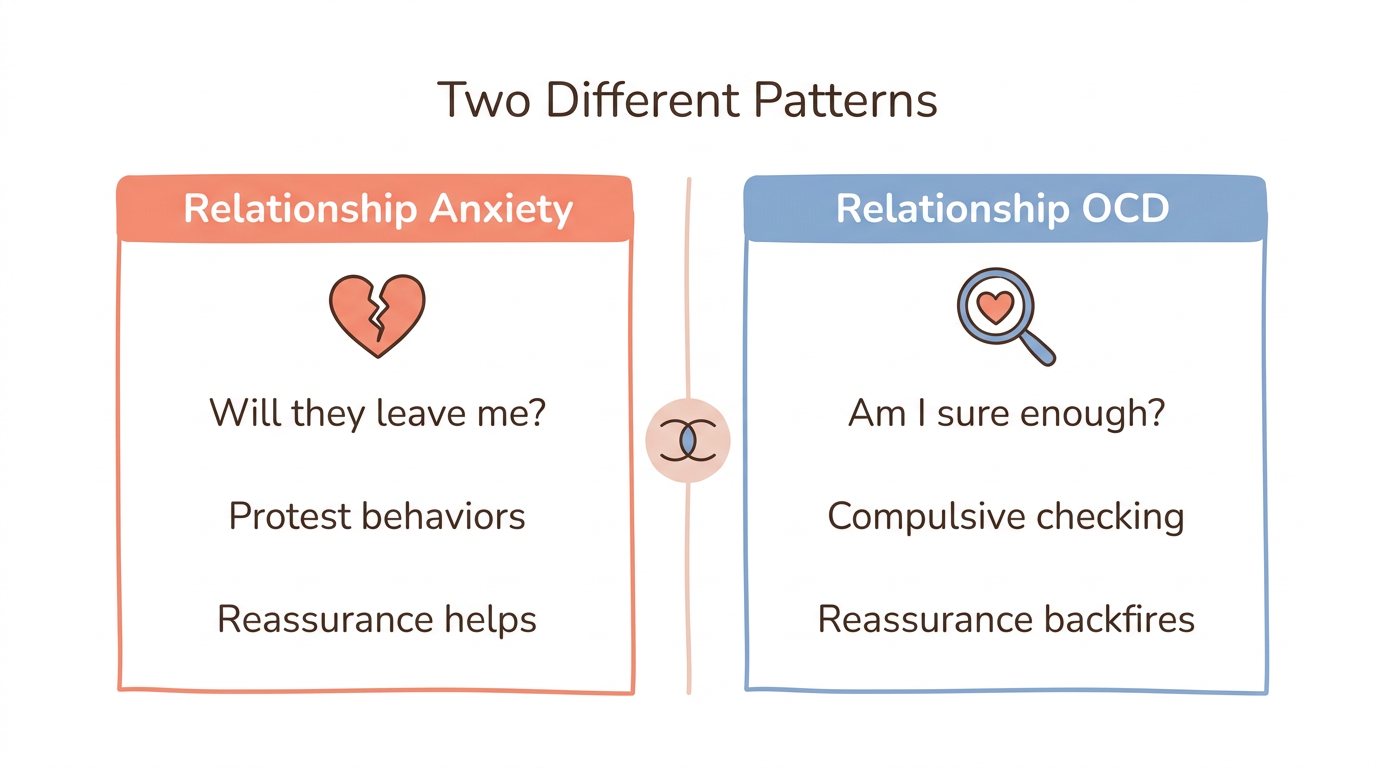
Attachment-based relationship anxiety centers on fear of abandonment. The core question is: Will they leave me? It activates protest behaviors—clinging, testing, escalating—aimed at pulling the partner closer. ROCD centers on intrusive obsessional doubts about the relationship's "rightness." The core question is: Am I sure enough about my feelings? Is this the right person? It activates compulsions—compulsive checking of your own feelings, comparing your partner to others, and seeking reassurance about whether your love is "real."
Doron and colleagues' research program found that ROCD affects over 50 percent of OCD sufferers who identify with this subtype (IOCDF). A defining feature: reassurance helps briefly, then intensifies the doubt long-term. Each cycle of checking and reassurance strengthens the obsessional loop. ERP (Exposure and Response Prevention) achieves 80 percent significant symptom reduction for ROCD (cogbtherapy.com)—but ERP would not address the attachment wound driving protest behaviors.
| Dimension | Normal Doubt | Relationship Anxiety (Attachment-Based) | Relationship OCD |
|---|---|---|---|
| Core fear | "Is this the right fit?" | "Will they abandon me?" | "Am I sure enough about my feelings?" |
| Trigger | Real relationship events | Perceived distance or threat | Intrusive thoughts, often without trigger |
| Relief pattern | Discussion resolves it | Reassurance helps temporarily | Reassurance helps briefly, then intensifies doubt |
| Physical experience | Mild unease | Chest tightness, racing heart, hypervigilance | Spike of anxiety, urge to "check" feelings |
| Frequency | Occasional, situational | Chronic, often daily | Obsessional, repetitive |
| Best approach | Communication, reflection | Attachment-focused therapy, nervous system work | ERP (Exposure and Response Prevention) |
| Key attachment style | Any | Primarily anxious | Any (not attachment-specific) |
If you are trying to sort out whether your doubt is anxiety, intuition, or something else entirely, this guide on distinguishing anxiety from intuition can help. And if you are wondering whether the anxiety means you should leave, read this first.
The Pattern Identifier (for anxious attachment and ROCD presentations)
- Does your worry focus on "Will they leave me?" (attachment anxiety) or "Am I with the right person?" (ROCD)?
- Do you compare your partner to others or compulsively check your own feelings? (points toward ROCD)
- Does reassurance help briefly then make the doubt worse? (points toward ROCD)
- Does closeness with your partner increase your anxiety (ROCD) or decrease it (attachment anxiety)?
- Based on your answers, note which pattern feels more familiar
Identifying which pattern drives your experience matters because the treatment pathways diverge significantly. Attachment-based anxiety responds to nervous system regulation and earned security work. ROCD responds to exposure and response prevention. Applying the wrong framework can inadvertently reinforce the cycle you are trying to break.
How Does Relationship Anxiety Affect Your Partner?
Relationship anxiety does not only affect the person experiencing it—it significantly impacts the partner's emotional well-being and daily experience of the relationship. Research shows this happens not through dramatic conflict but through a quiet diminished warmth that accumulates day by day.
Zaider, Heimberg, and Iida (2010) tracked couples through daily diaries and found that on days when one partner experienced elevated anxiety, the other partner reported lower positive relationship quality and increased same-day distress—including anxiety, anger, and depression. The partners were not fighting. The anxiety was simply absorbing the emotional availability that makes a relationship feel nourishing.
Perhaps the most counterintuitive finding: when partners accommodate the anxiety—providing excessive reassurance, avoiding triggers, walking on eggshells—the cycle strengthens rather than weakens. This is the accommodation paradox. The partner's well-intentioned efforts to soothe the anxiety become fuel for it, because the anxious system learns that the threat was real enough to require management.
Fifty percent of couples report that anxiety, depression, or mental health issues have affected their relationship (South Denver Therapy). The partner's daily experience of relationship anxiety is one of gradually shrinking space—less spontaneity, less lightness, less room for the relationship to simply be enjoyed. The partner effect from Candel and Turliuc's (2019) meta-analysis confirms this: your anxiety does predict your partner's dissatisfaction, even though the actor effect on your own experience is stronger.
Your partner's exhaustion is not a sign they do not love you. It is a sign that the anxiety is taking something from both of you.
The Partner Impact Letter (for anxious attachment)
- Write a letter to your partner that you do not need to send
- Name one specific way your anxiety has shown up in the relationship recently
- Acknowledge what your partner has been absorbing—the reassurance requests, the emotional weight, the reduced spontaneity
- Distinguish between what you genuinely need from them and what you need to work on within yourself
- If it feels safe, share one insight from the letter with your partner
This builds mentalization—the capacity to see the relationship from your partner's perspective. Hyperactivation creates a self-focused tunnel vision where the anxious person's fear dominates the relational space. Practicing this perspective-shift counteracts that narrowing and opens room for genuine empathy rather than anxiety-driven caretaking of the bond.
What Actually Works to Stop Anxiety from Ruining Your Relationship?
Beyond general self-care, these interventions have measured effect sizes for specifically interrupting the anxiety-to-relationship-damage cycle. The research points to six approaches with the strongest support.
Six Evidence-Based Approaches Ranked by Research Support
-
Emotionally Focused Therapy (EFT) for couples. The gold standard, with an effect size of d = 1.3—the largest of any couple intervention. EFT achieves a 70 percent recovery rate with 82 percent stability at follow-up (ICEEFT). It works by helping couples identify pursue-withdraw cycles and create new bonding interactions that directly address attachment anxiety. Beasley and Ager's systematic review confirmed that EFT decreases relationship-specific attachment anxiety, with gains continuing after therapy ends.
-
What if the pattern is more obsessional than attachment-driven? CBT and ERP target that variant. Cognitive restructuring addresses catastrophic interpretations of ambiguous relationship events, while ERP achieves 80 percent significant symptom reduction for ROCD specifically (cogbtherapy.com). Behavioral experiments—deliberately testing anxiety-driven beliefs rather than avoiding them—build corrective evidence.
-
Individual attachment-focused therapy. If you identify with anxious attachment, individual therapy can address the underlying attachment patterns that generate relationship anxiety. Zhang et al. (2022) found a moderate-to-large correlation between attachment anxiety and mental health difficulties, suggesting that treating the attachment pattern improves well-being broadly.
-
Porges' polyvagal framework explains why anxious partners misread safe cues as danger—and co-regulation practices offer a direct counter. Building ventral vagal capacity through shared nervous system regulation—prosody, eye contact, synchronized breathing—retrains the system to use the relationship as a source of safety.
-
Security priming. Mikulincer and Shaver's research program demonstrates that brief interventions activating secure attachment representations can temporarily shift insecure individuals toward more secure functioning. Daily practice compounds these temporary shifts into lasting neural change.
-
During conflict, something deceptively simple outperforms reassurance seeking: naming the emotion out loud. When partners label their feelings during disagreements, both nervous systems settle, with measurable cortisol reduction (Rowan Center LA). Saying "I feel scared right now" does more to regulate both partners than any reassurance-seeking behavior.
You do not rewire attachment in a single insight. You rewire it by noticing the activation 10 percent earlier, responding 10 percent differently, 10 percent more often. For a full toolkit of self-regulation techniques, see how to self-soothe anxious attachment. And the damage is not permanent—relationship anxiety can go away.
Co-Regulation Check-In (for anxious attachment in couples)
- Sit facing each other, knees or hands touching
- One partner shares: "Right now I'm feeling..." (name the emotion only—no story, no explanation)
- The other reflects back: "I hear that you're feeling..."
- Switch roles
- End with 30 seconds of synchronized breathing—inhale together, exhale together
This builds the co-regulation neural pathway that attachment anxiety disrupts. When the anxious partner's nervous system learns to settle in the presence of the other person—rather than escalating—the relationship becomes a corrective attachment experience. Five minutes daily trains both systems to use the bond as safety rather than threat.
When Should You Seek Professional Help for Relationship Anxiety?
You should seek professional help when relationship anxiety persists despite self-awareness and self-help efforts, when your partner shows signs of accommodation burnout, or when you cannot reliably distinguish between anxiety and genuine relationship problems.
Specific signs that self-help is not enough:
- Anxiety dominates most days and is not responsive to the exercises above
- Your partner has begun walking on eggshells, withdrawing, or expressing frustration about reassurance requests
- You cannot tell whether your concerns reflect anxiety or intuition
- Obsessional checking, comparing, or feeling-monitoring features are present (suggesting ROCD)
- Anxiety has spread beyond the relationship into work, friendships, or physical health
- You recognize the pattern but keep repeating it despite genuine effort to change
Sixty-four percent of individuals with mental health conditions report experiencing relationship challenges (NAMI). Zhang et al. (2022) found a moderate-to-large correlation between attachment anxiety and broader mental health difficulties. Professional support is not a sign of failure—it is the most evidence-backed path to earned security.
When choosing between individual vs. couples therapy: if the anxiety predates the relationship and shows up across partners, start with individual attachment-focused work. If the pattern is specific to this relationship or the pursue-withdraw dynamic has entrenched, couples therapy—particularly EFT—may be the faster path. Many people benefit from both simultaneously. For a broader perspective on the timeline, here is what to expect for how long relationship anxiety lasts.
Frequently Asked Questions
Can anxiety make you fall out of love?
No—but it blocks access to love. When your nervous system is in threat mode, the brain prioritizes fear over connection. fMRI research shows the amygdala activates during relationship threat, suppressing the neural circuits associated with bonding (Frontiers in Human Neuroscience, 2015). The love is still there beneath the activation.
How do I stop anxiety from ruining my relationship?
Start by recognizing anxiety as a nervous system pattern, not relationship truth. Evidence-based approaches include EFT for couples with a 70 percent recovery rate (ICEEFT), cognitive restructuring of catastrophic thoughts, and daily co-regulation practices with your partner. Building self-soothing capacity reduces reliance on reassurance seeking, which Rodriguez et al. (2022) found actively erodes trust.
Is it anxiety or am I not in love?
Anxiety creates emotional numbness and doubt that can mimic falling out of love. Key differences: anxiety-driven doubt fluctuates—worse when stressed, better when calm—involves checking feelings compulsively, and often intensifies after reassurance. Genuine incompatibility tends to feel more like steady disinterest without the distress spikes.
What does relationship anxiety feel like?
It shows up as persistent fear of abandonment, hypervigilance for signs of rejection, intrusive "what if" thoughts, and physical tension—chest tightness, stomach knots, racing heart. There is an urge to seek reassurance and difficulty enjoying closeness without waiting for something to go wrong. Many people describe it as feeling most anxious when things are going well.
Is relationship anxiety a mental illness?
Not a clinical diagnosis itself, but it often stems from attachment insecurity or anxiety disorders that are diagnosable. When it becomes obsessional and compulsive—intrusive doubts about feelings, compulsive checking and comparing—it may meet criteria for Relationship OCD. People with generalized anxiety disorder are two times more likely to experience significant relationship problems (HealthyPlace).
How can you help a partner with relationship anxiety?
Offer consistent, predictable reassurance without accommodating avoidance behaviors—Zaider et al. (2010) found that accommodation strengthens anxiety cycles rather than reducing them. Learn their specific triggers, practice co-regulation through calm presence rather than problem-solving, and avoid dismissing their fears as irrational. Encourage professional support if anxiety continues escalating despite your efforts.
Can anxiety cause you to doubt your feelings?
Yes—and the mechanism is counterintuitive. Hypervigilating strategies include compulsive emotional monitoring, constantly scanning your own feelings for "proof" of love. This checking behavior paradoxically creates more uncertainty because feelings are not stable data points. Chronic cortisol from sustained anxiety also suppresses oxytocin, the neurochemical most associated with bonding and felt security (Attachment Project).
What is the difference between relationship OCD and relationship anxiety?
The key difference is the core fear. Relationship anxiety is driven by fear of abandonment and activates protest behaviors—clinging, testing, emotional escalation. Relationship OCD is driven by obsessional doubt about the relationship's "rightness" and activates compulsions—checking feelings, comparing partners, seeking certainty. Relationship anxiety craves closeness; ROCD questions whether closeness is deserved. They require different therapeutic approaches: attachment-focused work versus ERP.
Want to Go Deeper?
Meadow includes a structured assessment to help you understand your specific attachment patterns, followed by a 66-day program of daily practices designed to build earned security.
Start your free week →References
Meta-Analyses and Systematic Reviews
-
Candel, O. S., and Turliuc, M. N. (2019). Insecure attachment and relationship satisfaction: A meta-analysis of actor and partner associations. Personality and Individual Differences, 147, 190-199.
-
Li, T., and Chan, D. K. S. (2012). How anxious and avoidant attachment affect romantic relationship quality differently: A meta-analytic review. European Journal of Social Psychology, 42(4), 406-419.
-
Zhang, X., Li, J., Xie, F., Chen, X., Xu, W., and Hudson, N. W. (2022). The relationship between adult attachment and mental health: A meta-analysis. Journal of Personality and Social Psychology, 123(5), 1089-1137.
-
Beasley, C. C., and Ager, R. Emotionally Focused Therapy: A systematic review of its effectiveness with various client populations. Journal of Contemporary Psychotherapy, 49(3), 163-172.
Daily Diary and Longitudinal Studies
-
Zaider, T. I., Heimberg, R. G., and Iida, M. (2010). Anxiety disorders and intimate relationships: A study of daily processes in couples. Journal of Abnormal Psychology, 119(1), 163-173.
-
Rodriguez, L. M., Knee, C. R., and Neighbors, C. (2022). Attachment anxiety, reassurance seeking, and trust in romantic relationships: A daily diary study. Personal Relationships, 29(1), 161-180.
Attachment Theory Foundations
-
Mikulincer, M., and Shaver, P. R. (2003). The attachment behavioral system in adulthood: Activation, psychodynamics, and interpersonal processes. Advances in Experimental Social Psychology, 35, 53-152.
-
Mikulincer, M., and Shaver, P. R. (2016). Attachment in Adulthood: Structure, Dynamics, and Change (2nd ed.). Guilford Press.
-
Levine, A., and Heller, R. (2010). Attached: The New Science of Adult Attachment and How It Can Help You Find—and Keep—Love. TarcherPerigee.
Neuroscience
-
Porges, S. W. (2011). The Polyvagal Theory: Neurophysiological Foundations of Emotions, Attachment, Communication, and Self-Regulation. W. W. Norton.
-
Cacioppo, S., Bianchi-Demicheli, F., Hatfield, E., and Rapson, R. L. (2015). Social neuroscience of love. Frontiers in Human Neuroscience, 9, 71.
-
Feldman, R. (2017). The neurobiology of human attachments. Trends in Cognitive Sciences, 21(2), 80-99.
Clinical and ROCD
-
Doron, G., Derby, D. S., Szepsenwol, O., and Talmor, D. Relationship obsessive compulsive disorder (ROCD). International OCD Foundation Expert Opinion.
-
ICEEFT. (2024). EFT research. International Centre for Excellence in Emotionally Focused Therapy.
Surveys and Population Data
-
Thriveworks Research. Relationship anxiety statistics and mental health survey data.
-
National Alliance on Mental Illness (NAMI). Mental health conditions and relationship challenges survey.
-
HealthyPlace. How anxiety affects relationships: GAD and intimacy avoidance statistics.
-
South Denver Therapy. Relationship statistics: Anxiety, depression, and couples.
This article is for educational purposes only and is not a substitute for professional mental health advice, diagnosis, or treatment. If you are experiencing significant relationship anxiety, please consult a licensed therapist or counselor who specializes in attachment-focused or evidence-based approaches.