Avoidant attachment is a relational pattern where emotional closeness triggers the need to pull away—not from lack of caring, but from learned protective strategies that keep vulnerability at a distance. Research estimates that avoidant attachment affects roughly one in four adults (Hazan and Shaver, 1987), with the US National Comorbidity Survey Replication (N=5,645) finding 22.2 percent of adults meet criteria for avoidant attachment. A meta-analysis of 73 studies found that avoidance is the attachment dimension most negatively associated with relationship quality (Li and Chan, 2012).
If you or your partner has avoidant attachment, the emotional distance you experience is not indifference. Neuroscience reveals that the avoidant brain actually works harder to suppress emotional responses—with elevated prefrontal cortex activity and persistent amygdala activation during emotional processing (Vrtička et al., 2012). This article maps how avoidant attachment shows up across romantic relationships, friendships, and family—and what the research says about changing these patterns. If you are wondering whether this applies to you, the patterns below may feel familiar.
Key takeaway: Avoidant attachment affects approximately one in four adults and is more strongly linked to reduced relationship satisfaction than anxious attachment. Deactivating strategies like emotional withdrawal protect against vulnerability but reduce intimacy for both partners. These patterns are not fixed and can shift through therapy, somatic approaches, and graduated vulnerability practice.
What Are Deactivating Strategies and Why Do Avoidant Partners Use Them?
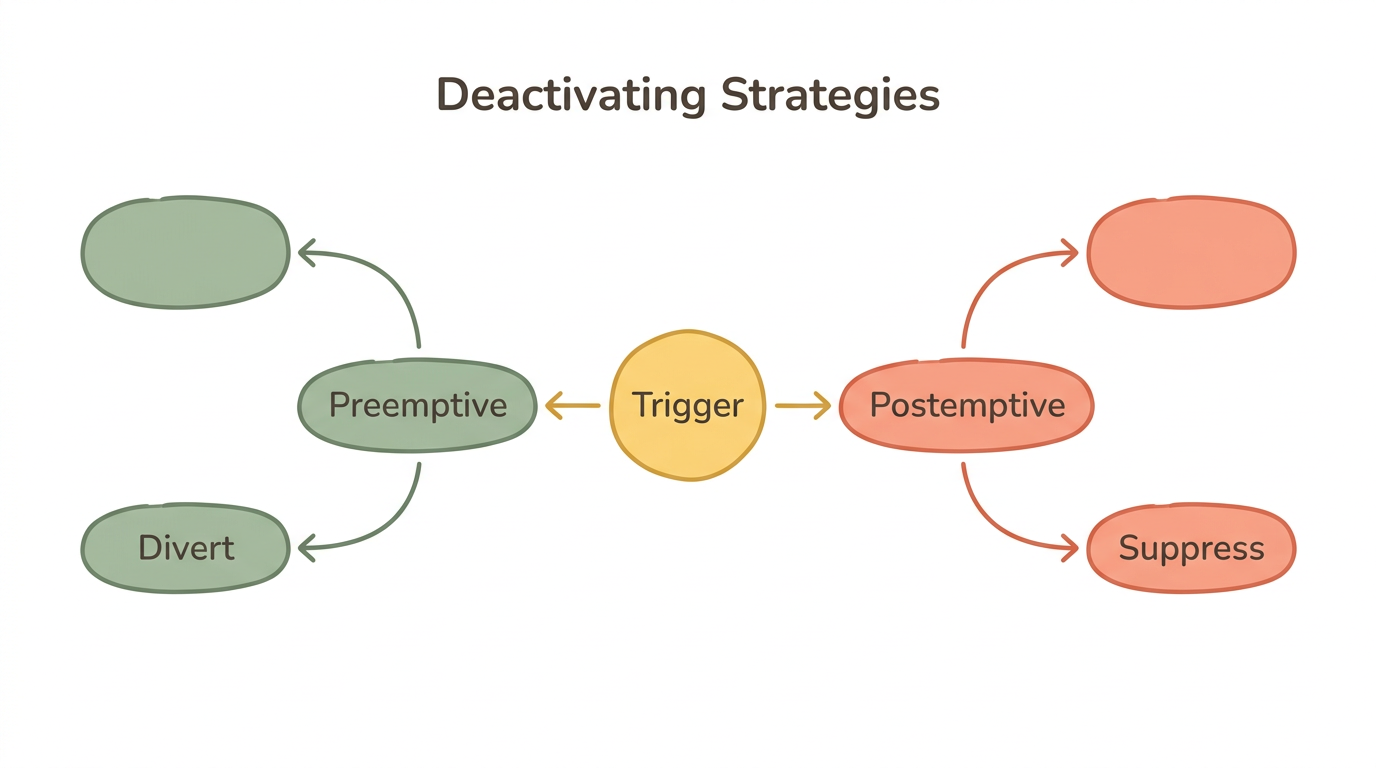
Deactivating strategies are the core mechanism of avoidant attachment—automatic processes that keep the attachment system turned off when closeness begins to feel threatening. Mikulincer and Shaver (2003) identified two distinct types: preemptive strategies, which divert attention away from threat cues before distress even activates, and postemptive strategies, which suppress or repress emotions after distress has already been triggered.
Your nervous system learned these strategies for a reason. At some point, emotional closeness was met with rejection, dismissal, or unavailability—and your system adapted by learning to handle things alone. That adaptation made sense then. Understanding how it operates now is the first step toward choosing something different.
Observable deactivating behaviors include denial of negative emotions, suppression of painful thoughts, projection of negative self-traits onto others, and repression of negative memories (Shaver and Mikulincer, 2002). In relationships, this looks like motivated inattention—a partner shares something vulnerable and the avoidant individual's attention instinctively shifts elsewhere. Not because they do not care, but because their nervous system registers closeness as a signal to protect.
The Deactivation Log (for dismissive-avoidant attachment)
- Keep a small notebook or phone note for one week
- When you notice emotional shutdown, record the situation that triggered it
- Name what you felt before the shutdown kicked in (even a guess counts)
- Rate the intensity of that pre-shutdown feeling from 1 to 10
- Identify the deactivating behavior you used: withdrawal, intellectualizing, minimizing, or changing the subject
This works for avoidant attachment because it builds awareness of the gap between felt emotion and expressed response. Deactivating strategies operate automatically—the log interrupts that automaticity by creating a moment of conscious observation, which is the first step toward choosing a different response.
How Does Avoidant Attachment Affect Relationship Satisfaction?
Avoidant attachment is more negatively associated with relationship quality than anxious attachment—across multiple large-scale meta-analyses. Li and Chan (2012) analyzed 73 studies with 21,602 individuals and found that avoidance had a stronger negative impact on general satisfaction, connectedness, and perceived support than anxiety did.
That finding can be hard to sit with if you recognize avoidant patterns in yourself. Your system developed these strategies to protect you, and they worked. The cost, though, shows up in the numbers.
Candel and Turliuc (2019) confirmed this pattern across 132 studies, finding negative associations between avoidant attachment and relationship satisfaction at both actor and partner levels—meaning your avoidance affects your own satisfaction and your partner's. The actor effects were stronger than the partner effects, which means the avoidant individual often suffers more from these patterns than they realize. Bonache et al. (2022) found an avoidance-satisfaction correlation of r = −0.63 among 175 couples—a strong effect where both partners suffer.
If you recognize yourself in these patterns, remember they developed for protective reasons—and naming them is part of shifting them. Five specific ways avoidant attachment reduces satisfaction:
- Withdraw emotionally during moments when a partner needs comfort or co-regulation
- Conflict goes unresolved because the avoidant partner shuts down rather than working through disagreements
- A partner who consistently feels unseen, unimportant, or emotionally alone in the relationship
- Difficulty expressing love, appreciation, or attachment verbally—even when the feelings exist
- Reduced physical affection and discomfort with prolonged closeness erode the sense of being wanted
What Does the Pursue-Withdraw Cycle Look Like From the Avoidant Side?
Withdrawal is the primary conflict strategy for avoidant individuals, with Bonache et al. (2022) finding that avoidance predicted withdrawal at β = 0.41—and that this withdrawal directly mediated the pathway between avoidance and low relationship satisfaction. When paired with an anxiously attached partner, this creates the pursue-withdraw cycle that erodes both partners' wellbeing.
Most descriptions of this cycle focus on the anxious partner's experience of feeling abandoned. But the avoidant partner's internal experience deserves understanding too.
When conflict escalates, the avoidant partner's nervous system does not choose indifference—it chooses safety. Through a polyvagal lens, this maps onto dorsal vagal shutdown: the oldest branch of the autonomic nervous system activates, producing numbness, emotional flatness, and a desperate need to escape the interaction (Porges). The avoidant person is not stonewalling out of cruelty. Their body is doing what it learned to do when emotional intensity exceeded what their system could process.
That does not mean withdrawal has no impact. A partner's withdrawal predicts the other partner's reduced satisfaction (β = −0.12 to −0.14, Bonache et al., 2022). The avoidant's protective strategy creates the exact outcome they fear—emotional disconnection. Understanding this is not about blame. It is about recognizing the pattern clearly enough to interrupt it.
The Pause-and-Name Practice (for dismissive-avoidant attachment, somatic/body-based)
When you feel the urge to withdraw during conflict, try this two-part approach:
In the moment: Say out loud, "I need a moment." Place one hand on your chest. Notice three physical sensations—chest tightness, jaw tension, numbness, shallow breathing.
Before returning: Name the emotion underneath the shutdown: "I think I feel overwhelmed" or "I think I feel criticized." Return to the conversation within an agreed timeframe of 15 to 30 minutes.
What you notice in your body What it might mean emotionally Chest tightness, shallow breathing Anxiety or fear of conflict escalating Jaw clenching, fists tightening Anger or frustration you haven't named Numbness, heaviness, blankness Dorsal vagal shutdown—system overwhelm Restlessness, urge to leave the room Flight response to perceived emotional threat This targets avoidant dorsal vagal shutdown by interrupting the automatic withdrawal-to-numbing sequence. Saying "I need a moment" out loud keeps the relational bridge intact while the somatic steps build a pathway from body sensation to emotional naming—bypassing the intellectualizing that avoidant strategies default to. Over time, this expands your window of tolerance for emotional intensity in conflict.
Is Avoidant Attachment the Same as Not Caring?
No—avoidant attachment is effortful neural suppression, not genuine indifference. fMRI research reveals that the avoidant brain works harder, not less, when processing social and emotional information. This is one of the most important reframes in attachment science, and it changes everything about how we understand avoidant behavior.
Vrtička et al. (2012) found that avoidant individuals show decreased activation of the ventral striatum and ventral tegmental area when viewing positive social cues like smiling faces—meaning the brain's reward system responds less to social connection. Avoidant mothers showed very low striatum and medial orbitofrontal cortex activation when viewing their own babies. This is not coldness. It is a nervous system that learned to dampen its response to closeness.
During attempts at emotional reappraisal, avoidant individuals showed persistent left amygdala activation that did not decrease—unlike non-avoidant individuals whose amygdala calmed during the same task (Vrtička et al., 2012). The brain works harder, not less—with increased dorsolateral prefrontal cortex activity reflecting the high cognitive effort required to maintain suppression (BMC Neuroscience, 2021). When the emotional load becomes too heavy, regulation breaks down under load and the suppressed emotions break through.
Perhaps most revealing: during social exclusion tasks, avoidant individuals showed decreased anterior insula and dorsal anterior cingulate cortex activation—the brain regions that register social pain. This appears as not caring but represents active neural dampening that fails when emotional intensity is high enough.
The Felt Sense Check-In (for dismissive-avoidant attachment, somatic)
- Set a timer twice daily—morning and evening—for 90 seconds
- Close your eyes and scan your body slowly from feet to head
- Notice areas of tension, numbness, or blankness without trying to change them
- Ask yourself: "What might this sensation be connected to?"
- Write one sentence about what you notice—even "I notice nothing" counts
This targets the dorsal vagal pattern of somatic disconnection that maintains the "I don't feel anything" experience common in avoidant attachment. By rebuilding interoceptive awareness—the ability to sense what is happening inside your body—you create a foundation for eventually connecting physical sensations to emotional states. Ninety seconds is short enough to stay within your window of tolerance while still building the practice.
How Does Avoidant Attachment Show Up in Intimacy and Sexuality?
Avoidant attachment shows up in intimacy as a pattern of distancing after closeness—sex experienced as physical rather than emotional, discomfort with prolonged contact, and pulling away after moments of connection. Avoidant individuals tend to report greater discomfort with prolonged physical contact and display more distancing behaviors after moments of vulnerability.
If you notice yourself pulling away after sex, wanting space after a close evening, or feeling claustrophobic when a partner wants to cuddle—your body is running a familiar program. Closeness activated your attachment system, and deactivating strategies kicked in to restore the distance that feels safe.
Research shows avoidant individuals prefer casual sexual encounters, may use fantasy or pornography as intimacy substitutes, and tend to maintain fewer long-term relationships. Post-intimacy distancing—pulling away emotionally or physically after moments of closeness—is one of the most confusing patterns for partners, who experience it as rejection.
A less visible but equally impactful pattern involves misreading positive emotions. Research found that avoidant individuals are less accurate at inferring their partners' positive emotions during conversations about love—showing reduced sensitivity to exactly the cues that build relational intimacy (PMC, 2025). Your partner may be radiating warmth and affection, and your perceptual system filters it out. This is not a character flaw. It is deactivating strategies extending into perception itself.
Does Avoidant Attachment Affect Friendships and Family Relationships?
Avoidant attachment extends well beyond romance—shaping friendships, parenting, and work relationships in ways that often go unrecognized. Meta-analytic research links avoidant attachment to loneliness at r = 0.32 (Zhang et al., 2022), reflecting the cumulative cost of deactivating strategies across all relationship domains.
Avoidant Attachment in Friendships
Four signs of avoidant attachment in friendships:
- Many acquaintances but few close friends. The social network stays wide but surface-level.
- When friends share emotional struggles, does the urge to fix, minimize, or change the subject feel automatic? That is deactivation in action.
- Pulling away when friendships cross an invisible threshold of "too close"—canceling plans, slowing response times, creating distance
- Activity-based friendships feel safer than emotion-based ones, so bonding happens over doing rather than feeling
Avoidant Attachment in Parenting and Family
Intergenerational transmission of avoidant attachment is well-documented. A 2023 study found that parental avoidance predicts offspring avoidance with 75 percent of the effect independent of depression severity (PMC, 2023). Transmission may be stronger in father-offspring and father-son dyads specifically.
In parenting, avoidant attachment can manifest as difficulty responding to a child's emotional distress, discomfort with a child's dependency needs, and an emphasis on independence and self-reliance at developmentally inappropriate ages. The child learns—implicitly—that emotions are unwelcome, and the cycle continues. Understanding this pattern is not about guilt. It is about awareness that opens the door to doing it differently with the next generation.
What Happens When Avoidant Partners Go Through a Breakup?
The post-breakup paradox defines the avoidant experience of relationship endings: avoidant individuals show fewer behavioral difficulties during the initial dissolution period but experience greater distress 4.5 years later—a finding that upends the common assumption that avoidants "get over it faster."
Fraley and Roisman found that attachment avoidance—not anxiety—predicted greater long-term distress following separation (PMC, 2018). Research on dissolution outcomes confirmed that dismissive-avoidant individuals show greater long-term loneliness and difficulty forming new relationships compared to their initial post-breakup presentation (Frontiers in Psychology, 2021).
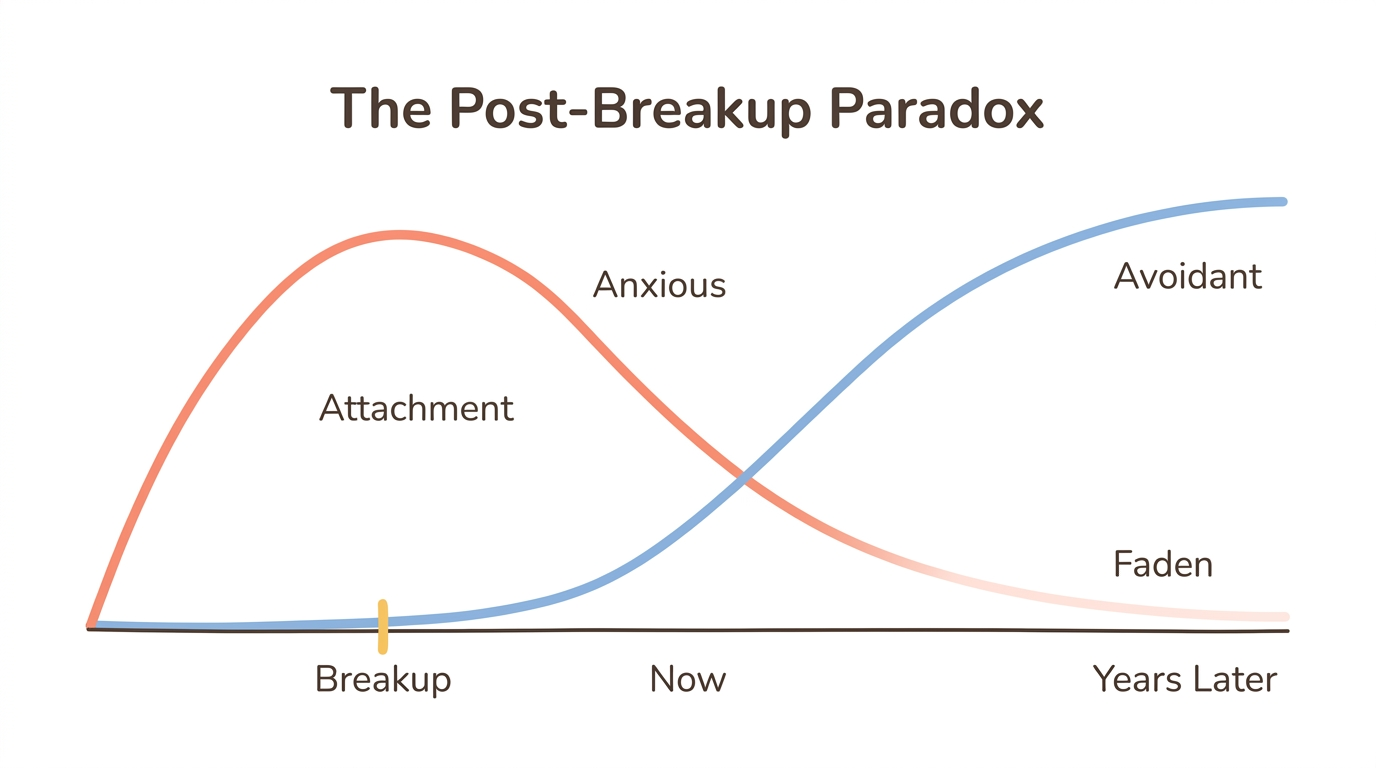
Deactivating strategies explain this paradox. Suppression works short-term but unprocessed grief accumulates. The avoidant individual bypasses the acute pain of loss through the same mechanisms they use in relationships—emotional suppression, minimizing the relationship's significance, redirecting attention to work or new pursuits. Partners, friends, and even the avoidant person themselves believe the breakup did not affect them deeply.
Months or years later, the suppressed attachment needs surface—often as chronic loneliness, difficulty trusting new partners, or an unexpected wave of grief triggered by something seemingly unrelated. The grief was never absent. It was deactivated. And deactivated emotions do not disappear. They wait.
Can Avoidant Attachment Patterns Change in Relationships?
Yes—avoidant attachment patterns can and do change. The rising prevalence of dismissive-avoidant attachment among US college students—from 11.93 percent in 1988 to 18.62 percent in 2011 (Konrath meta-analysis)—suggests cultural and environmental factors shape these patterns, meaning they are not fixed biology.
Therapeutic approaches with evidence for shifting avoidant patterns include Emotionally Focused Therapy, which directly targets the avoidant deactivation cycle by helping access vulnerable emotions underneath defensive withdrawal (Johnson). Schema Therapy addresses the emotional inhibition and unrelenting standards schemas common in dismissive avoidance. Acceptance and Commitment Therapy builds psychological flexibility toward intimacy despite discomfort—directly targeting experiential avoidance. You can explore these approaches in depth in our guide on what therapy works best for avoidant attachment.
Research on oxytocin and attachment offers a biological window into change: studies have found that intranasal oxytocin can reduce betrayal aversion and increase trust in individuals with high attachment avoidance, suggesting that the neurochemistry of trust can partially override deactivating strategies when the right conditions are present.
Earned secure attachment is the term for what this change looks like over time. You do not rewire avoidant attachment in a single insight. You rewire it by noticing the deactivation 10 percent earlier, staying present 10 percent longer, sharing 10 percent more honestly—again and again, until the new pattern becomes the familiar one.
Graduated Vulnerability Practice (for dismissive-avoidant attachment) Over four weeks, practice sharing one emotionally honest statement per week at increasing depth:
- Week 1 — Share a preference: "I actually prefer quiet evenings to big parties"
- Week 2 — Share a mild frustration: "It bothered me when that meeting ran over"
- Week 3 — Share a need: "I would like it if you checked in with me during the day"
- Week 4 — Share a fear or longing: "I worry that I am hard to get close to" or "I wish we could feel more connected"
This targets avoidant emotional inhibition by building a tolerance ladder for vulnerability. Each week expands the window of tolerance for emotional exposure in small, manageable steps. The graduated structure matters—it prevents the common avoidant experience of "trying to be vulnerable," overshooting, feeling overwhelmed, and shutting down harder than before.
How Avoidant Attachment Shows Up Across Relationship Domains
| Domain | Avoidant Pattern | What the Partner or Other Person Experiences | What Is Actually Happening Internally |
|---|---|---|---|
| Conflict | Withdrawal, stonewalling, shutting down | Feeling dismissed, abandoned, unheard | Nervous system overwhelm, dorsal vagal shutdown |
| Intimacy | Distancing after closeness, discomfort with vulnerability | Feeling rejected, confused by hot-cold pattern | Deactivating strategies triggered by closeness |
| Communication | Short responses, intellectualizing, deflecting | Feeling unable to reach the person emotionally | Suppression of emotional content requires high cognitive effort |
| Breakups | Appears fine, moves on quickly | Feels like the relationship did not matter | Suppressed grief that surfaces months or years later |
| Friendships | Keeps interactions surface-level, activity-based | Feels like the friendship has invisible limits | Discomfort with emotional dependency in any direction |
| Parenting | Difficulty responding to a child's distress | Child learns that emotions are unwelcome | Deactivating strategies becoming intergenerational |
When Should You Seek Professional Support?
Self-awareness is a powerful first step—but some patterns need more than awareness to shift. Consider seeking professional support when you notice a repeated pattern of relationships ending the same way, when you want closeness but cannot maintain it despite trying, or when you recognize avoidant patterns but experience awareness without change.
Other signals include a partner whose distress about the emotional distance has reached a breaking point, chronic loneliness despite an active social life, or difficulty being emotionally present with your children. A therapist trained in attachment—particularly in EFT, Schema Therapy, or ACT—can work with the nervous system patterns that self-help alone may not reach.
If you are in a relationship where the anxious-avoidant cycle has become entrenched, couples therapy designed for this dynamic can help both partners understand the pattern and build something different together. Seeking help is not evidence that you have failed at relationships. It is evidence that you are taking your relationships—and yourself—seriously enough to invest in change.
Frequently Asked Questions
Can avoidant attachment be healed?
Yes. Research on neuroplasticity and earned secure attachment shows avoidant patterns can change through therapy, corrective relationship experiences, and consistent practice. Therapies like EFT, Schema Therapy, and ACT show evidence for shifting deactivating strategies toward greater emotional availability.
Is avoidant attachment the same as not caring?
No. fMRI research shows avoidant individuals' brains work harder—not less—to manage emotions. Increased prefrontal cortex activity and persistent amygdala activation during emotional processing reveal effortful suppression, not genuine indifference (Vrtička et al., 2012). The appearance of "not caring" is a learned protective strategy.
Do avoidants fall in love?
Yes, avoidant individuals experience love and attachment. However, closeness activates deactivating strategies—emotional withdrawal, minimizing the relationship's importance, or focusing on a partner's flaws. These are protective responses to vulnerability, not evidence of absent feelings. Many avoidant individuals deeply want connection while simultaneously fearing it.
What triggers avoidant attachment in relationships?
Common triggers include a partner expressing strong emotions or needs, conversations about commitment or the future, prolonged physical closeness, feeling depended upon, and perceived loss of independence or autonomy. These activate the learned association between closeness and threat that formed in early attachment relationships.
How does avoidant attachment affect intimacy?
Avoidant attachment creates a pattern of distancing after closeness—pulling away after sex, discomfort with prolonged physical affection, and preference for physical over emotional intimacy. Research shows avoidant individuals also misread partners' positive emotions (PMC, 2025), reducing opportunities for the very connection both partners want.
Can an avoidant person have a successful relationship?
Yes, particularly when both partners understand the avoidant pattern and the avoidant partner actively works on graduated vulnerability. Research shows attachment security can increase within relationships when partners provide consistent, non-pressuring emotional availability. An anxious-avoidant relationship can become secure with mutual effort and understanding.
Why do avoidants come back after pulling away?
The pull-away-return cycle reflects competing needs. Closeness feels threatening, triggering withdrawal. But distance eventually activates the attachment system's longing for connection. Once enough distance restores safety, the desire for closeness returns—beginning the cycle again until consciously interrupted.
How does avoidant attachment affect friendships?
Avoidant attachment creates surface-level social networks—many acquaintances, few close friends. Avoidant individuals prefer activity-based over emotionally intimate friendships, feel uncomfortable when friends share emotional struggles, and withdraw when friendships deepen. Meta-analytic research links avoidance to loneliness at r = 0.32 (Zhang et al., 2022).
Want to Go Deeper?
Meadow includes a structured assessment to help you understand your specific attachment patterns, followed by a 66-day program of daily practices designed to build earned security.
Start your free week →References
Meta-Analyses and Large Studies
-
Li, T., and Chan, D. K. S. (2012). How anxious and avoidant attachment affect romantic relationship quality differently: A meta-analytic review. European Journal of Social Psychology, 42(4), 406–419. (73 studies, N=21,602)
-
Candel, O. S., and Turliuc, M. N. (2019). Insecure attachment and relationship satisfaction: A meta-analysis of actor and partner associations. Personality and Individual Differences, 147, 190–199. (132 studies)
-
Bonache, H., Gonzalez-Mendez, R., and Krahé, B. (2022). Adult attachment styles, conflict resolution, and relationship satisfaction. Frontiers in Psychology, 13, 752982. (N=350, 175 couples)
-
Zhang, X., Li, J., Xie, F., Chen, X., Xu, W., and Hudson, N. W. (2022). The relationship between adult attachment and mental health: A meta-analysis. Journal of Personality and Social Psychology, 123(5), 1089–1137.
Neuroscience Research
-
Vrtička, P., Andersson, F., Grandjean, D., Sander, D., and Vuilleumier, P. (2012). Individual attachment style modulates human amygdala and striatum activation during social appraisal. Social Neuroscience, 7(5), 473–484.
-
BMC Neuroscience. (2021). Neural basis of individual differences in attachment avoidance: A voxel-based morphometry study. BMC Neuroscience, 22, Article 17.
-
De Dreu, C. K. W., Greer, L. L., Van Kleef, G. A., Shalvi, S., and Handgraaf, M. J. J. (2011). Oxytocin promotes human ethnocentrism. Psychoneuroendocrinology, 36(1), 67–74.
Attachment Theory Foundations
-
Mikulincer, M., and Shaver, P. R. (2003). The attachment behavioral system in adulthood: Activation, psychodynamics, and interpersonal processes. Advances in Experimental Social Psychology, 35, 53–152.
-
Shaver, P. R., and Mikulincer, M. (2002). Attachment-related psychodynamics. Attachment and Human Development, 4(2), 133–161.
-
Hazan, C., and Shaver, P. (1987). Romantic love conceptualized as an attachment process. Journal of Personality and Social Psychology, 52(3), 511–524.
-
Fraley, R. C. A brief overview of adult attachment theory and research. University of Illinois at Urbana-Champaign.
Prevalence and Trends
-
Konrath, S. H., Chopik, W. J., Hsing, C. K., and O'Brien, E. (2014). Changes in adult attachment styles in American college students over time: A meta-analysis. Personality and Social Psychology Review, 18(4), 326–348.
-
National Comorbidity Survey Replication (NCS-R). Prevalence of adult attachment styles (N=5,645).
Breakup, Loneliness, and Long-Term Outcomes
-
Fraley, R. C., and Roisman, G. I. (2018). The development of adult attachment styles: Four lessons. Current Opinion in Psychology, 25, 26–30.
-
Frontiers in Psychology. (2021). Relationship dissolution and attachment: A systematic review. Frontiers in Psychology, 12, 662237.
Intergenerational and Broader Impact
-
PMC. (2023). Intergenerational transmission of avoidant attachment: The role of parenting and depression. (Father-offspring transmission findings)
-
PMC. (2025). Avoidant attachment and accuracy in perceiving partner emotions during conversations about love.
Polyvagal Theory and Somatic Approaches
-
Porges, S. W. The polyvagal theory: Neurophysiological foundations of emotions, attachment, communication, and self-regulation. (Dorsal vagal mapping to avoidant patterns)
-
Trauma Solutions. Attachment styles and the nervous system: A polyvagal primer for therapists.
-
Johnson, S. M. Emotionally Focused Therapy for couples. (EFT approach to avoidant deactivation cycles)
This article is for educational purposes only and is not a substitute for professional mental health advice, diagnosis, or treatment. If you are experiencing significant distress in your relationships, please consult a licensed mental health professional. Meadow provides self-help tools and psychoeducation—not therapy.