Avoidant attachment is a relational pattern where a person instinctively distances themselves from emotional closeness, relying on independence as a primary coping strategy. Research estimates that approximately 22–25% of adults have an avoidant attachment style (Hazan & Shaver, 1987), making it roughly as common as anxious attachment — about 1 in 4 people.
You may have arrived here because someone called you "emotionally unavailable," or because you noticed you pull away every time a relationship gets serious. Avoidant attachment is often the hardest style to self-identify because the core defense mechanism involves not noticing your own emotional needs. The very thing that protects you also hides the pattern from view. This article will help you see what's hard to see in yourself.
Key takeaway: Avoidant attachment affects roughly 22–25% of adults and shows up as emotional distancing, compulsive self-reliance, and discomfort with closeness — what researchers call deactivating strategies. Your body may carry stress signals even when your mind says "I'm fine." Recognizing these patterns is the first step toward earned security.
What Is Avoidant Attachment and Why Is It Hard to Recognize?
Avoidant attachment is a pattern of relating where a person suppresses their need for emotional closeness and relies almost exclusively on themselves. Researchers Mikulincer and Shaver (2003, 2007) named the core mechanism behind this pattern deactivating strategies — an umbrella term for the ways avoidant individuals keep emotional distance.
Deactivating strategies include suppression of attachment needs, compulsive self-reliance, emotional distancing, stress denial, and thought suppression. These aren't conscious choices. They're automatic responses your nervous system learned early in life to keep you safe when closeness wasn't rewarded — or when it was met with rejection.
Avoidant attachment is uniquely difficult to self-diagnose. If your primary defense is suppressing emotional needs, you're unlikely to notice those needs going unmet. A person with anxious attachment feels their distress acutely. A person with avoidant attachment often feels... fine. That "fine" is the pattern.
The prevalence of avoidant attachment may also be rising. Data from US college students shows dismissing attachment increased from 11.93% in 1988 to 18.62% in 2011 — a significant upward trend that suggests cultural factors are reinforcing avoidant patterns in younger generations.
Bartholomew and Horowitz (1991) identified two distinct subtypes of avoidant attachment — dismissive-avoidant and fearful-avoidant — each with different inner experiences and different paths toward healing. We'll explore both throughout this article.
The Independence Audit
- Ask yourself: When was the last time I asked someone for emotional support?
- When a partner expresses a need, is my first instinct relief or discomfort?
- Do I feel more like "myself" alone than with a partner?
- Jot down your answers without editing or judging them
- Notice any resistance to answering — that resistance itself is information
What Are the Core Signs of Avoidant Attachment?
The most recognizable signs of avoidant attachment are patterns of emotional distancing that intensify as relationships deepen. Research by Zhang et al. (2022) found that attachment avoidance explains nearly half the variance in relationship satisfaction — meaning these patterns have an outsized impact on how relationships feel for both partners.
Here are 10 core signs, organized from most to least obvious:
Behavioral Signs (What Others See)
-
Pulling away when things get serious. You feel interested early on, then lose attraction as the relationship deepens. The "spark" fades right when your partner starts to feel safe.
-
Keeping partners at arm's length. You avoid labels, delay commitment, or maintain emotional distance through humor, sarcasm, or changing the subject during vulnerable conversations.
-
Rarely initiating repair after conflict. After an argument, you wait for things to "blow over" rather than addressing the rupture directly. Conflict feels pointless or exhausting.
-
Idealizing past partners or singlehood. You compare your current partner unfavorably to an ex, or frequently fantasize about being single. This mental escape is a deactivating strategy that creates emotional distance.
-
Irritation when a partner expresses needs. Requests for closeness, reassurance, or emotional conversations trigger annoyance or a feeling of being suffocated — even when the request is reasonable.
Internal Signs (What You Experience)
-
Valuing independence above connection. Freedom feels like your most important value. The idea of needing someone feels uncomfortable, even shameful.
-
Difficulty identifying or naming emotions. When asked "How do you feel?" you draw a blank, default to "fine," or intellectualize the answer. Emotions feel vague and hard to pin down.
-
Mentally checking out during emotional conversations. Your mind wanders, you feel foggy, or you start planning your exit. Your body is present but your attention has quietly left.
-
Feeling "trapped" in relationships. Commitment feels like a loss of self rather than a gain. You may fantasize about escape even when nothing is objectively wrong.
-
Compulsive self-reliance. You handle everything alone — not because you prefer it, but because depending on someone feels fundamentally unsafe.
If you recognize five or more of these patterns, avoidant attachment may be shaping your relationship experiences. Recognizing the pattern is not a diagnosis — it's an invitation to understand yourself more clearly.
The Relationship Timeline Reflection
- List your last 3 significant relationships (or close friendships)
- For each, note when you felt most comfortable and most uncomfortable
- Look for patterns: did discomfort peak when closeness increased?
- Write one sentence summarizing what you notice
- Spend 30 seconds sitting with whatever comes up — no need to fix it
What's the Difference Between Dismissive Avoidant and Fearful Avoidant?
Dismissive-avoidant and fearful-avoidant are two distinct subtypes of avoidant attachment identified by Bartholomew and Horowitz (1991). The difference lies in how each subtype views themselves and others — and the inner experience is dramatically different.
A dismissive-avoidant person holds a positive self-model ("I'm fine on my own") and a negative view of others ("People are unreliable"). They maintain consistent emotional distance, experience low attachment anxiety, and genuinely feel comfortable alone. Their avoidance looks steady and self-assured from the outside.
A fearful-avoidant person holds a negative self-model ("I'm not worthy of love") and a negative view of others ("Others will hurt me"). They crave closeness but fear rejection, which creates the painful experience of oscillating between clinging and withdrawing. Their avoidance looks chaotic — they may panic when a partner doesn't text back one day, then go emotionally cold the next.
| Dimension | Dismissive Avoidant | Fearful Avoidant |
|---|---|---|
| Self-image | Positive ("I'm fine on my own") | Negative ("I'm not worthy of love") |
| View of others | Negative ("Others are unreliable") | Negative ("Others will hurt me") |
| Core fear | Loss of independence | Rejection AND intimacy |
| In relationships | Consistent emotional distance | Oscillates between clinging and withdrawing |
| Attachment anxiety | Low | High |
| When a partner gets close | Feels suffocated, pulls away steadily | Wants closeness but panics, push-pull |
| After a breakup | Relief, quickly moves on (outwardly) | Devastation, may try to reconnect then retreat |
| Common thought | "I don't need anyone" | "I want love but I'll only get hurt" |
Both subtypes use deactivating strategies, but fearful avoidants also use hyperactivating strategies — the same protest behaviors seen in anxious attachment. This dual pattern makes fearful avoidance particularly confusing to live with.
Which Pattern Fits?
- Complete this sentence: "When a relationship ends, my first feeling is usually: (a) relief, (b) devastation, (c) both at different moments"
- Complete this sentence: "When someone gets close to me, I feel: (a) nothing much / mildly uncomfortable, (b) panicked longing mixed with dread"
- Mostly (a) answers suggest dismissive-avoidant patterns; mostly (b) or (c) answers suggest fearful-avoidant patterns
- Neither answer is wrong — both are your nervous system's learned response to closeness
How Does Avoidant Attachment Show Up in Your Body?
Avoidant attachment lives in the body as much as the mind — and your body often tells the truth before your thoughts catch up. Research reveals a striking cortisol-self-report disconnect: avoidant individuals show elevated physiological stress (increased heart rate, higher cortisol) during interpersonal conflict while simultaneously reporting low subjective distress. Your body knows even when your mind doesn't.
Porges' polyvagal theory explains this through the dorsal vagal shutdown response. When emotional closeness feels threatening, your nervous system doesn't go into fight-or-flight — it goes into freeze. The dorsal vagal pathway triggers disconnection, numbness, and emotional flatness. Deb Dana's "polyvagal ladder" framework describes this as dropping from ventral vagal (safe connection) past sympathetic activation (fight/flight) into dorsal vagal (shutdown/freeze).
Common somatic signatures of avoidant attachment include:
- Chronic muscle tension in the neck, jaw, and back — what somatic therapists call physical armoring
- Shallow or constricted breathing, including unconscious breath-holding during emotional moments
- Headaches, GI problems, or chest tightness without clear medical cause
- A pounding heart combined with an urge to flee when someone asks "How are you feeling?"
- Feeling physically heavy, foggy, or "checked out" during intimate conversations
These are not signs of weakness. They are your nervous system doing exactly what it learned to do — protecting you by shutting down the signals that once brought pain instead of comfort.
The 60-Second Body Check-In (somatic exercise)
- Pause and close your eyes
- Think of a recent moment when a partner or close friend expressed a strong emotional need toward you
- Notice: where does your body tense? Jaw? Shoulders? Chest?
- Notice your breathing — did it get shallower or stop momentarily?
- Rate your physical tension on a scale of 1–10
- Now rate your emotional distress on a scale of 1–10
- If there's a gap between those numbers, that's the disconnect worth paying attention to
Is It Healthy Independence or Avoidant Attachment?
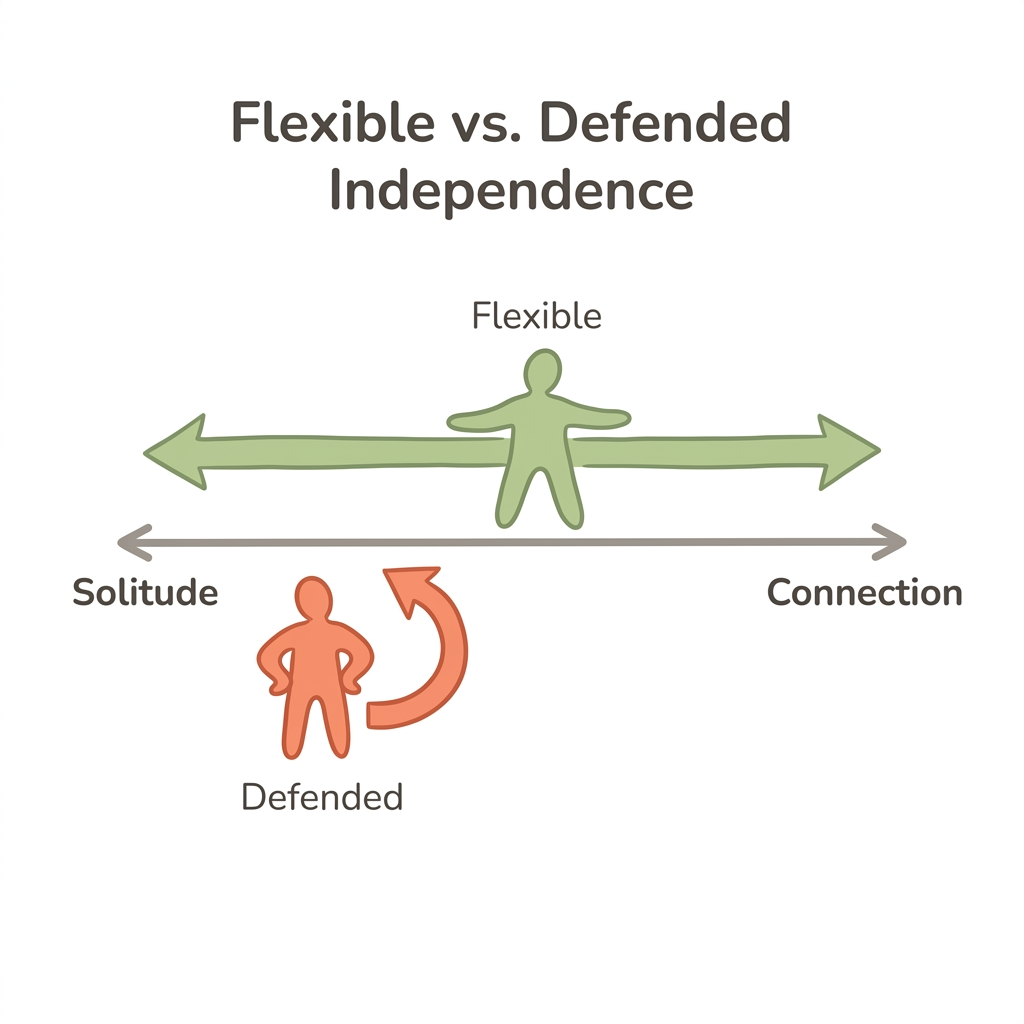
Healthy independence is flexible — avoidant independence is compulsive. The difference between the two isn't about how much time you spend alone, but about whether solitude is a choice or an automatic escape from vulnerability.
Healthy independence looks like: being able to be alone AND connect deeply, choosing solitude from a place of fullness, identifying and expressing needs when they arise, and experiencing relationships as enhancing your life rather than threatening it.
Avoidant independence looks like: needing to be alone to feel safe, using solitude as an escape from emotional discomfort, having difficulty identifying your own needs, and experiencing closeness as fundamentally threatening to your sense of self.
The key differentiator is flexibility. A securely attached person can move between independence and connection without distress. An avoidantly attached person gets stuck in independence — not because they've chosen it, but because their nervous system won't let them relax into anything else. Healthy independence is a choice; avoidant independence is compulsive.
A useful clue: secure independence feels expansive. You enjoy your solitude and you enjoy your connections. Avoidant independence feels defended. You enjoy your solitude, but closeness brings a creeping tension — a pull to retreat, even when part of you wants to stay.
The Flexibility Test
- Ask yourself: Can I ask for help when I need it, or does asking feel unbearable?
- When I choose to be alone, am I moving toward something I enjoy or away from emotional discomfort?
- Do I feel energized after deep conversations, or drained and relieved when they end?
- Flexible answers suggest healthy independence; rigid patterns suggest avoidance
- Sit with your answers for 30 seconds — notice what your body does as you consider them
What Causes Avoidant Attachment?
Avoidant attachment typically develops in childhood when caregivers are emotionally unavailable, dismissive of emotional needs, or reward independence and toughness over emotional expression. The child learns a powerful implicit lesson: "My needs won't be met, so I'll stop having them." This isn't a conscious decision — it's an adaptive response that once made perfect sense.
Research on infant attachment found that 14.7% of children show avoidant attachment patterns in a meta-analysis of over 20,000 participants. These children learn early to suppress crying, avoid seeking comfort, and self-soothe — not because they don't need connection, but because reaching for it brought indifference or rejection.
The effects run deeper than behavior. Studies have linked attachment avoidance to epigenetic modifications — changes in gene expression caused by experience rather than DNA sequence. Specifically, avoidant attachment is associated with methylation of the oxytocin receptor gene (OXTR) and the glucocorticoid receptor gene (NR3C1), suggesting early attachment experiences create lasting biological changes in stress and bonding systems.
Perhaps the most striking finding is the oxytocin paradox. Oxytocin — often called the "bonding hormone" — increases social affiliation and cooperation in people with low attachment avoidance. But in people with high attachment avoidance, intranasal oxytocin had the opposite effect: it increased detection of disgust faces rather than promoting closeness. The same hormone that helps secure individuals bond actually heightens avoidant individuals' vigilance. Your biology adapted to your early relational world.
Your nervous system learned this response for good reason. It kept you safe. And now, with awareness, you can begin to teach it something new.
The Origin Story Sketch
- Write 2–3 sentences about how emotions were handled in your childhood home
- Complete the sentence: "When I was upset as a child, the adults around me usually…"
- Notice if there's a connection between that response and how you handle emotions now
- No judgment — just noticing. Spend 30 seconds with whatever comes up
Can Avoidant Attachment Be Changed?
Yes — attachment researchers call it earned security, and it's one of the most hopeful findings in the field. Roisman et al. (2002) demonstrated that individuals can shift from insecure to secure attachment through therapy and reparative relationships. A 2016 case study published in the American Journal of Psychotherapy documented full remission of avoidant patterns through long-term psychodynamic therapy.
Several evidence-based approaches are particularly effective for avoidant attachment:
- Emotionally Focused Therapy (EFT) helps access vulnerable emotions — fear, longing, sadness — that avoidant defenses typically suppress (Levy & Johnson, 2018)
- Schema Therapy targets core beliefs driving avoidance, such as "Depending on others is weakness" or "I don't need anyone"
- Somatic Experiencing reconnects you with suppressed physical sensations, addressing the body-level patterns discussed earlier
- Acceptance and Commitment Therapy (ACT) builds tolerance for difficult emotions while committing to values-aligned relationship behaviors
Here's something worth acknowledging: research shows avoidant attachment predicts less willingness to seek therapy, less self-disclosure in sessions, and higher dropout rates. The defense mechanism that keeps you from closeness also keeps you from the help that could change the pattern. The fact that you're reading this article is already a break in the pattern.
You don't rewire attachment in a single insight. You rewire it by noticing 10% earlier, responding 10% differently, 10% more often. Graduated vulnerability — small, repeated acts of emotional openness — is how your nervous system learns that closeness can be safe.
The Micro-Vulnerability Practice
- This week, try one small act of emotional openness
- Tell someone "I missed you" when you mean it
- Or ask for help with something you'd normally handle alone
- Or share one feeling — even something small like "That made me happy"
- Notice what happens in your body before, during, and after
- Repeat next week with a slightly bigger step
When Should You Seek Professional Help?
Consider working with a therapist if avoidant patterns are causing you significant distress, if your relationships consistently end in the same way, if you feel unable to connect despite wanting to, or if the exercises in this article trigger overwhelming shutdown or numbness.
A therapist trained in attachment theory — particularly one who uses EFT, schema therapy, or somatic approaches — can provide the safe relational experience that helps your nervous system learn a new pattern. You don't have to do this alone, even if every instinct tells you that you should.
Look for therapists who specifically list attachment theory, EFT, or somatic experiencing in their specialties. The relationship with your therapist becomes a practice ground for the skills you're building — and that's by design, not a side effect.
Frequently Asked Questions
What are the signs of avoidant attachment?
Core signs include discomfort with emotional intimacy, pulling away when relationships deepen, compulsive self-reliance, difficulty identifying your own emotions, and feeling suffocated by a partner's needs. Your body may also show signs — chronic tension, shallow breathing, and elevated stress responses — even when you consciously feel fine.
What causes avoidant attachment?
Avoidant attachment typically develops in childhood when caregivers are emotionally unavailable or dismissive of a child's emotional needs. The child learns to suppress attachment needs for self-protection. Research shows these early experiences can create lasting biological changes through epigenetic modifications to stress and bonding genes (OXTR and NR3C1 methylation).
Can avoidant attachment be healed?
Yes. Research on earned security (Roisman et al., 2002) shows attachment styles can change through therapy and reparative relationships. A 2016 case study in the American Journal of Psychotherapy documented full remission of avoidant patterns through long-term therapy. Change is gradual and non-linear, but it is well-supported by evidence.
What is the difference between dismissive avoidant and fearful avoidant?
Dismissive avoidants maintain high self-esteem and consistent emotional distance — they genuinely feel comfortable alone and experience low attachment anxiety. Fearful avoidants crave closeness but fear rejection, oscillating between clinging and withdrawing with high attachment anxiety. The distinction comes from Bartholomew and Horowitz's (1991) four-category model.
Do avoidant people love their partners?
Yes. Avoidant individuals experience love but struggle to express it due to deeply ingrained deactivating strategies that suppress emotional vulnerability. Research shows they experience elevated physiological stress during conflict — their bodies register care and distress even when their words or behavior suggest indifference.
Why do I shut down when my partner wants to talk?
Emotional shutdown during intimate conversations is a classic deactivating strategy. Your nervous system perceives emotional closeness as a threat and activates the dorsal vagal "freeze" response — a pattern described by Porges' polyvagal theory. This isn't a conscious choice or character flaw. It's an automatic protective response learned early in life that can be gradually rewired.
What's the difference between being independent and being avoidant?
Healthy independence is flexible — you can be alone and connect deeply when you choose to. Avoidant independence is compulsive — you need distance to feel safe, and closeness triggers discomfort or automatic shutdown. The key test is whether you can ask for help when you genuinely need it without significant distress.
Can an anxious and avoidant person make it work?
The anxious-avoidant pairing creates a painful pursue-withdraw cycle, but it can work with mutual awareness and effort. Both partners need to understand their attachment triggers: the anxious partner's pursuit activates the avoidant's withdrawal, which amplifies pursuit. Couples therapy — especially EFT — can effectively interrupt this cycle.
Want to Go Deeper?
Meadow includes a structured assessment to help you understand your specific attachment patterns, followed by a 66-day program of daily practices designed to build earned security.
Start your free week →References
Foundational Attachment Research
- Hazan, C., & Shaver, P. (1987). Romantic love conceptualized as an attachment process. Journal of Personality and Social Psychology, 52(3), 511–524.
- Bartholomew, K., & Horowitz, L. M. (1991). Attachment styles among young adults: A test of a four-category model. Journal of Personality and Social Psychology, 61(2), 226–244.
- Mikulincer, M., & Shaver, P. R. (2003). The attachment behavioral system in adulthood: Activation, psychodynamics, and interpersonal processes. Advances in Experimental Social Psychology, 35, 53–152.
- Mikulincer, M., & Shaver, P. R. (2007). Attachment in adulthood: Structure, dynamics, and change. Guilford Press.
Neuroscience & Biology
- Frontiers in Human Neuroscience (2017). Neural correlates of attachment style differences. Frontiers in Human Neuroscience, 11, 136.
- PMC cortisol study. Cortisol reactivity and self-report disconnect in avoidant attachment. PMC/NIH.
- PMC oxytocin study. Differential effects of intranasal oxytocin by attachment style. PMC/NIH.
- Tandfonline (2018). Epigenetic modifications of OXTR and NR3C1 associated with attachment avoidance. Attachment & Human Development.
Therapeutic Approaches
- Roisman, G. I., Padrón, E., Sroufe, L. A., & Egeland, B. (2002). Earned-secure attachment status in retrospect and prospect. Child Development, 73(4), 1204–1219.
- Levy, K. N., & Johnson, S. M. (2018). Attachment and psychotherapy: Implications from empirical research. Canadian Psychology, 59(1), 89–98.
- American Journal of Psychotherapy (2016). Earned security through long-term psychodynamic therapy: A case study. American Journal of Psychotherapy, 70(3), 233.
Prevalence & Trends
- Zhang, X., et al. (2022). Attachment avoidance and mental health: A meta-analysis. Personality and Individual Differences.
- Heirloom Counseling (2021). Dismissing attachment trend data among US college students, 1988–2011.
Polyvagal & Somatic
- Porges, S. W. (2011). The polyvagal theory: Neurophysiological foundations of emotions, attachment, communication, and self-regulation. Norton.
- Dana, D. (2018). The polyvagal theory in therapy: Engaging the rhythm of regulation. Norton.
- Trauma Solutions. Somatic signatures of avoidant attachment and attachment-informed somatic work.
This article is for educational purposes only and is not a substitute for professional mental health advice, diagnosis, or treatment. If you're struggling with attachment patterns that affect your daily life or relationships, please consult a licensed mental health professional. Attachment styles exist on a spectrum, and self-identification through an article is not equivalent to clinical assessment.