Communicating your needs in a relationship means clearly expressing what you require emotionally, physically, or practically from a partner without activating their defensive system. Gottman's research shows that 96 percent of the time, the outcome of a conversation can be predicted from its first three minutes — a harsh startup almost guarantees a harsh ending (Gottman Institute).
You have probably rehearsed exactly what to say, only to have your partner shut down, get defensive, or escalate. This is not a failure of your message — it is a nervous system collision. Your attachment style determines your default communication pattern, and your partner's attachment style determines how they receive it. The techniques in this article bridge that gap with neuroscience-backed strategies that work with your biology, not against it.
Key takeaway: Your attachment style shapes how you raise and receive needs in a relationship. Research shows 96 percent of conversations end the way they start, so how you open matters more than what you say. Combining soft startups, nervous system awareness, and attachment-specific language lets you express needs while keeping your partner's defenses down.
Why Does My Partner Get Defensive When I Share My Feelings?
Defensiveness is a nervous system response, not a character flaw. When your partner perceives threat — even unintentionally from your tone, posture, or facial tension — their body shifts into a protective state before their thinking brain can process your actual words. This is what polyvagal theory calls neuroception: the nervous system's unconscious scanning for cues of safety or danger (Porges, 2022).
Your partner's brain is constantly reading your tone before it registers your words. Warm vocal prosody, relaxed facial muscles, and gentle eye contact activate what Porges calls the ventral vagal social engagement system — the neural circuit that signals "you are safe here." When that circuit is offline, the amygdala takes over and productive listening becomes nearly impossible.
Gottman's research on physiological flooding confirms this at the body level. When heart rate climbs above 100 BPM, adrenaline surges, blood pressure rises, and the sympathetic nervous system takes control. In this state, your partner physically cannot hear you clearly or respond thoughtfully (Gottman Institute). Lieberman and colleagues (2007) found that simply naming emotions — "I notice I am feeling frustrated" — reduces amygdala reactivity and increases prefrontal cortex engagement, creating a neurological opening for real dialogue.
Your nervous system learned to broadcast urgency for good reason. It kept you connected to caregivers who required intensity to respond. And now you can teach it something new.
The Safety Signal Scan
- Before speaking, soften your facial muscles — unclench your jaw, relax your forehead
- Drop your shoulders away from your ears
- Slow your breathing: inhale for 4 counts through your nose, exhale for 6 counts through your mouth
- Place one hand on your chest and notice it settling
- Use a warm, measured tone for your first sentence — this activates your partner's ventral vagal system
- Try this for 30 seconds before you begin the conversation
How Does Your Attachment Style Shape the Way You Ask for What You Need?
Your attachment style creates a default communication pattern that activates automatically under stress. Mikulincer and Shaver (2003, 2007) found that securely attached individuals communicate feelings "accurately, freely, and without distortions," while insecure attachment styles distort communication in predictable directions.
Anxiously attached individuals tend toward hyperactivation — over-disclosing, pursuing, escalating urgency, and maintaining an exaggerated focus on personal vulnerabilities that can overwhelm mutual dialogue (Mikulincer & Shaver, 2007). If you recognize anxious attachment patterns in yourself, you may notice that stress makes you talk more, louder, and faster.
Avoidantly attached individuals use deactivating strategies — suppressing attachment emotions, minimizing needs, and withdrawing from emotional conversations (PMC, 2024). If you identify with avoidant attachment, you may notice that stress makes you go quiet, change the subject, or leave the room.
Disorganized attachment oscillates between both patterns — pursuing intensely one moment, withdrawing the next — creating confusion for both partners.
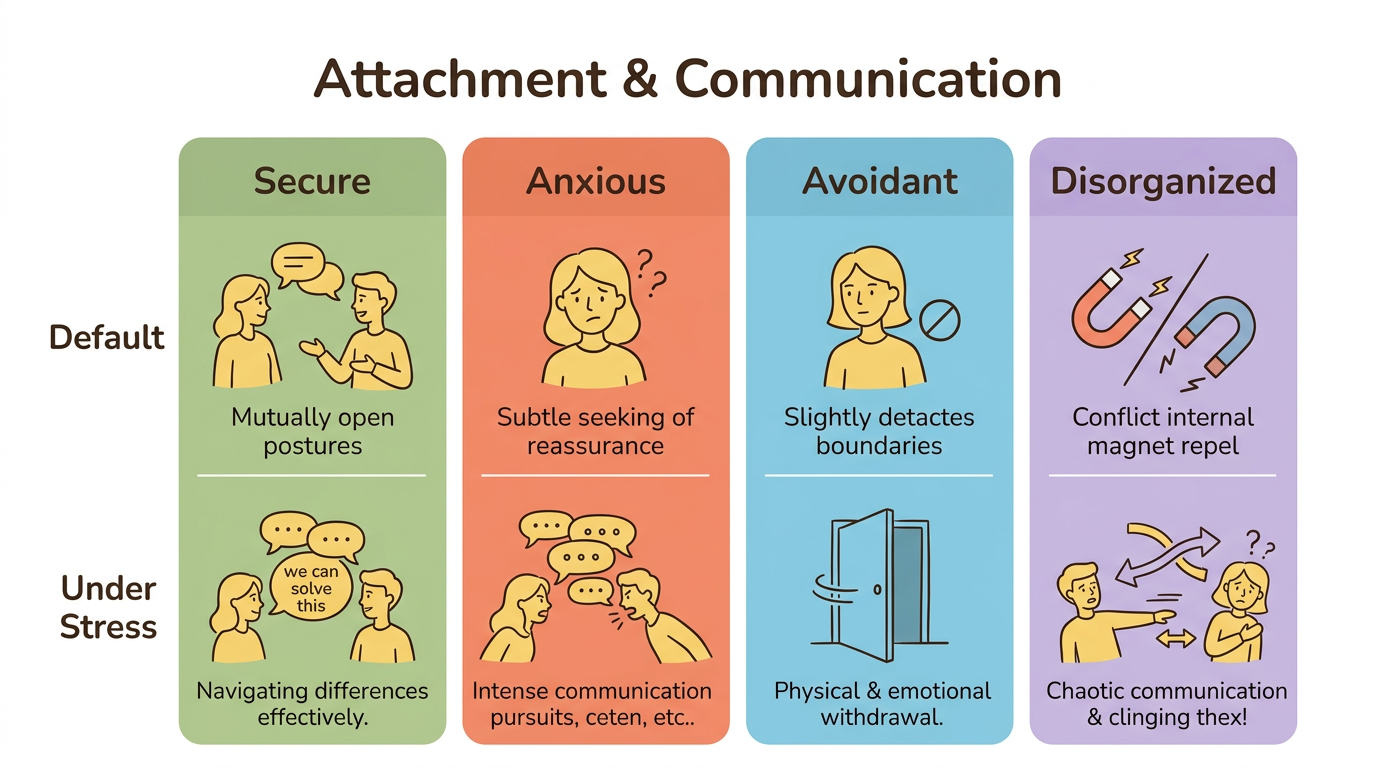
These patterns collide in what researchers call the demand-withdraw cycle: the anxious partner seeks closeness, the avoidant partner distances, and the anxious partner intensifies pursuit (PMC, 2022). This is one of the most destructive relational cycles, and it mirrors the panic you may feel when your partner goes silent.
A study of 170 individuals found that attachment orientations predicted 22 percent of the variance in criticism, defensiveness, contempt, and stonewalling — Gottman's "Four Horsemen" of relationship breakdown — above and beyond relationship satisfaction. Attachment anxiety was an especially strong predictor (Dillow, 2011). Li and Chan's (2012) meta-analysis confirmed that both anxiety and avoidance are detrimental to relationship quality, with avoidance being more negatively associated with general satisfaction and support.
| Secure | Anxious | Avoidant | Disorganized | |
|---|---|---|---|---|
| Default pattern | Open, balanced disclosure | Over-disclose, pursue, escalate | Under-disclose, withdraw, minimize | Oscillate between pursuit and withdrawal |
| Under stress | Seeks resolution calmly | Hyperactivates — louder, more urgent | Deactivates — shuts down, stonewalls | Freezes or swings unpredictably |
| Common "Four Horsemen" risk | Low risk | Criticism, defensiveness | Stonewalling, contempt via dismissal | All four |
| What they need to hear first | Direct honesty | "I'm not leaving" (reassurance) | "Take the time you need" (space) | "You're safe here" (safety) |
| Growth edge | Continued openness | Pause before pursuing; tolerate silence | Lean into discomfort; name one feeling | Ground in body; choose one response |
Identify Your Communication Default
- Think of your last unresolved argument with your partner
- Did you pursue and escalate, or withdraw and shut down?
- Did you over-explain your need or under-explain it?
- Did your body feel activated (racing heart, chest tightness, heat) or numb (flat, checked-out, disconnected)?
- Write down the pattern you notice — this is your attachment style's communication signature
What Is the Best Way to Start a Difficult Conversation?
The best way to start a difficult conversation is with a soft startup — a Gottman-researched technique that replaces blame with personal experience. Gottman's research found that 96 percent of the time, the outcome of a conversation can be predicted from how it begins. A harsh startup almost guarantees a harsh ending.
A harsh startup sounds like: "You never listen to me. You only care about yourself." A soft startup sounds like: "I feel unheard when I share something and the topic changes. I need to feel like my words land with you."
The soft startup formula has three parts:
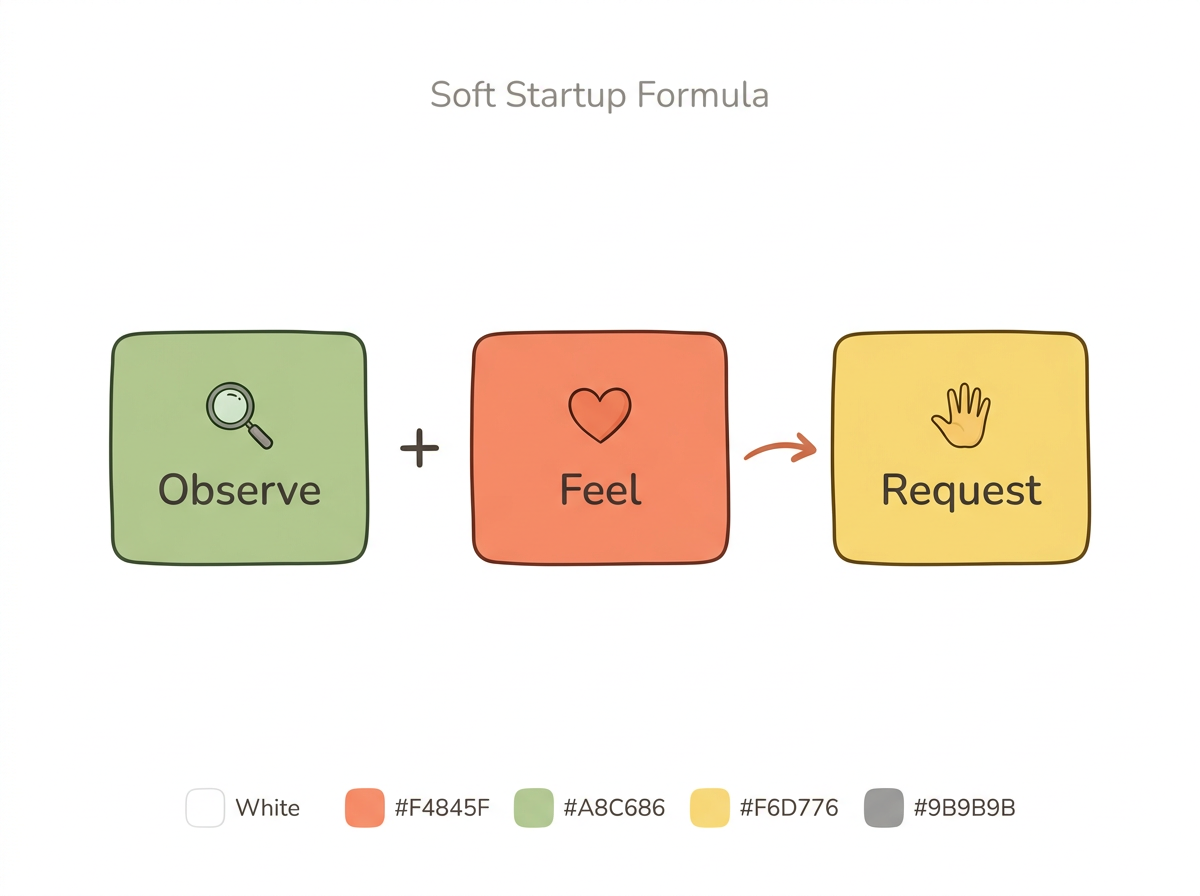
- Describe without judgment — "When plans change at the last minute…" (not "When you flake on me again…")
- Express your feeling — "I feel anxious and unimportant…"
- State a positive need — what you want, not what you do not want: "I need a heads-up by the morning if plans might shift" (not "Stop being so unreliable")
The difference between these approaches is not just politeness. A harsh startup triggers your partner's amygdala. A soft startup engages their prefrontal cortex — the part of the brain that can actually listen, empathize, and problem-solve.
The Soft Startup Rewrite
- Write down the last critical thing you said — or wanted to say — to your partner
- Circle any "you always" or "you never" language
- Rewrite it using the formula: "I feel [emotion] when [specific observation]. I need [positive request]."
- Read both versions aloud and notice how your body feels saying each one — the tension difference is your nervous system telling you which version feels safer to receive
What Communication Frameworks Do Therapists Actually Recommend?
Therapists most commonly recommend three evidence-based frameworks for expressing needs: Nonviolent Communication (Rosenberg), DEAR MAN from Dialectical Behavior Therapy (Linehan), and Gottman's soft startup. Each approaches the same problem from a slightly different angle, and combining their strengths creates a more complete communication tool.
Nonviolent Communication (NVC) follows four steps: observation, feeling, need, request. "When I see dishes in the sink for two days (observation), I feel overwhelmed (feeling) because I need shared responsibility (need). Would you be willing to do them tonight? (request)." Emerging research supports NVC-informed approaches for helping couples navigate difficult conversations (UW Research).
DEAR MAN from DBT adds structure for staying on track: Describe the situation factually, Express your feelings, Assert your need, Reinforce by explaining benefits, stay Mindful and on topic, Appear confident, and Negotiate. The companion skill GIVE (Gentle, Interested, Validate, Easy manner) preserves the relationship during the conversation.
Soft startup (Gottman) focuses specifically on the opening — the make-or-break moment — emphasizing "I" language, no blame, and stating what you want rather than what is missing.
These frameworks overlap significantly. Synthesizing them creates a single, attachment-aware communication template.
The Meadow Communication Template
- Body check — Am I regulated? Is my heart rate steady, my breathing even? If not, use the Safety Signal Scan first.
- Observation — "When [factual, non-judgmental observation]…"
- Feeling — "I feel [specific emotion word]…"
- Need — "because I need [core need: safety, closeness, respect, predictability]…"
- Request — "Would you be willing to [specific, doable action]?"
- Reinforce — "That would help me feel [positive outcome: connected, secure, valued]."
- Negotiate — "What would work for you?"
This template works because it respects both nervous systems. You regulate yourself first (step 1), speak from your experience (steps 2 through 4), make a concrete ask (step 5), show your partner why it matters (step 6), and leave room for their reality (step 7).
How Can You Communicate with Your Partner Based on Their Attachment Style?
The most effective communication adapts to your partner's attachment style by leading with what they need to hear first. Generic advice like "use I-statements" misses the crucial variable: what feels safe to one nervous system may feel threatening to another. Attachment-pairing scripts close this gap.
If You Are Anxious, Speaking to an Avoidant Partner
Your avoidant partner needs reassurance of space before they can hear your need. Lead with brevity and autonomy.
Example: "I want to bring something up, and it does not need to be a long conversation. I feel disconnected when we do not check in during the day. Would you be open to one text at lunch? No pressure on the length — just a touchpoint."
Keep it concise. Resist the urge to over-explain. Your partner's nervous system will stay more open with a shorter conversation.
If You Are Avoidant, Speaking to an Anxious Partner
Your anxious partner needs reassurance of connection before they can tolerate your need for space. Lead with commitment and do not delay.
Example: "I love you and I'm not going anywhere. I've noticed I need some quiet time after work to decompress. Could we try 30 minutes of solo time when I get home, and then I'm fully present for us? This will actually help me show up better."
Name the relationship explicitly. Your anxious partner's nervous system needs to hear that closeness is still available. If you identify with avoidant attachment patterns, practicing this opener may feel vulnerable — and that is the growth edge.
If Both Partners Are Anxious
Two anxious nervous systems can escalate quickly. Co-regulate first, speak second. Sit together, take five slow breaths, and agree to take turns speaking for two minutes each without interruption.
Example: "We are both activated right now. Let us take five breaths together before we talk. I will listen to you fully, then share mine."
If Both Partners Are Avoidant
Two avoidant partners may avoid the conversation entirely. Schedule it in advance and consider a written format as an option.
Example: "I have something I would like to talk about — nothing urgent. Could we set aside 15 minutes this weekend? I can also write it down first if that is easier for both of us."
Script Your Next Conversation
- Identify your own attachment style using the communication defaults table above
- Identify your partner's likely style
- Find your pairing in the scripts above
- Adapt the Meadow Communication Template using the pairing-specific tips
- Practice saying it aloud once before the real conversation — hearing your own regulated voice rewires the pattern
What Should You Do When a Conversation Starts Going Wrong?
When a conversation escalates, the most effective response is a repair-oriented pause — not pushing through. Gottman's research on physiological flooding shows that when heart rate exceeds 100 BPM, the sympathetic nervous system takes over and productive conversation becomes physically impossible. Your body prioritizes defensive protection over comprehension.
The neuroscience makes this urgent: cortisol and its partnering neurotransmitters remain in the bloodstream for up to 30 hours (Frontiers, 2013). Chronic cortisol elevation shifts neural priority away from the prefrontal cortex — the brain region responsible for reasoning and impulse control. An unresolved argument does not just ruin that conversation. It neurologically impairs the next one.
Gottman's research also found that 85 percent of stonewallers in his studies were male — but stonewalling is not gender-specific. It is a flooding response that any nervous system can produce. The critical distinction is between stonewalling — unannounced withdrawal that leaves the other partner abandoned — and a repair-oriented pause — an announced, time-limited break with a commitment to return.
The 20-Minute Reset Protocol
- Notice your body signals: racing heart, clenched jaw, heat in your chest, urge to flee or attack
- Say out loud: "I am getting flooded. I need 20 minutes to calm down, and then I want to come back to this."
- Leave the room — this is not abandonment, it is regulation
- Self-soothe: try slow 4-count inhale and 6-count exhale breathing, take a walk outside, or splash cold water on your face and neck (this activates the dive reflex, which engages the vagal brake and slows your heart rate)
- Return at the agreed time — even if you do not feel completely calm, honoring the commitment builds trust
- Re-enter the conversation with a soft startup: "Thank you for giving me that space. I want to hear what you were saying."
You do not rewire these patterns in a single conversation. You rewire them by noticing your flooding 10 percent earlier, pausing 10 percent sooner, and returning 10 percent more gently — over and over.
How Do You Build a Long-Term Pattern of Safe Communication?
Safe communication becomes a long-term pattern through consistent repetition outside of conflict, not just crisis-mode techniques during arguments. Oxytocin — the neurochemical of bonding and trust — plays a central role. Schneiderman and colleagues (2012) found that oxytocin levels in new couples differentiated those who stayed together from those who separated over six months. Physical touch from a trusted partner reliably triggers oxytocin release, reduces cortisol, and buffers the stress response (eLife, 2023).
Co-regulation — the process of two nervous systems calming each other — builds a safety baseline over time. Eye contact, vocal warmth, and gentle touch activate each other's ventral vagal circuits, making future conversations less likely to trigger flooding. Sue Johnson's Emotionally Focused Therapy (EFT) calls this the consolidation stage, where new interaction patterns become the couple's default rather than exceptions. 70 to 80 percent of couples improve significantly with EFT (Johnson, ICEEFT).
The most powerful intervention is also the simplest: regular emotional check-ins when nothing is wrong.
The Weekly Emotional Check-In
- Set a recurring 20-minute weekly time — same day, same place
- Each partner shares one appreciation and one need
- The listener's only job: reflect back what they heard — "It sounds like you need more quality time after dinner"
- No problem-solving, no rebuttals — just witnessing
- End with 30 seconds of eye contact or physical touch — let your nervous systems co-regulate
This practice works because it normalizes needs-communication as a routine, not a crisis signal. Over time, your partner's nervous system learns that "I have a need" means "I trust you," not "You failed."
When Should You Seek Professional Help for Communication Issues?
Professional help is warranted when communication patterns are entrenched and self-help techniques are not creating change. Therapy for communication is skill-building, not a sign that your relationship is failing.
Consider seeking a couples therapist when:
- The same argument recycles without resolution, despite your best efforts
- One partner consistently shuts down or escalates, regardless of how softly the other starts
- Contempt has entered the relationship — sarcasm, eye-rolling, mockery, or disgust. Gottman's research identifies contempt as the single greatest predictor of divorce, and his team can predict divorce with 94 percent accuracy by observing communication patterns
- Either partner feels emotionally or physically unsafe
Evidence-based couples therapy options include Emotionally Focused Therapy (EFT), which reframes withdrawal and anger not as pathology but as misguided bids for connection, and Gottman Method Couples Therapy, which directly targets the Four Horsemen patterns. Both have strong research support.
Meadow can complement therapy as a daily attachment-awareness practice — helping you notice your patterns between sessions and build the self-regulation skills that make therapy homework stick.
Frequently Asked Questions
How do I express my needs without sounding needy?
Expressing needs is not needy — it is a core relationship skill that securely attached people practice regularly. Use the observation-feeling-need-request format to stay grounded: "I feel disconnected when we do not check in during the day. Could we text once at lunch?" Framing needs as specific requests rather than broad complaints signals maturity, not neediness.
How do I tell my partner their needs are not being met without starting a fight?
Start with a soft startup: lead with "I feel" rather than "You don't." Avoid "always" and "never" language. State what you want — a positive need — not what is missing. Gottman's research shows that how you start a conversation determines how it finishes 96 percent of the time.
Why do I feel guilty asking for what I need?
Guilt around needs often stems from anxious or disorganized attachment, where childhood caregivers were inconsistent or dismissive of emotional needs. Your nervous system learned that having needs caused disconnection or rejection. This is not a character flaw — it is an adaptive pattern that therapy and attachment-awareness work can rewire over time.
What are "I" statements and how do I use them?
"I" statements shift focus from blaming your partner to sharing your internal experience. The formula: "I feel [emotion] when [observation]." For example, "I feel worried when plans change last-minute" instead of "You are so unreliable." "I" statements reduce defensiveness because they remove accusation and invite empathy rather than counter-attack.
How do I communicate with an avoidant partner?
Keep conversations concise — avoidant partners can feel overwhelmed by lengthy emotional discussions. Lead with reassurance of autonomy: "I respect your space." State your need briefly and offer a specific, doable request. Scheduling conversations in advance helps avoidant partners prepare rather than feeling ambushed by emotional intensity.
How do I take a break during an argument without stonewalling?
The key difference between stonewalling and a healthy break is announcement and return. Say: "I need 20 minutes to calm down, and I will come back." Then self-soothe with walking, breathing, or cold water on your face. Return at the agreed time and re-enter with a soft startup. Stonewalling is unannounced withdrawal. A repair break is a mutual agreement to pause.
What is a soft startup in relationships?
A soft startup is a Gottman-researched technique for beginning difficult conversations gently rather than harshly. Soft startups have three parts: describe the situation without judgment, express your feeling with an "I" statement, and state a positive need — what you want, not what is missing. Conversations that begin with soft startups are dramatically more likely to end constructively.
Why does my partner shut down when I try to talk about problems?
Shutting down — or stonewalling — is often a physiological flooding response. Your partner's heart rate exceeds 100 BPM, their nervous system enters fight-or-flight mode, and their capacity for empathic listening goes offline. Shutting down is not indifference — it is overwhelm. Try shorter conversations, a softer tone, and proactively offering breaks. Avoidant attachment also predisposes people to withdrawal under emotional pressure.
Want to Go Deeper?
Meadow includes a structured assessment to help you understand your specific attachment patterns, followed by a 66-day program of daily practices designed to build earned security.
Start your free week →References
Attachment Theory
- Mikulincer, M., & Shaver, P. R. (2003). The attachment behavioral system in adulthood: Activation, psychodynamics, and interpersonal processes. Advances in Experimental Social Psychology, 35, 53–152.
- Mikulincer, M., & Shaver, P. R. (2007/2008). An overview of attachment theory. In Attachment in Adulthood: Structure, Dynamics, and Change. Guilford Press.
- Li, T., & Chan, D. K. S. (2012). How anxious and avoidant attachment affect romantic relationship quality differently: A meta-analytic review. European Journal of Social Psychology, 42(4), 406–419.
- Dillow, M. R., Dunleavy, K. N., & Weber, K. D. (2011). The effect of attachment dimensions on relational maintenance behaviors and Gottman's "Four Horsemen of the Apocalypse." Communication Research Reports, 28(3), 230–240.
Gottman Research
- Gottman, J. M. (1994). What Predicts Divorce? The Relationship Between Marital Processes and Marital Outcomes. Lawrence Erlbaum Associates.
- Gottman Institute. The Four Horsemen: Recognizing criticism, contempt, defensiveness, and stonewalling. Retrieved from https://www.gottman.com/blog/the-four-horsemen-recognizing-criticism-contempt-defensiveness-and-stonewalling/
- Gottman Institute. Softening startup. Retrieved from https://www.gottman.com/blog/softening-startup/
- Gottman Institute. Physiological self-soothing. Retrieved from https://www.gottman.com/blog/weekend-homework-assignment-physiological-self-soothing/
Neuroscience
- Lieberman, M. D., Eisenberger, N. I., Crockett, M. J., Tom, S. M., Pfeifer, J. H., & Way, B. M. (2007). Putting feelings into words: Affect labeling disrupts amygdala activity in response to affective stimuli. Psychological Science, 18(5), 421–428.
- Porges, S. W. (2022). Polyvagal theory: A science of safety. Frontiers in Integrative Neuroscience, 16, 871227.
- Schneiderman, I., Zagoory-Sharon, O., Leckman, J. F., & Feldman, R. (2012). Oxytocin during the initial stages of romantic attachment: Relations to couples' interactive reciprocity. Psychoneuroendocrinology, 37(8), 1277–1285.
- Frontiers in Human Neuroscience. (2013). Neural traces of stress: Cortisol related sustained enhancement of amygdala-hippocampal functional connectivity. Frontiers in Human Neuroscience, 7, 313.
- López-Pérez, B., et al. (2023). Affectionate touch and oxytocin. eLife, 12, e83934.
Therapeutic Frameworks
- Johnson, S. M. Emotionally Focused Therapy. International Centre for Excellence in Emotionally Focused Therapy (ICEEFT). Retrieved from https://drsuejohnson.com/iceeft/
- Johnson, S. M. (2006). The contribution of emotionally focused therapy. Journal of Contemporary Psychotherapy, 36(2), 87–93.
- Linehan, M. M. DBT DEAR MAN interpersonal effectiveness skill. Retrieved from https://dbt.tools/interpersonal_effectiveness/dear-man.php
- Rosenberg, M. B. Nonviolent Communication: A Language of Life. PuddleDancer Press.
- Ramos, A., et al. Supporting hard conversations through design. University of Washington. Retrieved from https://faculty.washington.edu/alexisr/HardConversationsDesign.pdf
Conflict Patterns
- Szielasko, A. L., et al. (2022). Avoidant attachment, withdrawal-aggression conflict pattern, and relationship satisfaction. PMC. Retrieved from https://pmc.ncbi.nlm.nih.gov/articles/PMC8841843/
- Attachment orientations and emotion regulation (2024). PMC. Retrieved from https://pmc.ncbi.nlm.nih.gov/articles/PMC10849076/
- Pistole, M. C. (1994). Demand-withdraw communication in couples: An attachment perspective. ResearchGate.
This article is for educational purposes only and is not a substitute for professional mental health treatment. If you or your partner are experiencing persistent communication difficulties, emotional distress, or feel unsafe in your relationship, please consult a licensed therapist or counselor.