People-pleasing is the chronic prioritization of others' needs and desires over your own—not out of genuine generosity, but out of a learned compulsion rooted in fear. Whether clinicians classify it as a trauma response (the fawn response) or an attachment strategy (hyperactivation) depends on where the pattern originated. According to a 2024 YouGov survey, 48 percent of Americans self-identify as people-pleasers, and 93 percent report at least one frequent people-pleasing behavior.
If you've been searching for answers about why you can't stop saying yes, you're likely trying to understand something deeper than a habit. People-pleasing can be both a trauma response and an attachment style pattern—and often, it's both at once. These two pathways produce nearly identical behavior but require different healing approaches. Below, you'll identify which root applies to you, why that distinction matters, and what to do next.
Key takeaway: People-pleasing can be a trauma survival response called fawning, an attachment hyperactivation strategy driven by fear of abandonment, or both simultaneously. Approximately 48 percent of Americans identify as people-pleasers. Identifying whether your pattern is rooted in perceived danger or perceived disconnection determines which healing approach will be most effective for you.
What Is People-Pleasing, and Why Is It So Common?
People-pleasing is a pattern of self-erasure—abandoning your own needs, preferences, and boundaries to manage other people's emotions or perceptions of you. It goes beyond kindness or generosity. Genuine care flows from a sense of choice and fullness. People-pleasing flows from fear and depletion.
The behavior is remarkably widespread. A 2024 YouGov survey found that 48 percent of Americans self-identify as people-pleasers, with women (52 percent) more likely than men (44 percent) to recognize the pattern in themselves. Half of those who identify as people-pleasers say the pattern makes their life harder (YouGov, 2024).
Recent research reveals that people-pleasing exists on a spectrum. Kuang et al. (2025) identified 4 latent profiles of people-pleasing ranging from mild to severe in a study of 2,203 participants. Higher profiles predicted significantly lower mental well-being. If you recognize yourself somewhere on that spectrum, that recognition matters. People-pleasing isn't binary—it's a matter of degree, and the degree shapes its impact on your well-being.
The Motive Check (for all attachment styles)
- Before your next "yes," pause for 10 seconds
- Ask yourself: Am I saying yes because I genuinely want to?
- Ask: Am I saying yes because I'm afraid of what happens if I say no?
- If fear is driving the yes, name the specific fear—rejection? Anger? Abandonment? Danger?
- Notice the difference between choosing generosity and performing compliance
What fear came up? That single word—rejection, danger, disapproval—is your first clue to which root is driving the pattern.
Is People-Pleasing a Trauma Response? Understanding the Fawn Response
Yes—people-pleasing can be a direct trauma survival strategy. Therapist Pete Walker coined the term "fawn" as the fourth survival response alongside fight, flight, and freeze (Walker, 2003). Fawning involves automatically appeasing a perceived threat by becoming helpful, agreeable, or invisible.
When fight and flight aren't safe options—as they often aren't for children in unpredictable homes—and freeze doesn't resolve the danger, a child's nervous system discovers a fourth option: compliance equals safety. If I make myself useful, if I anticipate what they need, if I never cause friction, maybe the danger passes. This adaptation is brilliant in childhood. It becomes a prison in adulthood.
Through a polyvagal lens, fawning reflects a blended sympathetic and dorsal vagal state (Porges; Dana). Your body activates fight-or-flight energy but channels it into compliance rather than resistance, while the freeze response simultaneously suppresses your authentic expression. Bailey et al. (2023) proposed reframing appeasement as a recognized survival strategy in the European Journal of Psychotraumatology, connecting it directly to polyvagal-informed trauma responses.
The key marker of trauma-based people-pleasing is that it's activated by perceived threat—not by a desire for closeness. If you find yourself people-pleasing with authority figures, strangers, or anyone who carries a hint of power or unpredictability, that indiscriminate quality points toward a fawn origin.
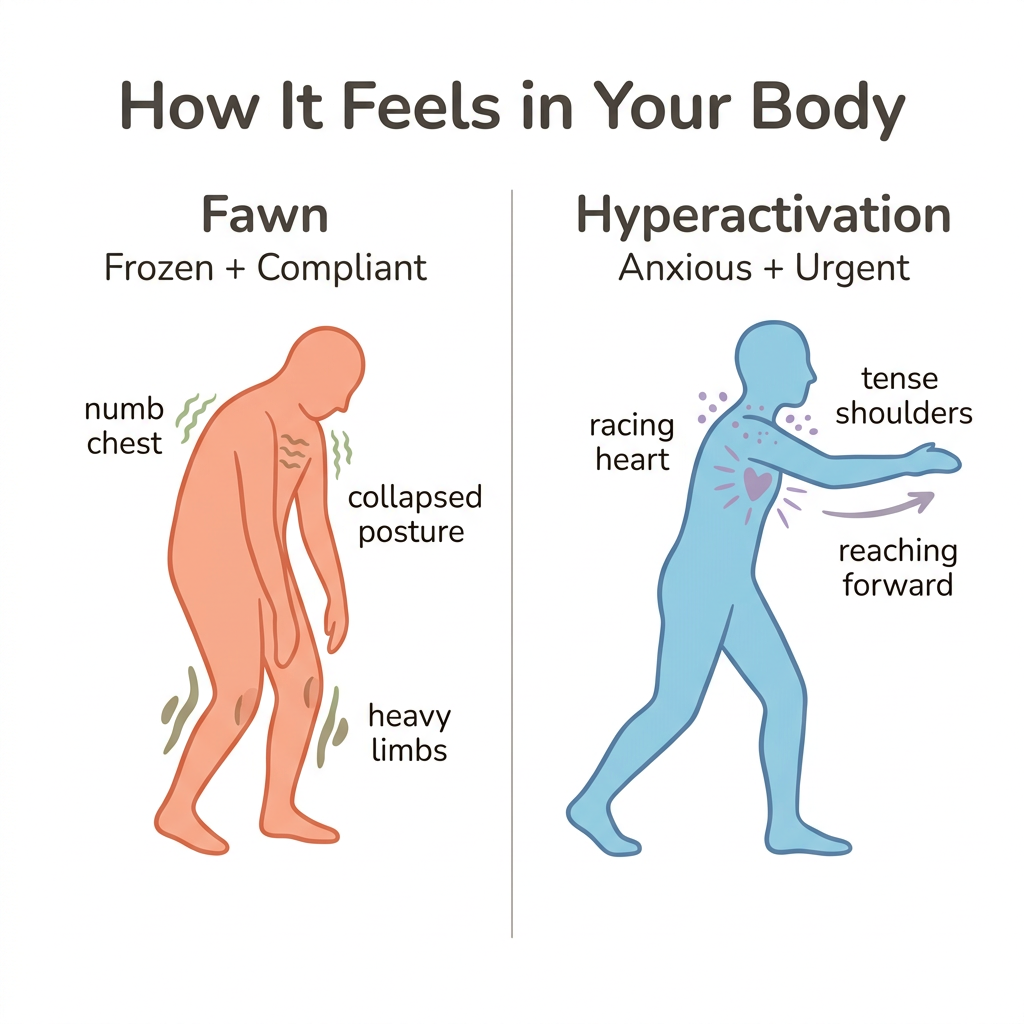
Fawn Response Body Scan (somatic exercise for trauma-based people-pleasers)
- Recall a recent moment you said yes when you meant no
- Notice where tension lives in your body—jaw, throat, chest, stomach?
- Notice if your body feels simultaneously activated (heart racing, muscles tight) and collapsed (heavy, numb, foggy)—this dual sensation is the fawn signature
- Place one hand on your chest and one on your belly. Breathe into whichever hand feels more tense
- Whisper "I am safe right now" and notice what shifts—even slightly
If you felt both activation and collapse at the same time, you just identified the blended sympathetic-dorsal vagal state that drives fawning. That split is your nervous system's old blueprint for safety.
Is People-Pleasing an Attachment Style? The Hyperactivation Connection
People-pleasing is strongly linked to attachment insecurity—particularly anxious-preoccupied and fearful-avoidant styles. Mikulincer and Shaver (2003) describe hyperactivating strategies as the chronic amplification of emotions and behaviors designed to attract and maintain the attention of attachment figures. People-pleasing maps directly onto this: self-sacrifice, compliance, and hyper-attunement to others' needs as proximity-seeking tools.
The critical distinction from trauma-based fawning is the driver. Attachment-based people-pleasing is fueled by fear of abandonment, not fear of danger. Your nervous system isn't tracking threat—it's tracking distance. When your partner goes quiet, when a friend seems irritated, when you sense even the slightest withdrawal, the hyperactivation system fires and you scramble to close the gap through compliance.
Research supports this connection. A study on the role of attachment insecurity in people-pleasing found that it was the insecurity dimension—specifically a negative self-model—that predicted people-pleasing behaviors, rather than proximity-seeking alone. Bartholomew and Horowitz (1991) mapped this further: the preoccupied style (negative self, positive other) produces classic people-pleasing through active pursuit of closeness, while the fearful-avoidant style (negative self, negative other) produces people-pleasing laced with simultaneous withdrawal.
Dana Crowley Jack's "Silencing the Self" theory (2011) adds a gendered dimension: many people—particularly women—learn to suppress anger, censor authentic expression, and devalue their own experience specifically to maintain intimate relationships. If this push-pull pattern sounds familiar, the fearful-avoidant combination of pleasing and withdrawing may be at play.
The Attachment Autopilot Audit (for anxious and preoccupied attachment)
- Write down the last 3 times you went out of your way for someone
- For each, identify: was this person an attachment figure—partner, parent, close friend?
- What were you afraid would happen if you hadn't done it?
- Did you feel resentful afterward?
- Rate your distress 1-10 if you imagine not having done it
If your distress is high and every name on the list is an attachment figure, ask yourself: am I earning closeness, or am I earning the right not to be left?
How Do You Tell the Difference? Trauma-Based vs. Attachment-Based People-Pleasing
The behavioral surface of trauma-based fawning and attachment-based people-pleasing looks nearly identical—but the underground wiring is different, and that difference determines which healing approach works. Perceived threat versus perceived distance is the core differentiator.
Trauma-based fawning activates when you feel unsafe. Your nervous system detects a power imbalance, anger, unpredictability, or authority, and it defaults to appeasement. This tends to be indiscriminate—you may find yourself people-pleasing with bosses, strangers, customer service workers, anyone who carries a whiff of potential threat.
Attachment-based people-pleasing activates when you feel disconnected. Your nervous system detects withdrawal, silence, emotional distance, or a partner pulling away, and it scrambles to close the gap through compliance. This tends to be targeted—it shows up most intensely with romantic partners, parents, and close friends.
Here's what makes this genuinely complex: both can coexist. Someone can carry insecure attachment and unresolved trauma, producing layered people-pleasing with dual roots (Herstich, LCSW). A single moment of saying yes when you mean no might be driven by both threat and disconnection simultaneously.
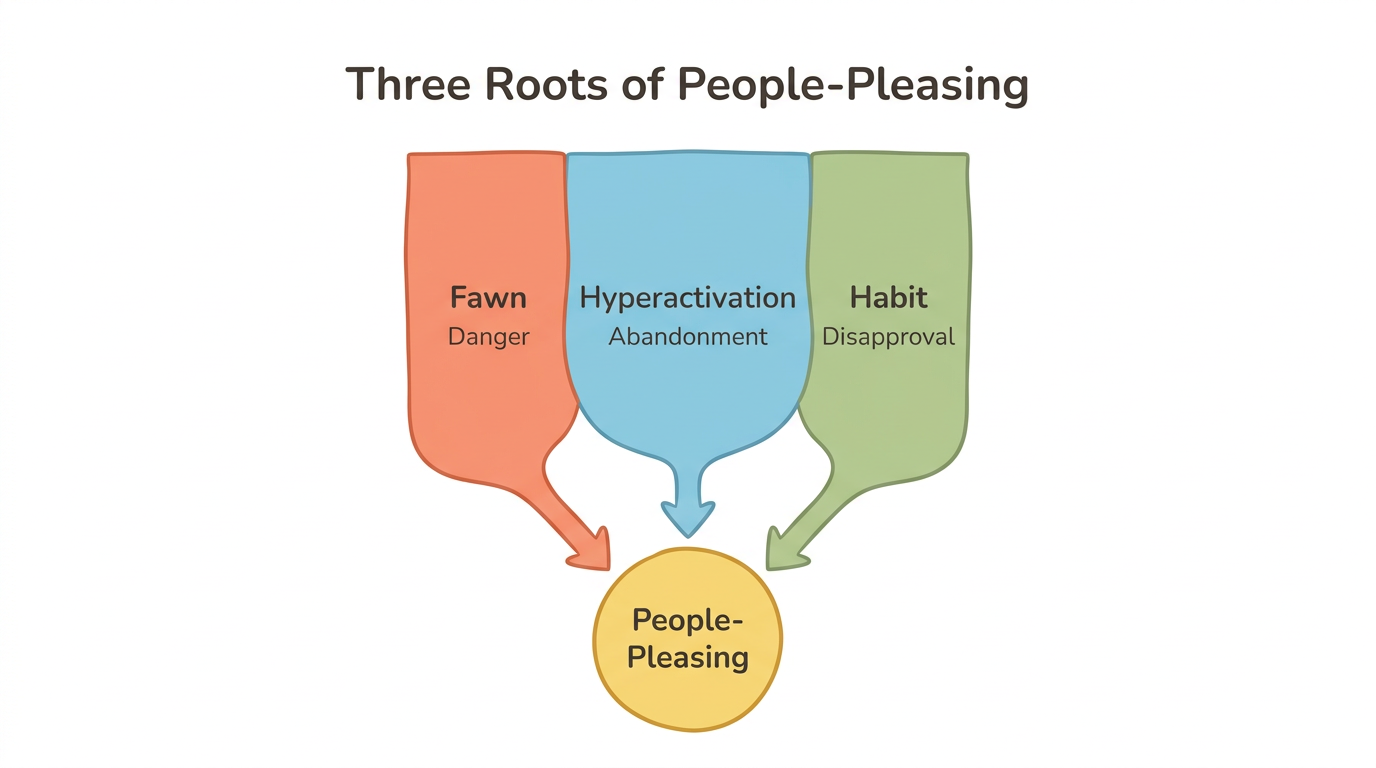
| Dimension | Trauma-Based (Fawn) | Attachment-Based (Hyperactivation) | Socialized (Habit) |
|---|---|---|---|
| Core fear | Danger or harm | Abandonment or rejection | Disapproval or conflict |
| Trigger | Perceived threat (authority, anger, power imbalance) | Perceived distance (partner pulling away, silence) | Social expectation (politeness norms, gender roles) |
| Body sensation | Freeze plus compliance (numb, dissociated, "on autopilot") | Anxiety plus urgency (racing heart, compulsive action) | Mild discomfort (tension, irritation) |
| Scope | Indiscriminate (anyone perceived as threatening) | Targeted (attachment figures—partners, parents) | Context-dependent (work, social settings) |
| After complying | Relief plus emptiness or dissociation | Temporary calm plus lingering resentment | Mild frustration |
| Attachment styles | Disorganized or fearful-avoidant | Anxious-preoccupied or fearful-avoidant | Any style |
| Nervous system state | Blended sympathetic plus dorsal vagal | Sympathetic activation (hyperarousal) | Ventral vagal (regulated but habitual) |
| Healing approach | Somatic therapy, EMDR, IFS, polyvagal work | EFT, security priming, distress tolerance | CBT/DBT skills, assertiveness training |
The Trigger Map (for all attachment styles)
- List 5 recent people-pleasing moments
- For each, note: Who was involved? What triggered it—a sense of danger or threat, or a sense of distance or disconnection?
- Did your body feel more frozen-compliant (fawn) or anxiously eager (hyperactivation)?
- Create two columns on paper: left for threat-triggered, right for distance-triggered
- Place each moment in the appropriate column—if both columns fill up, your people-pleasing has dual roots
Look at your two columns. Which one is fuller? That's your dominant root—and it tells you where to start healing.
Can You Be a People-Pleaser Without Trauma?
Yes—and recognizing this prevents unnecessary pathologizing of what might be a socialized habit rather than a wound. People-pleasing can develop through cultural norms, gender conditioning, family roles ("the easy child," "the peacemaker"), or simply a temperament that values harmony.
The gender dimension is significant. YouGov data shows 52 percent of women versus 44 percent of men self-identify as people-pleasers. Jack's (2011) Silencing the Self research documents how women are specifically socialized to suppress authentic expression to maintain relationships—producing people-pleasing that's culturally installed rather than trauma-driven.
The distinction matters because each type responds to different interventions. Socialized people-pleasing is a habit that causes frustration and can shift through behavioral strategies like assertiveness training and boundary scripts. Trauma-based fawning involves nervous system dysregulation—dissociation, freeze responses, flooding—and requires somatic or trauma-focused therapy. Attachment-based people-pleasing involves relational anxiety and benefits from attachment-focused work like EFT or self-soothing techniques.
The Origin Story Reflection (journal exercise for all styles)
- When did you first learn that being agreeable kept you safe or loved?
- Was "being nice" rewarded in your family, culture, or gender role?
- When you imagine setting a boundary, does your body feel: (a) mildly uncomfortable, (b) panicky or abandoned, or (c) unsafe or in danger?
Option (a) suggests a socialized habit. Option (b) suggests attachment roots. Option (c) suggests trauma roots. Where did your body land?
What Happens in Your Brain When You People-Please?
When you people-please, your medial prefrontal cortex and anterior insula activate more strongly during disagreement—your brain treats saying no as a social threat. A Frontiers in Human Neuroscience study (N=39) found these regions, involved in decision-making, self-referential processing, and social emotions, showed significantly heightened activation when people-pleasers disagreed with others. In other words, disagreement creates cognitive dissonance in the people-pleasing brain.
The neurochemistry adds another layer. Individuals with insecure attachment tend to have lower baseline oxytocin levels. Those with attachment anxiety show a stronger link between stress-induced oxytocin reactivity and support-seeking behavior—meaning the anxious brain's bonding chemistry actually intensifies the drive to people-please under stress. Anxiously attached individuals also show heightened HPA axis reactivity, producing more cortisol during interpersonal stress and making conflict feel genuinely physiologically dangerous.
Van der Kolk's research on trauma and the body reveals perhaps the most important piece: trauma disrupts interoception—the ability to sense your own internal states. People-pleasers often cannot identify their own needs, preferences, or even physical sensations because the brain learned to track others' states instead of their own. When survival depended on reading a caregiver's mood, the neural resources that would normally monitor your own hunger, fatigue, and emotions got redirected outward. To learn more about how your attachment style shapes these nervous system responses, explore our guide on the topic.
Interoception Recovery Practice (somatic exercise for all styles, especially trauma-based)
- Set a timer for 3 minutes
- Close your eyes and turn your attention inward
- Scan slowly: Are you hungry? Tired? Tense? Cold? Do you need to use the bathroom?
- Name 3 physical sensations you notice, without judgment—just labeling ("tight shoulders," "warm hands," "empty stomach")
- Practice once daily for one week
Notice how hard or easy it was to turn attention inward. If it felt disorienting or blank, that's not a failure—it's information about how thoroughly your nervous system learned to track outward instead of inward.
How Do You Start Healing People-Pleasing at Its Root?
You start by identifying whether your pattern is trauma-based, attachment-based, or socialized—then matching a specific therapeutic approach to that root. A generic "just set boundaries" approach fails because it doesn't address why boundaries feel impossible—and the "why" differs depending on whether the pattern is survival-based, attachment-based, or habitual.
If part of you resists letting go of people-pleasing, that makes sense. Your nervous system developed it for a reason—it kept you safe, connected, or accepted. That adaptation deserves respect, not shame. Healing isn't about eliminating the part of you that learned to please—it's about understanding its protective function and finding safer ways to meet the need underneath.
For Trauma-Based Fawning
In IFS terms, the part of you that pleases is a "protector"—it formed to shield you from rejection or harm, and it's still doing that job even when the original danger is gone. A 2023 National Center for PTSD review highlights IFS as promising for complex trauma, noting lower dropout rates. Somatic Experiencing and EMDR can help reprocess the original memories that installed the fawn pattern. Polyvagal-informed therapy targets ventral vagal engagement—helping your nervous system learn that safety doesn't require compliance.
For Attachment-Based People-Pleasing
The pursue-withdraw cycle often hides people-pleasing in plain sight: one partner over-functions to prevent disconnection while the other retreats. Emotionally Focused Therapy (EFT) identifies this compliance as a "protest behavior" and helps you access the underlying attachment needs rather than the surface performance. Security priming and earned secure attachment work build the internal foundation that makes boundaries feel less threatening. Self-soothing techniques help you tolerate the distress that arises when you stop using compliance to manage disconnection anxiety.
For Socialized People-Pleasing
Try this: say no to one low-stakes request this week and observe what actually happens. Behavioral experiments like this help disconfirm the belief that authenticity costs you connection. CBT and DBT skills—particularly the DEAR MAN interpersonal effectiveness framework—provide concrete scripts for boundary-setting when you're ready for higher stakes. For actionable strategies, explore our dedicated guide.
The Graduated No (for anxious attachment)
- Rate your current difficulty saying "no" on a scale of 1 to 10
- This week, practice one "no" at difficulty level 2 or 3—low stakes, like declining a restaurant suggestion or saying you need 5 minutes before responding
- Before saying no, take one grounding breath—inhale for 4 counts, exhale for 6
- After saying no, notice: Did the feared outcome happen? What actually occurred?
- Next week, move to difficulty level 4 or 5
Each survived "no" becomes evidence that connection doesn't require compliance. You don't rewire attachment in a single act of boundary-setting. You rewire it by noticing 10 percent earlier, responding 10 percent differently, 10 percent more often.
When Should You Seek Professional Help for People-Pleasing?
You should seek professional support when people-pleasing involves dissociation or flooding—when saying yes comes with numbness, blank spots, flashbacks, or nervous system overwhelm that you can't regulate on your own. These are signs that the pattern has trauma roots that benefit from trauma-informed therapy.
Your pattern of people-pleasing also warrants professional attention if it's eroding your relationships through chronic resentment, if you've lost access to your own preferences and desires, or if attempts to change the pattern on your own trigger panic or despair. 50 percent of people-pleasers say the pattern makes their life harder (YouGov, 2024)—and recognizing that cost is itself a sign of readiness.
Specific modalities to consider: EMDR for reprocessing the original experiences that installed the fawn pattern. IFS for understanding and unburdening the "protector part" that learned to please. EFT for couples when people-pleasing is eroding a partnership. Somatic Experiencing for reconnecting with your body's signals and boundaries.
Seeking help isn't a sign that your coping failed. It's a sign that the adaptation that once protected you has become a cage—and trauma-informed therapy can help you find the door.
Frequently Asked Questions
Is people-pleasing the same as fawning?
Not exactly. Fawning is a specific trauma survival response where you appease a perceived threat to stay safe. People-pleasing is broader and can stem from attachment insecurity, cultural conditioning, or trauma. All fawning is people-pleasing, but not all people-pleasing is fawning.
What attachment style are people-pleasers?
People-pleasing is most associated with anxious-preoccupied attachment, where compliance maintains closeness, and fearful-avoidant attachment, where pleasing coexists with withdrawal. Research shows attachment insecurity—specifically a negative self-model—predicts people-pleasing more than attachment style alone.
Can you be a people-pleaser without trauma?
Yes. People-pleasing can develop through cultural norms, gender socialization, family dynamics, or temperament without trauma. The difference is intensity: socialized people-pleasing causes frustration, while trauma-based fawning involves nervous system dysregulation like dissociation or freeze responses.
Is people-pleasing a sign of anxiety?
Often, yes. Research links attachment anxiety to people-pleasing through hyperactivating strategies—the anxious drive to earn closeness through compliance. Zhang et al. (2025) confirmed in a meta-analysis that attachment insecurity combined with anxiety predicts poorer mental health outcomes. However, people-pleasing can exist without clinical anxiety.
Is people-pleasing connected to childhood trauma?
It can be. Pete Walker (2003) identified fawning as a survival strategy children develop when fight, flight, and freeze responses fail—typically in homes with unpredictable or frightening caregivers. The child learns that being helpful and agreeable reduces threat, and this pattern persists into adulthood as automatic people-pleasing.
How do I stop people-pleasing in relationships?
Start by identifying the root: is your people-pleasing driven by fear of danger, fear of abandonment, or social habit? Trauma-based patterns benefit from somatic and trauma therapy. Attachment-based patterns respond to distress tolerance and earned security work. Our full guide on how to stop people-pleasing in relationships offers concrete strategies for each root.
Is people-pleasing codependency?
They overlap but are not identical. Pete Walker described fawning as the codependent trauma response. Codependency involves deriving identity from caretaking others, while people-pleasing can be more situational. Both involve self-abandonment, but codependency tends to be a more pervasive relational pattern.
What is the fawn response?
The fawn response, coined by therapist Pete Walker (2003), is a fourth trauma survival strategy alongside fight, flight, and freeze. It involves automatically appeasing a perceived threat—becoming helpful, agreeable, or submissive to avoid conflict or danger. It is common in survivors of interpersonal and childhood trauma, and it reflects a blended nervous system state of simultaneous activation and collapse.
Want to Go Deeper?
Meadow includes a structured assessment to help you understand your specific attachment patterns, followed by a 66-day program of daily practices designed to build earned security.
Start your free week →References
Attachment Theory
-
Mikulincer, M., & Shaver, P. R. (2003). The attachment behavioral system in adulthood: Activation, psychodynamics, and interpersonal processes. Advances in Experimental Social Psychology, 35, 53–152.
-
Bartholomew, K., & Horowitz, L. M. (1991). Attachment styles among young adults: A test of a four-category model. Journal of Personality and Social Psychology, 61(2), 226–244.
-
Zhang, H., et al. (2025). Insecure attachment and social anxiety: A meta-analysis. Journal of Social and Personal Relationships.
-
Attachment insecurity and people-pleasing behaviors. ResearchGate, 2024.
Trauma and Fawn Response
-
Walker, P. (2003). Codependency, trauma, and the fawn response. The East Bay Therapist.
-
Bailey, H. N., et al. (2023). From Stockholm syndrome to appeasement: Reconceptualizing survival strategies in the context of intimate partner violence. European Journal of Psychotraumatology, 14(1).
-
Schwartz, A. The fawn response in complex PTSD. DrArielleSchwartz.com.
Neuroscience
-
Brain activity in people-pleasers during disagreement. Frontiers in Human Neuroscience (N=39). Reported by Medical Daily.
-
Oxytocin reactivity, rejection sensitivity, and attachment. PubMed Central, 2022.
-
OXTR gene variants (rs53576) and cortisol modulation. PubMed, 2015.
-
Attachment insecurity and cortisol dysregulation. PubMed Central, 2011.
-
Van der Kolk, B. Trauma, the body, and interoception. Psychotherapy.net interview.
Polyvagal and Somatic Approaches
-
Porges, S. W. Polyvagal theory. Polyvagal Institute.
-
Dana, D. Polyvagal-informed clinical work.
-
Levine, P. Somatic Experiencing framework.
Survey Data
-
YouGov. (2024). Half of self-described people-pleasers think being this way makes life harder. YouGov America.
-
Kuang, Y., et al. (2025). Latent profile analysis of people-pleasing behaviors and mental well-being. PsyCh Journal (N=2,203).
Gender and Self-Silencing
- Jack, D. C. (2011). Reflections on the Silencing the Self Scale and its origins. Psychology of Women Quarterly, 35(3), 523–529.
Therapeutic Modalities
-
Internal Family Systems for trauma: National Center for PTSD review (2023).
-
Johnson, S. Emotionally Focused Therapy framework.
-
Linehan, M. DBT interpersonal effectiveness (DEAR MAN).
-
EMDR for people-pleasing trauma response. Bright Spot Therapy.
This article is for educational purposes only and is not a substitute for professional mental health care. If you are experiencing trauma symptoms, dissociation, or significant distress related to people-pleasing patterns, please consult a licensed mental health professional. The Meadow Clinical Team comprises licensed therapists specializing in attachment theory, but this content does not constitute a therapeutic relationship.