People-pleasing is a pattern of chronically prioritizing others' needs, emotions, and approval over your own — especially in romantic relationships. According to a YouGov (2022) survey, 48 percent of Americans self-describe as people-pleasers, and 69 percent put others' needs first at the expense of their own somewhat or very often.
People-pleasing is not a personality trait. It is a learned survival strategy rooted in attachment insecurity — a nervous system response that developed because, at some point, keeping others happy was how you stayed safe and connected. What looks like generosity and selflessness is often your body running an old protective program. This article covers why your body does this, how people-pleasing connects to your attachment style, and concrete, evidence-based techniques to start showing up as yourself in relationships.
Key takeaway: People-pleasing in relationships stems from attachment insecurity and the fawn trauma response. Your nervous system learned to prioritize others' comfort for survival. Recovery involves somatic awareness, practicing assertiveness with frameworks like DEAR MAN, and understanding your people-pleaser as a protective part rather than a character flaw. Nearly half of Americans identify as people-pleasers, but evidence-based techniques can help you build authentic connection.
What Is People-Pleasing and Why Does It Feel So Automatic?
People-pleasing is the chronic pattern of suppressing your own needs, preferences, and boundaries to keep others comfortable — driven not by genuine generosity but by fear of rejection, conflict, or abandonment. According to YouGov (2022), 93 percent of Americans engage in at least one of nine people-pleasing behaviors "somewhat or very often." The pattern is so widespread because it is deeply wired into the nervous system.
Pete Walker identified the fawn response as the fourth trauma response alongside fight, flight, and freeze. Fawning is a trauma-driven pattern where safety depends on appeasing others — especially those with power. It often develops in childhood homes where love was conditional, inconsistent, or entangled with threat.
What makes fawning especially difficult to recognize is that it is a socially rewarded survival strategy. As one Psychology Today analysis puts it, "it doesn't look like fear. It looks like being helpful, agreeable, and selfless." People praise you for it. Partners benefit from it. And your nervous system registers the approval as confirmation that the strategy is working.
The distinction between people-pleasing and genuine kindness comes down to motive. Genuine generosity flows from a desire to give freely — you feel warm, voluntary, and present. People-pleasing flows from fear — you feel anxious, obligated, and braced for the consequences of saying no.
The Motive Check
- Think of the last time you agreed to something in your relationship
- Ask yourself: "Did I say yes because I genuinely wanted to, or because I was afraid of what would happen if I said no?"
- Notice what happens in your body when you consider the alternative — actually saying no
- Write down one sentence about what you feared would happen
- This takes 30 seconds and starts building awareness of the pattern
Is People-Pleasing a Trauma Response or an Attachment Style Thing?
People-pleasing is both a trauma response and an attachment pattern — these two roots are deeply intertwined. A 2025 study found that attachment insecurity significantly predicted people-pleasing behaviors, while proximity-seeking alone did not (ResearchGate, 2025). People-pleasing is not driven by wanting closeness. It is driven by the fear that closeness will disappear.
Mikulincer and Shaver (2003) describe hyperactivating strategies in anxiously attached individuals — chronic intensification of emotions to attract attention and care, keeping the person perpetually focused on threats, separations, and betrayals. People-pleasing functions as one such strategy. But the research is clear that people-pleasing is not limited to anxious attachment. It shows up across all insecure attachment styles, each with different motivations.
How People-Pleasing Looks Across Attachment Styles
-
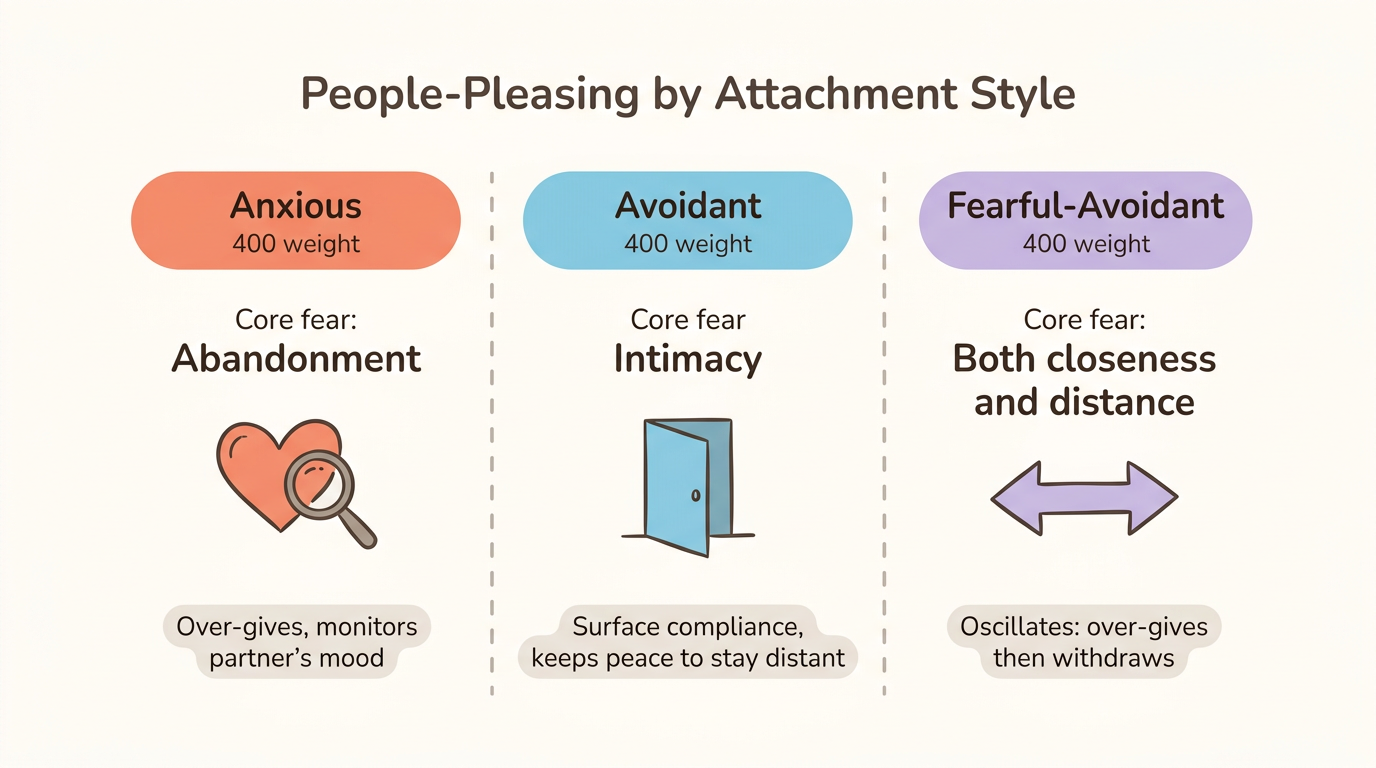
Anxious attachment: You people-please to prevent abandonment. You monitor your partner's mood constantly and adjust yourself to keep them happy, because their happiness feels like proof that they will stay. You over-give, over-apologize, and suppress anger because conflict feels like a threat to the bond itself. If you recognize these patterns, our guide on anxious attachment signs goes deeper into hyperactivating strategies.
-
Avoidant attachment: You people-please to maintain emotional distance while avoiding dislike. You agree to things on the surface to prevent the deeper conversations that feel suffocating. Your compliance keeps the peace — and keeps your partner from pushing for more emotional intimacy. Avoidant people-pleasing is the less obvious pattern — learn more in our avoidant attachment guide.
-
Fearful-avoidant attachment: You oscillate between over-giving and withdrawing. You people-please intensely, then feel engulfed and pull away, then feel guilty and people-please harder. The contradictory push-pull of wanting closeness and fearing it creates the most confusing version of this pattern.
Young's Schema Therapy framework identifies three maladaptive schemas that drive people-pleasing: Subjugation (suppressing your needs because you believe expressing them leads to punishment), Self-Sacrifice (voluntarily meeting others' needs at the expense of your own to avoid guilt), and Enmeshment/Undeveloped Self (an insufficiently developed identity that fuses with the partner's).
Why Does Saying No Feel Like Physical Pain?
Saying no feels like physical pain because, neurologically, it is. Eisenberger and colleagues at UCLA found that social rejection activates the dorsal anterior cingulate cortex and anterior insula — the same brain regions that process physical pain. Social pain equals physical pain in the nervous system. Saying no triggers the same neural alarm as a physical threat.
People-pleasing is also reinforced by a dopamine reinforcement loop. Making others happy triggers a dopamine release, creating a neurochemical reward that makes the behavior self-perpetuating. Your brain registers approval as a hit of the same neurotransmitter involved in addiction. The pattern feels automatic because, biochemically, it is.
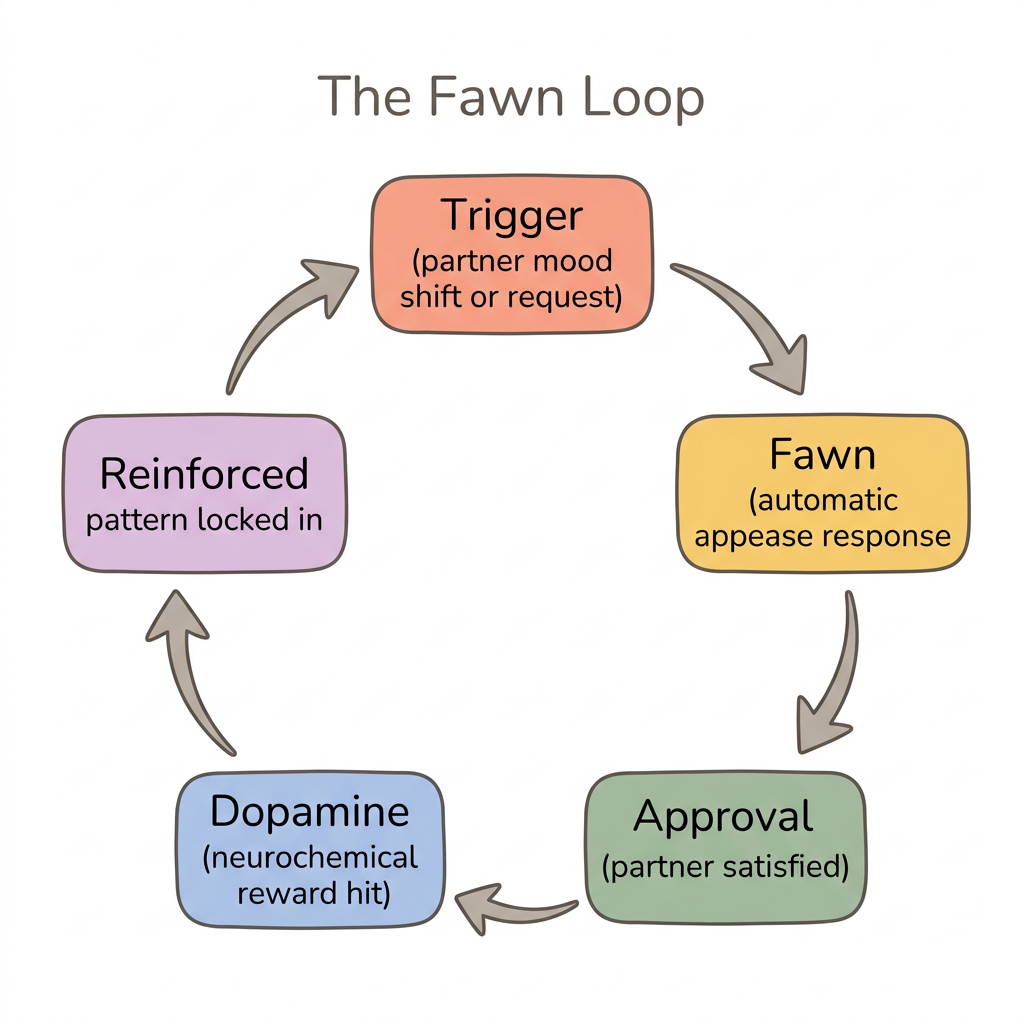
From a Polyvagal Theory perspective (Porges), the fawn response involves over-reliance on the ventral vagal circuit — the social nervous system — for appeasement. People-pleasers use social engagement not for genuine connection but as a survival strategy, staying in an appeasing, accommodating mode to signal safety to others and prevent threat.
Research also shows that messages of love and belonging reduce cortisol levels, while rejection increases them. Your nervous system treats social exclusion as a survival threat — because for our evolutionary ancestors, being cast out from the group meant death. When you feel that flood of anxiety before saying no to your partner, your body is responding to an ancient alarm system, not to the actual danger of the present moment.
The same nervous system activation drives texting anxiety — the dread when your partner does not respond is your body reading silence as social rejection.
The Body Scan Pause
- When someone asks you for something, pause before answering
- Place one hand on your chest, one on your belly
- Notice: Is your chest tightening? Is your stomach clenching? Is your jaw locking?
- Take three slow breaths — inhale for 4 counts, exhale for 6 counts (the longer exhale activates your parasympathetic nervous system)
- Ask yourself: "What do I actually want right now?" — answer from the body, not the mind
- You do not have to answer the request immediately. "Let me think about it" is a complete sentence
What Happens When You Silence Yourself in Relationships?
When you silence yourself in relationships, you lose access to your own identity — and research shows this directly precipitates depression. Dana Crowley Jack's Silencing the Self Theory (1991) demonstrates how people actively censor their feelings, devalue their experience, and repress anger to maintain intimate relationships. Self-silencing precipitates depression not as a side effect, but as a direct consequence.
Jack's research has a significant gender dimension. YouGov (2022) data shows women (52 percent) are more likely than men (44 percent) to self-identify as people-pleasers. Jack's work suggests this gap reflects gendered socialization — women receive more cultural reinforcement for accommodating, nurturing, and prioritizing the relationship over the self.
The experience readers often describe as "losing yourself in relationships" maps directly onto the clinical concept of enmeshment. You stop knowing what you want for dinner because you have spent years anticipating what your partner wants. You cannot identify your own preferences because your identity has become a mirror of your partner's needs.
Beck's concept of sociotropy — excessive investment in interpersonal relationships and the need for social approval — further explains why people-pleasing escalates. Sociotropy is positively correlated with anxiety and serves as a mediator between insecure attachment and depressive symptoms. The more you orient your sense of worth around others' approval, the more vulnerable you become to both anxiety and depression.
The Silenced Voice Journal
- At the end of each day for one week, write down one thing you wanted to say but did not
- Note who you were with, what you held back, and what you feared would happen
- Rate from 1 to 10 how important the unsaid thing was to you
- After the week, look for patterns: Who do you silence yourself around most? What topics come up repeatedly?
- Choose one low-stakes item from the list and practice expressing it this week
How Do You Set Boundaries Without Feeling Guilty?
You set boundaries by learning assertiveness as a specific, practicable skill — and by accepting that guilt is a predictable nervous system response, not evidence that you are doing something wrong. Speed and colleagues (2017) call assertiveness training "a forgotten evidence-based treatment" with effect sizes of 0.95 to 1.73 for adaptive assertiveness compared to waitlist controls — among the strongest effects in psychotherapy research.
The gold standard assertiveness framework is DEAR MAN from Dialectical Behavior Therapy (Linehan). DEAR MAN gives you a concrete structure for expressing needs without aggression or collapse.
DEAR MAN for Your Relationship
- Describe the situation factually: "When we make plans and they change last minute..."
- Express your feelings using "I" statements: "I feel unimportant and anxious..."
- Assert your need clearly: "I need at least a few hours' notice when plans change..."
- Reinforce the benefit to both of you: "That would help me feel more secure, and I would be less stressed when we are together..."
- Stay Mindful: Keep to the topic. Do not get pulled into side arguments or old grievances
- Appear confident: Make eye contact, keep your voice steady — even if your insides are shaking
- Negotiate: "What would work for both of us?"
Guilt is not evidence that you are being selfish. Guilt is your nervous system firing the old alarm — the one that says any deviation from accommodation means danger. You can feel the guilt and set the boundary anyway. The guilt fades with repetition. The self-abandonment compounds.
Boundary Scripts for Common Scenarios
Declining an extra favor: "I care about you and I am not able to take that on right now. I need to protect my energy this week."
Expressing a different preference: "I know you want Thai food tonight. I would actually love Italian — can we alternate?"
Asking for space: "I need some time alone tonight. It is not about you. I will feel more connected after I have recharged."
Start with low-stakes boundaries and build your tolerance gradually. Assertiveness is a muscle that strengthens with use.
What Is the Difference Between People-Pleasing and Codependency?
The core distinction is this: people-pleasers want to avoid conflict and rejection, while codependents need to be needed — their identity depends on being indispensable to their partner. As PsychCentral puts it, in codependency "neither of you can function without the other."
All codependents are people-pleasers, but not vice versa. You can have strong people-pleasing patterns driven by conflict avoidance without the identity fusion and compulsive caretaking that define codependency. The table below clarifies the differences.
| Dimension | People-Pleasing | Genuine Generosity | Codependency |
|---|---|---|---|
| Core motivation | Fear of rejection or conflict | Desire to give freely | Need to be needed |
| How it feels | Anxious, obligated | Warm, voluntary | Compulsive, identity-defining |
| Saying no | Feels impossible or terrifying | Feels comfortable when needed | Feels like losing your purpose |
| Resentment | Builds over time | Rare | Deep and chronic |
| Sense of self | Blurred, adapts to others | Intact, stable | Fused with partner's identity |
| Attachment root | Insecure (any style) | Secure | Insecure (often anxious) |
| Recovery path | Assertiveness and nervous system work | Already healthy | Boundary work and identity rebuilding |
If you recognize yourself in the codependency column — if your entire sense of purpose collapses when your partner does not need you — that is important information that a therapist can help you work through.
How Do You Befriend Your Inner People-Pleaser?
Recovery from people-pleasing does not mean destroying the part of you that wants to please others. In Internal Family Systems therapy (IFS), the people-pleaser is understood as a "Manager" protective part — a part that developed to keep you safe by keeping everyone around you happy. It is a protective part, not a character flaw.
IFS invites you to get curious about this part rather than fighting it. The Manager part is protecting a wounded exile — a younger part of you that carries the original pain of rejection, conditional love, or abandonment. When you understand what the people-pleaser is guarding, you can let your Self — your core, calm, compassionate center — lead instead.
Schema Therapy offers another lens through the three schemas discussed earlier: Subjugation, Self-Sacrifice, and Enmeshment. Recognizing which schema drives your particular pattern helps you target your healing more precisely.
For couples, Sue Johnson's Emotionally Focused Therapy (EFT) directly addresses the pursue-withdraw cycles that people-pleasers often fall into. EFT helps partners reshape attachment bonds and create what Johnson calls "effective dependency" — healthy reliance on each other from a place of security rather than fear. EFT has over 35 years of peer-reviewed research demonstrating its effectiveness for couples.
Parts Dialogue (IFS-Inspired)
- Close your eyes and locate the people-pleasing part in your body — where do you feel it? (Common locations: chest, throat, stomach)
- Ask it: "What are you trying to protect me from?"
- Listen without judgment — notice whatever images, words, or feelings come up
- Thank it: "I understand you have been keeping me safe. You learned this for good reason"
- Ask it: "What would you need to feel safe enough to step back, just a little?"
- Spend 2 minutes journaling what came up
You do not rewire attachment in a single insight. You rewire it by noticing 10 percent earlier, responding 10 percent differently, 10 percent more often. Each time you pause before automatically saying yes, each time you express a preference instead of deferring, each time you sit with the guilt instead of rushing to fix it — you are teaching your nervous system something new.
When Should You Seek Professional Help for People-Pleasing?
You should seek professional help when people-pleasing has moved beyond a pattern you can work with on your own and is causing significant harm to your mental health, physical health, or relationships. People-pleasing exists on a spectrum, and some signs indicate that professional support is not just helpful but necessary.
Seek help if you experience any of the following:
- You cannot identify your own needs — when someone asks what you want, you genuinely do not know
- You experience chronic resentment toward your partner or others, despite outwardly accommodating them
- You have symptoms of depression that align with self-silencing — emotional flatness, loss of identity, persistent sadness
- You notice physical symptoms like autoimmune flares, chronic fatigue, or unexplained pain that intensify during relational stress
- Your relationship is in crisis because years of suppressed needs have created an emotional chasm between you and your partner
- You have tried self-help strategies and the patterns remain unchanged
Several validated self-assessment tools can help you and a therapist establish a baseline: the Silencing the Self Scale (Jack and Dill, 1992) measures four types of self-silencing in relationships, and the People Pleasing Scale (ResearchGate, 2025) assesses three factors — Responsibility, Neglect of Own Needs, and Others' Expectations.
Therapy modalities with strong evidence for people-pleasing include Internal Family Systems (IFS) for parts work, Schema Therapy for targeting core schemas, DBT skills groups for assertiveness training, and Emotionally Focused Therapy (EFT) for reshaping attachment bonds with a partner.
Asking for help is not a failure of self-sufficiency. It is the most direct form of not people-pleasing — prioritizing what you actually need over the appearance of being fine.
Frequently Asked Questions
Why am I such a people-pleaser in my relationship?
People-pleasing typically stems from attachment insecurity and early experiences where love felt conditional. Your nervous system learned that keeping others happy was the safest way to maintain connection. A 2025 study confirmed that attachment insecurity — not just anxious attachment specifically — significantly predicts people-pleasing behaviors. It is a survival strategy, not a character flaw, and it can be unlearned with practice and awareness.
Is people-pleasing a trauma response?
Yes. Pete Walker identified "fawn" as the fourth trauma response alongside fight, flight, and freeze. Fawning means automatically appeasing others to stay safe, especially those who hold power. It often develops in childhood homes where expressing needs led to punishment, withdrawal, or conflict. Fawning is socially rewarded, making it harder to identify than other trauma responses.
How do I set boundaries without feeling guilty?
Use the DEAR MAN framework from DBT: Describe the situation, Express your feelings, Assert your need, and Reinforce the benefit. Guilt is a normal nervous system reaction to boundary-setting, not proof you are being selfish. Assertiveness training shows effect sizes of 0.95 to 1.73 — start with low-stakes boundaries and build tolerance gradually.
What is the difference between people-pleasing and codependency?
People-pleasers want to avoid conflict and rejection. Codependents need to be needed — their identity depends on being indispensable to their partner. All codependents are people-pleasers, but not all people-pleasers are codependent. The key distinction is whether you can function independently and maintain a sense of self outside the relationship.
Can people-pleasing ruin a relationship?
Yes. Chronic people-pleasing erodes authenticity, builds resentment, and prevents genuine intimacy. Partners often sense the inauthenticity, which creates trust issues. Dana Crowley Jack's research shows self-silencing directly predicts depression, which further strains relationships. Healthy relationships require two whole people showing up honestly.
Is people-pleasing linked to attachment style?
Research confirms people-pleasing is linked to attachment insecurity across all insecure styles — not just anxious attachment. Anxious people-pleasers fear abandonment, avoidant people-pleasers maintain surface harmony to keep emotional distance, and fearful-avoidant people-pleasers oscillate between over-giving and withdrawing. Each style requires a different recovery approach.
Why do I lose myself in relationships?
Losing yourself reflects what schema therapists call Enmeshment or Undeveloped Self — a pattern where your identity becomes fused with your partner's needs and preferences. Dana Crowley Jack's research shows this self-silencing is especially common in women and directly contributes to depression. Reconnecting with your own preferences — even small ones like what you want for dinner — is the first step back to yourself.
How do I say no to my partner without starting a fight?
A respectful no stated calmly rarely starts a fight — the fear of conflict is usually bigger than the actual conflict. Try: "I love you, and I need to be honest — I would rather do something different." If your partner consistently punishes you for having boundaries, that is important information about the relationship dynamic itself, not evidence that you should stop setting boundaries.
Want to Go Deeper?
Meadow includes a structured assessment to help you understand your specific attachment patterns, followed by a 66-day program of daily practices designed to build earned security.
Start your free week →References
Attachment Theory and People-Pleasing
-
ResearchGate. (2025). The Role of Attachment Insecurity in People-Pleasing Behaviors. https://www.researchgate.net/publication/393613700
-
Mikulincer, M., & Shaver, P. R. (2003). The attachment behavioral system in adulthood: Activation, psychodynamics, and interpersonal processes. Advances in Experimental Social Psychology, 35, 53–152.
-
Attachment Project. People Pleasing and Attachment. https://www.attachmentproject.com/psychology/people-pleasing/
Trauma and Fawn Response
-
Walker, P. Complex PTSD: From Surviving to Thriving. Azure Coyote Publishing.
-
CPTSD Foundation. (2025). Fawn Response: The Trauma Survival Pattern That's Mistaken for Kindness. https://cptsdfoundation.org/2025/06/05/fawn-response-the-trauma-survival-pattern-thats-mistaken-for-kindness/
-
Psychology Today. (2025). Demystifying the Fawn Response. https://www.psychologytoday.com/us/blog/bipoc-mental-health/202504/demystifying-the-fawn-response
Neuroscience
-
Eisenberger, N. I. Why Rejection Hurts. UCLA Social and Affective Neuroscience Laboratory. https://sanlab.psych.ucla.edu/
-
Fika Mental Health. The Hidden Science Behind People-Pleasing: A Deeper Dive into Neurological Mechanisms. https://www.fikamentalhealth.com/post/the-hidden-science-behind-people-pleasing-a-deeper-dive-into-neurological-mechanisms
-
Porges, S. W. The Polyvagal Theory: Neurophysiological Foundations of Emotions, Attachment, Communication, and Self-Regulation. W. W. Norton.
-
Eisenberger, N. I., & Lieberman, M. D. (2012). The neural bases of social pain. Psychosomatic Medicine. PMC. https://pmc.ncbi.nlm.nih.gov/articles/PMC3273616/
Self-Silencing and Gender
-
Jack, D. C. (1991). Silencing the Self: Women and Depression. Harvard University Press.
-
Jack, D. C., & Dill, D. (1992). The Silencing the Self Scale: Schemas of intimacy associated with depression in women. Psychology of Women Quarterly, 16(1), 97–106.
-
YouGov. (2022). Half of self-described people-pleasers think being this way makes life harder. https://today.yougov.com/society/articles/50734
-
YouGov. (2022). Women more likely than men to be people-pleasing. https://today.yougov.com/society/articles/43498
Therapeutic Approaches
-
Linehan, M. M. DBT DEAR MAN Interpersonal Effectiveness. Therapist Aid. https://www.therapistaid.com/therapy-worksheet/dbt-dear-man
-
Speed, B. C., Goldstein, B. L., & Goldfried, M. R. (2017). Assertiveness training: A forgotten evidence-based treatment. Clinical Psychology: Science and Practice, 25(1), e12216.
-
IFS Institute. Internal Family Systems Model Outline. https://ifs-institute.com/resources/articles/internal-family-systems-model-outline
-
Johnson, S. Emotionally Focused Therapy. International Centre for Excellence in EFT. https://drsuejohnson.com/iceeft/
-
Young, J. E. Schema Therapy: Three maladaptive schemas (Subjugation, Self-Sacrifice, Enmeshment/Undeveloped Self).
Measurement and Validation
-
Kuang, Y., et al. (2025). Chinese People-Pleasing Questionnaire. PsyCh Journal. PMC. https://pmc.ncbi.nlm.nih.gov/articles/PMC12318589/
-
ResearchGate. (2025). Valuing Others Over Oneself: Development and Validation of a People Pleasing Scale. https://www.researchgate.net/publication/393791208
-
Beck Institute. Sociotropy-Autonomy Scale. https://beckinstitute.org/wp-content/uploads/2021/06/SAS-Full-Documents.pdf
Codependency
- PsychCentral. What Is Codependency? https://psychcentral.com/health/what-is-codependency-traits
This article is for educational purposes only and is not a substitute for professional mental health treatment. If you are experiencing significant distress related to people-pleasing, self-silencing, or relationship difficulties, please consult a licensed mental health professional. The Meadow Clinical Team comprises licensed therapists, but this content does not constitute a therapeutic relationship.